Zeus was the king of the gods in Greek mythology: god of the sky, weather, thunder, law and kingship, ruling from Mount Olympus. He was the son of the Titans Cronus and Rhea, overthrew his father in a ten-year war, and then divided the cosmos with his brothers Poseidon and Hades. Almost every Greek myth passes through him at some point — as judge, father, lover, or enforcer of oaths.
Zeus
Greek pantheon
Domain: Sky, thunder, weather, law, kingship, hospitality, oaths
Zeus quick facts
| Fact | Detail |
|---|---|
| Parents | Cronus and Rhea (Titans) |
| Siblings | Hestia, Demeter, Hera, Hades, Poseidon |
| Consort | Hera (his sister and queen) |
| Notable children | Athena, Apollo, Artemis, Hermes, Dionysus, Ares, Persephone, the Muses, Heracles, Perseus, Helen |
| Symbols | Thunderbolt, eagle, oak, scepter, aegis |
| Home | Mount Olympus |
| Roman name | Jupiter |
| Main sources | Hesiod's Theogony and Works and Days, Homer's Iliad and Odyssey, the Homeric Hymns, Apollodorus's Library, Ovid's Metamorphoses |
His name comes from the same ancient Indo-European root as the Latin Iu-piter and the Sanskrit sky-father Dyaus Pitar — a word for the bright daytime sky.
How did Zeus become king of the gods?
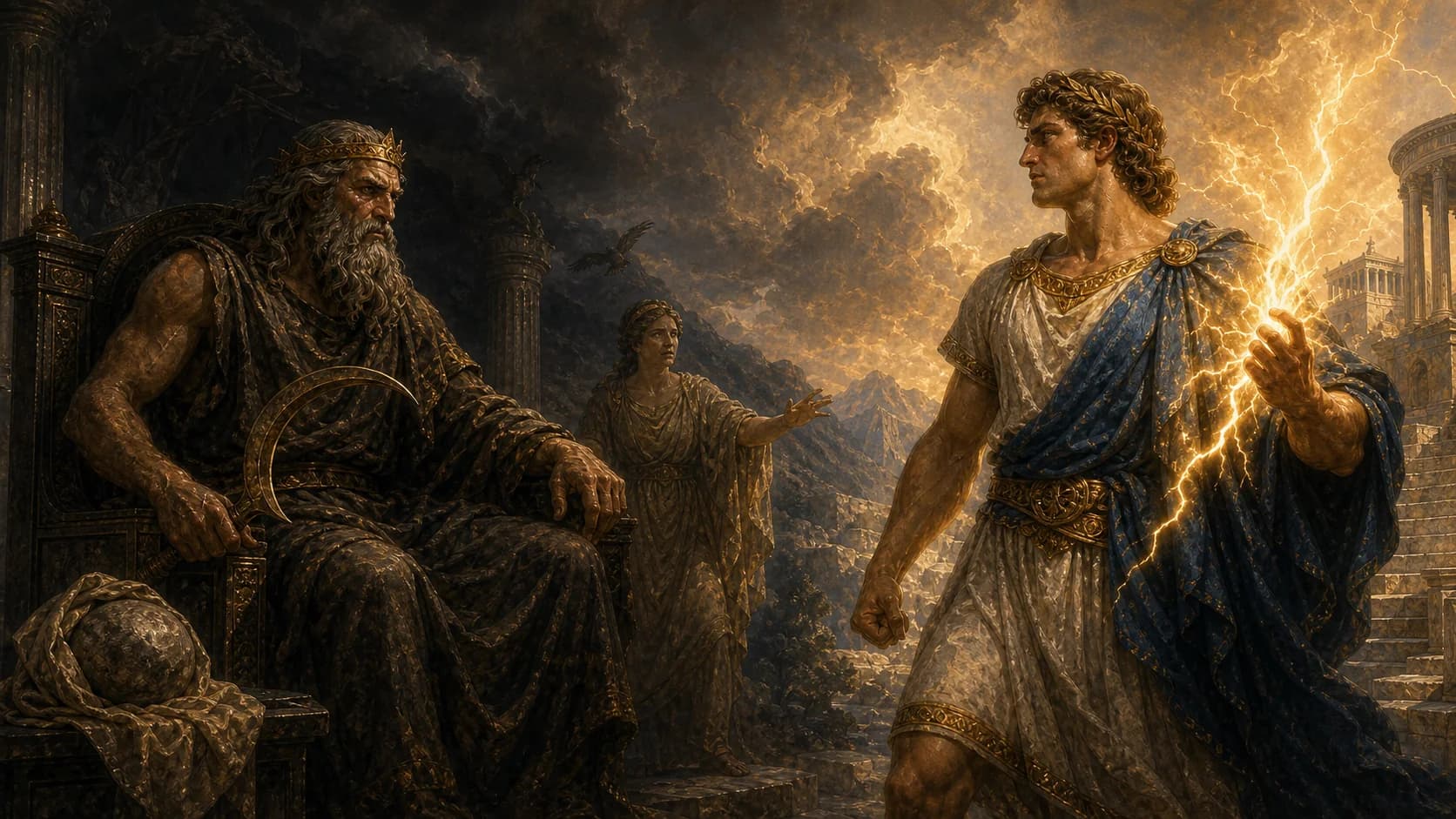
In Hesiod's Theogony, Cronus learned from his parents, Gaia and Ouranos, that one of his own children would overthrow him — exactly as he had overthrown Ouranos. So he swallowed each child the moment Rhea gave birth: Hestia, Demeter, Hera, Hades and Poseidon. When Rhea was about to bear her youngest, Zeus, she went to Crete to give birth in secret and handed Cronus a stone wrapped in swaddling clothes. He swallowed it without looking.
Later writers fill in the Cretan childhood. In Apollodorus, the infant is hidden in a cave, nursed by nymphs on the milk of the goat Amalthea, while the Curetes clash spears on their shields so Cronus cannot hear him cry.
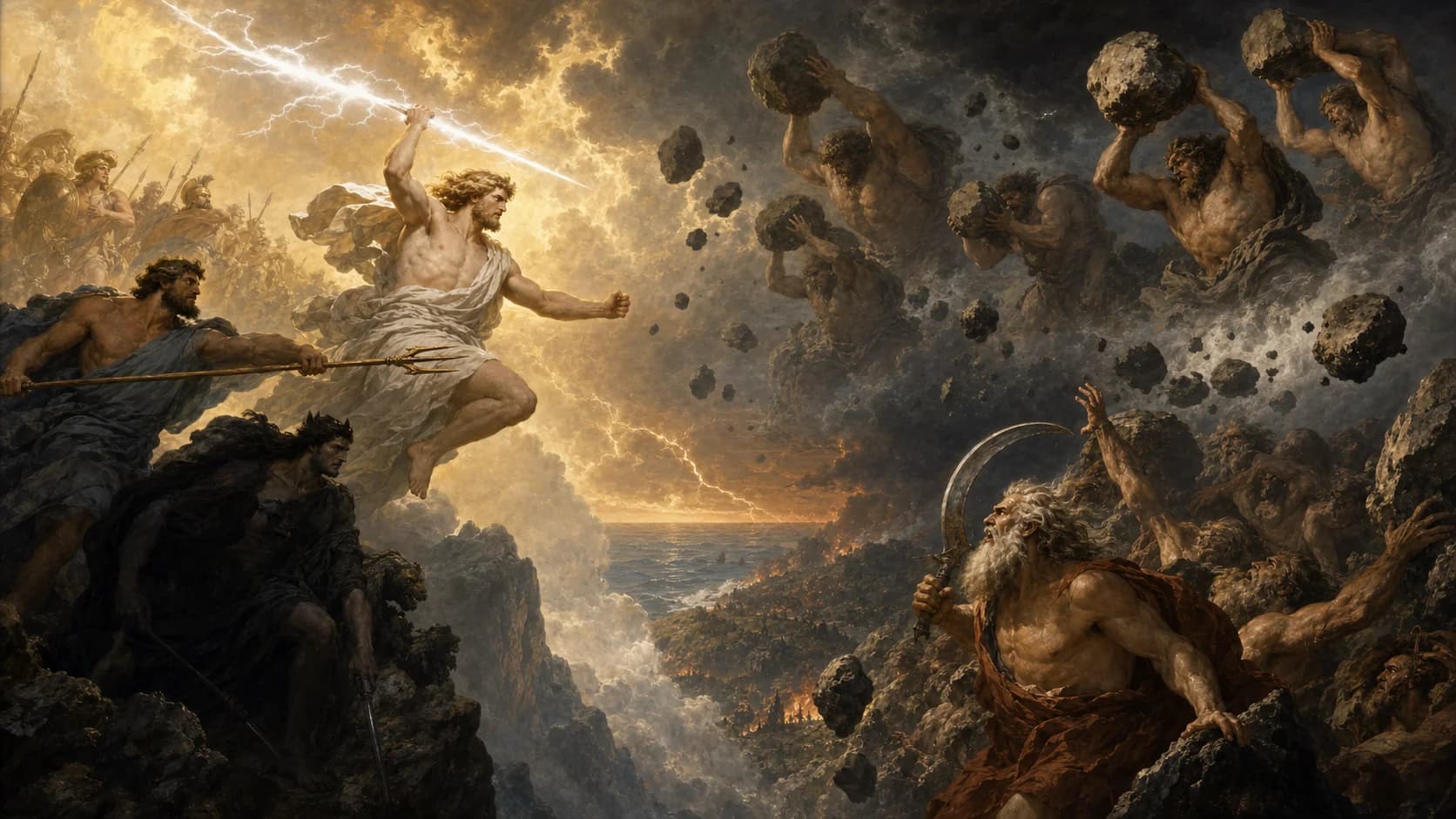
Grown, Zeus forced Cronus to vomit up his siblings (and the stone, which Hesiod says Zeus set up at Delphi as a marker). He freed the Cyclopes, who gave him thunder and the lightning bolt, and released the Hundred-Handers from their prison beneath the earth. Then came the Titanomachy, a war against Cronus and the older Titans that Hesiod says lasted ten full years. The Hundred-Handers' volleys of boulders and Zeus's lightning finally broke the Titans, who were chained in Tartarus.
Gaia then bore one last challenger, the monster Typhon, and Zeus had to defeat him too. Only then, in Hesiod's telling, did the gods urge Zeus to take the kingship, and he distributed their honors among them.
How did Zeus, Poseidon and Hades divide the world?
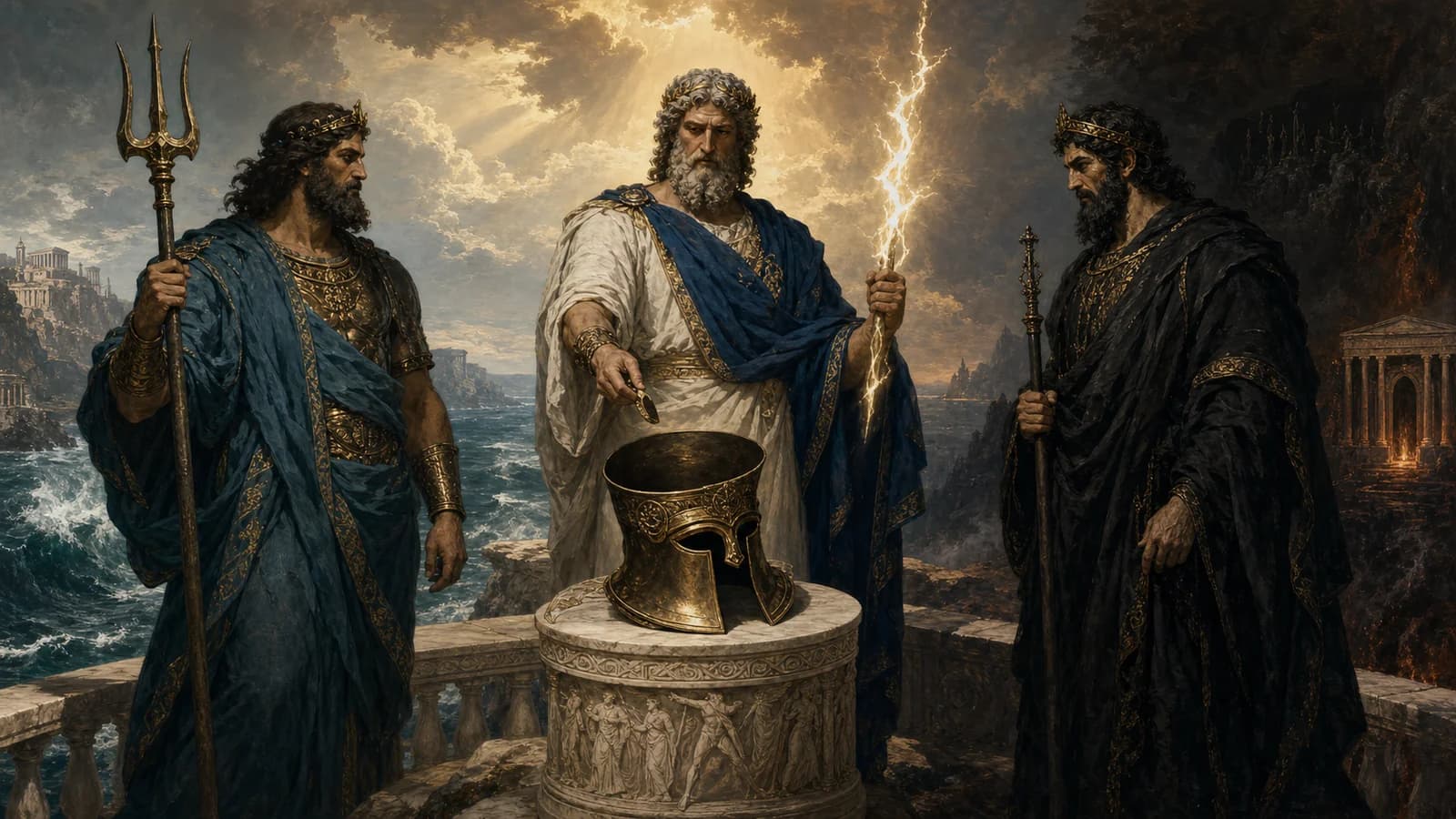
The best-known version comes from the Iliad, where Poseidon explains it himself: the three brothers drew lots. Zeus won the wide sky, Poseidon the grey sea, Hades the misty underworld — and the earth and Olympus were left common to all. Poseidon uses this to argue he is Zeus's equal, not his servant. He backs down anyway.
This "rule by victory, share by arrangement" model is very different from the Norse gods, who rule under a known deadline. For the full contrast, read Norse vs Greek Gods: Key Differences.
Who were Zeus's wives and children?
Hera is Zeus's wife and queen in every major source, but she was not his first. Hesiod gives Zeus a sequence of consorts, each producing children who help order the world:
| Consort | Children (in Hesiod) |
|---|---|
| Metis | Athena — Zeus swallowed Metis, and Athena was born from his head |
| Themis | The Seasons (Horai) and the Fates (Moirai) |
| Eurynome | The Graces (Charites) |
| Demeter | Persephone |
| Mnemosyne | The nine Muses |
| Leto | Apollo and Artemis |
| Hera (last) | Hebe, Ares, Eileithyia |
He swallowed Metis because she was destined to bear a son who would be king of gods and men — Zeus solving the Cronus problem by absorbing it. Beyond these, Hesiod names Maia (mother of Hermes), the mortal Semele (mother of Dionysus) and Alcmene (mother of Heracles). Other famous mortal lovers include Danaë (Perseus), Europa (Minos) and Leda (Helen).
The affairs are also where Zeus's shapeshifting lives: a bull for Europa, a swan for Leda, a shower of gold for Danaë, a disguise as Alcmene's own husband. Hera's jealousy, aimed usually at the lovers and their children rather than at Zeus, drives a large share of Greek myth — Heracles's whole life among them. To see how all these lines connect, open the Greek gods family tree.
What are Zeus's powers and symbols?
- Sky and storm. He gathers clouds, sends rain, and throws the thunderbolt — his signature weapon.
- Supreme authority. In Iliad Book 8 he boasts that if all the gods hung on a golden chain and pulled, they could not drag him down, but he could haul up all of them, earth and sea included.
- Justice and oaths. In Hesiod's Works and Days he is the watcher who punishes crooked judgments. As Zeus Horkios he guards oaths; as Zeus Xenios he protects guests and strangers, which is why hospitality violations are so serious in Greek myth.
- Human fortune. In the Iliad, Achilles describes two jars at Zeus's door, one of good gifts and one of evils, from which he hands out mortal lives.
| Symbol | Meaning |
|---|---|
| Thunderbolt | Power over sky and storm; the weapon that won the Titanomachy |
| Eagle | His bird, called in the Iliad the dearest of birds to him |
| Oak | Sacred at his oracle of Dodona, where his will was heard in the oak's leaves |
| Scepter | Kingship |
| Aegis | The terrifying protective goatskin, carried by Athena and by Apollo in the Iliad |
His greatest sanctuary was Olympia, home of the Olympic Games held in his honor and of Phidias's gold-and-ivory statue of Zeus, one of the Seven Wonders of the ancient world.
Did Zeus ever die?
No. Greek gods are deathless by definition, and Zeus never dies in any major myth. But he came close to losing his throne more than once:
- Typhon. In Apollodorus, the monster cuts the sinews from Zeus's hands and feet and hides him in a cave; Hermes and Aegipan steal the sinews back.
- A palace revolt. In the Iliad, Hera, Poseidon and Athena plot to bind Zeus, until Thetis brings the Hundred-Hander Briareus to sit by his side.
- Prophecies. The Metis prophecy made him swallow his first wife. A later tradition, found in Pindar and behind Aeschylus's Prometheus Bound, says the sea-nymph Thetis would bear a son greater than his father, so Zeus steered clear of her; she married the mortal Peleus and bore Achilles.
There was one odd exception: on Crete, people pointed out a "tomb of Zeus." The poet Callimachus, in his Hymn to Zeus, calls Cretans liars for it — Zeus did not die, he says, because he lives forever.
Zeus also has limits. In the Iliad he wants to save his mortal son Sarpedon from death at Troy, but Hera warns that the other gods would not accept it, and he lets fate run, weeping tears of blood.
Zeus vs Odin: who would win?
No ancient source ever set them against each other, so any answer is a thought experiment. On raw power, Zeus has the edge: a thunderbolt that defeated the Titans and a throne no one has taken from him. Odin's strength is knowledge — runes, prophecy, magic — and his own myths tell of his death at Ragnarök, swallowed by the wolf Fenrir. Zeus is what lasting power looks like; Odin is wisdom that knows its deadline. We break it down round by round in Zeus vs Odin.
In the sources
Zeus's story is told mainly in Hesiod's Theogony (his birth, the Titanomachy, Typhon, his marriages) and Works and Days (Zeus as guardian of justice, Prometheus and Pandora); in Homer's Iliad and Odyssey; in the Homeric Hymns (in the Hymn to Demeter he allows Hades to take Persephone); in the Library of Apollodorus, which fills in his Cretan childhood; and in Ovid's Metamorphoses, where he appears as Jupiter, turns the savage king Lycaon into a wolf and floods the world, leaving only Deucalion and Pyrrha.
The sources do not agree on several points:
- Eldest or youngest? In Hesiod, Zeus is Rhea's youngest child. In the Iliad, Zeus is the elder brother of Poseidon, and Zeus insists on it himself.
- King by vote or by lot? Hesiod has the gods ask Zeus to rule after his victory; the Iliad has the three brothers draw lots for their realms.
- Who freed his siblings? Hesiod credits Gaia's scheming for making Cronus vomit them up; Apollodorus says Metis gave Cronus a drug.
- Hephaestus. In Hesiod, Hera bears Hephaestus alone, without Zeus, out of anger at her husband. In Homer, Hephaestus is the son of Zeus and Hera.
- Aphrodite. In Hesiod, she rises from sea-foam around Ouranos's severed genitals, older than Zeus. In the Iliad, she is Zeus's daughter by Dione.
- The Fates. Even Hesiod contradicts himself: the Moirai are daughters of Night early in the Theogony and daughters of Zeus and Themis later.
- Wives vs lovers. Hesiod lists Zeus's consorts as a sequence of marriages ending with Hera. Homer knows no such sequence; in Iliad Book 14 Zeus reels off his past lovers — Danaë, Europa, Semele, Alcmene, Demeter, Leto — to Hera herself.
In popular culture
- Percy Jackson and the Olympians. In Rick Riordan's The Lightning Thief, Zeus's master bolt is stolen and he blames Poseidon's son Percy. Zeus is played by Sean Bean in the 2010 film and by Lance Reddick in the 2023 Disney+ series. The stolen-bolt plot is Riordan's invention, though the thunderbolt as Zeus's defining weapon is straight from Hesiod.
- Kaos (Netflix, 2024). Jeff Goldblum plays a vain, paranoid Zeus obsessed with a prophecy of his fall — a modern reworking of the fear that shaped his marriage to Metis.
- Blood of Zeus (Netflix, 2020). This animated series centers on Heron, a demigod son of Zeus invented for the show, with Hera's jealousy as a key driver of the conflict — true to the myths in spirit, not in cast.
- God of War. The games make Zeus the father of Kratos, who kills him in God of War III. No ancient myth kills Zeus; that is the franchise's biggest departure.
- Disney's Hercules (1997). Zeus and Hera are Hercules's loving parents. In the myths, Heracles's mother is the mortal Alcmene and Hera is his lifelong persecutor. For more films, see Greek mythology movies.
Frequently asked questions
Who was Zeus in Greek mythology?
Zeus was the king of the Greek gods and god of the sky, thunder, law and kingship. He ruled from Mount Olympus after overthrowing his father Cronus.
Who were Zeus's parents?
His parents were the Titans Cronus and Rhea. Cronus swallowed his children at birth, but Rhea saved Zeus by giving Cronus a stone wrapped in cloth instead.
Who was Zeus's wife?
Hera was Zeus’s wife and queen of the gods. In Hesiod’s Theogony she is his last wife, after Metis, Themis, Eurynome, Demeter, Mnemosyne and Leto.
What is Zeus the god of?
Zeus is the god of the sky, weather and thunder, and also of kingship, justice, oaths and hospitality to strangers.
What is Zeus's Roman name?
The Romans called him Jupiter. Both names come from the same ancient word for the bright sky.
Did Zeus ever die?
No. Zeus is immortal in every ancient myth. Cretans claimed to have his tomb, but the poet Callimachus mocked them for it.
What are the symbols of Zeus?
His main symbols are the thunderbolt, the eagle, the oak tree, the scepter and the aegis.
Keep exploring
Zeus is the doorway to the whole Greek pantheon. Trace his family in the Greek gods family tree, test yourself with the Greek mythology quiz, find out which Greek god you are, or start reading the originals with our best Greek mythology books guide.