Quick summary
- Greek goddess of wisdom, strategic war and crafts, and patron of Athens. Roman equivalent: Minerva.
- Born fully armed from Zeus's head after he swallowed Metis (Hesiod); Homer gives her no mother.
- Won Athens from Poseidon by planting the first olive tree against his salt-water sea.
- Guided Perseus, Heracles, Diomedes and, above all, Odysseus.
Athena is the Greek goddess of wisdom, strategic warfare and skilled crafts, and the patron of Athens. She was born fully armed from the head of Zeus, never married, and spent much of mythology standing behind heroes: Perseus, Heracles, Diomedes and above all Odysseus. Where her brother Ares stands for the chaos of battle, Athena stands for the plan that wins it.
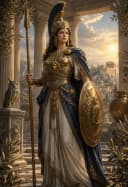
Athena
Greek pantheon
Domain: Wisdom, strategy, defensive war, weaving, crafts, cities
Athena quick facts
| Fact | Detail |
|---|---|
| Greek name | Athena (also Athene), often called Pallas Athena |
| Roman equivalent | Minerva |
| Parents | Zeus and the Oceanid Metis in Hesiod's Theogony; Homer names no mother |
| Consort | None; she is a virgin goddess (Parthenos) |
| Children | None of her own; foster mother of the Athenian king Erichthonius (Apollodorus) |
| Symbols | Aegis bearing the Gorgon's head, spear, helmet, shield |
| Sacred animals and plants | Owl, snake, olive tree |
| Main cult sites | The Acropolis of Athens (Parthenon, Erechtheion), Sparta, Tegea, Lindos on Rhodes |
| Great festival | The Panathenaia in Athens |
| Common epithets | Glaukopis (bright- or grey-eyed), Promachos (fighter in front), Ergane (worker), Polias (of the city) |
How was Athena born?
From her father's head, but the sources disagree on what came before. In Hesiod's Theogony, Zeus marries Metis, whose name means cunning intelligence. Warned that she will bear a son strong enough to overthrow him, Zeus swallows the pregnant Metis and later gives birth to Athena from his own head. He keeps Metis's wisdom inside himself, and the dangerous son is never born.
Homer skips the swallowing entirely. In the Iliad, a wounded Ares complains to Zeus that he alone fathered this reckless daughter, with no mother in the picture. The short Homeric Hymn to Athena adds the famous image: she leapt out in golden armor brandishing a spear, Olympus reeled, the sea heaved, and the sun held his horses still until she took her armor off.
Who opened Zeus's skull is a second dispute. Pindar's seventh Olympian Ode gives the job to Hephaestus and his bronze axe. Apollodorus, writing centuries later, says it was Prometheus or, according to others, Hephaestus.
What are Athena's powers?
Athena's power is intelligence put to work.
| Power | Where it shows up |
|---|---|
| Strategy and counsel | She plans Odysseus's return and the destruction of the suitors in the Odyssey |
| War | In Iliad Book 5 she rides with Diomedes and lets him wound Ares; in Book 21 she flattens Ares with a boundary stone |
| Disguise and transformation | She appears as Mentor and other mortals, and turns Odysseus into a ragged old beggar |
| Crafts | Weaving, spinning and shipbuilding; Hesiod has her teach the first woman to weave |
| Invention | Pindar credits her with the bridle she gave Bellerophon to tame Pegasus, and with the music of the pipes |
| The aegis | A terrifying goatskin cloak or shield, shared with Zeus, with the Gorgon's face at its center |
In Works and Days, when Zeus orders the making of Pandora, Athena dresses the new woman and teaches her needlework. The goddess of cities is also the goddess of the loom.
Her link to the pipes ends badly for someone else. Apollodorus says Athena threw the aulos away because playing it disfigured her face, and the satyr Marsyas picked it up. He later challenged Apollo to a music contest and paid for it with his skin.
Why is Athena the patron of Athens?
Because she beat Poseidon in a contest for the city. Herodotus reports that the Athenians kept two relics of it on the Acropolis: an olive tree and a pool of salt water. When the Persians burned the Acropolis in 480 BC, he says, the sacred olive put out a new shoot the very next day.
Apollodorus tells the full story. Poseidon struck the rock with his trident and produced a salt sea; Athena planted the first olive, with the early king Cecrops as her witness. The twelve gods judged the dispute and awarded the land to Athena, and Poseidon flooded the plain in anger. Pausanias says the scene filled the west pediment of the Parthenon.
There is a political version too. Augustine's City of God, quoting the Roman scholar Varro, says the citizens themselves voted, the women outnumbered the men by one, and Athena won. To calm Poseidon, the women lost the vote and their children stopped being named after their mothers. It is a late account, not the Athenians' own.
Why did Athena turn Arachne into a spider?
Because Arachne was better than her, or at least as good, and said so. The story is told in full only in Ovid's Metamorphoses, a Roman poem, so the goddess there is Minerva.
Arachne, a Lydian girl famous for weaving, denied that the goddess had taught her anything. Minerva visited her disguised as an old woman, warned her, then threw off the disguise and accepted the challenge. Minerva wove her victory over Neptune for Athens; Arachne wove the gods' deceptions, from Jupiter as a bull with Europa to Jupiter as a swan with Leda.
Ovid says not even Envy could find a flaw in Arachne's work. Furious, the goddess tore it up and struck the girl with her shuttle. Arachne hanged herself; Minerva let her live on as a spider, still weaving, by sprinkling her with the juice of a herb of Hecate.
What did Athena do to Medusa?
That depends entirely on which poet you read. In Hesiod, Medusa is simply one of the three Gorgons, daughters of the sea gods Phorcys and Ceto, with no curse and no backstory of a crime. In Ovid, she is a beautiful woman violated by Neptune inside Minerva's temple, and the goddess punishes Medusa, not Neptune, by turning her hair to snakes.
The later accounts share the ending: Athena helps Perseus kill her, and Apollodorus says she set the Gorgon's head in the middle of her aegis. We compare the versions side by side in Medusa in Greek mythology.
Did Athena have children?
No. Athena is one of three goddesses the Homeric Hymn to Aphrodite names as immune to desire, alongside Artemis and Hestia. Her title Parthenos, maiden, gave the Parthenon its name.
She does have a foster son. Apollodorus tells how Hephaestus tried to force himself on her; she escaped, his seed fell on her leg, and when she wiped it off with wool and threw it to the ground, the earth produced the child Erichthonius. Athena hid the baby in a chest and gave it to the daughters of Cecrops with orders not to look inside. They looked, and in Apollodorus they die for it, either killed by the snake guarding the child or leaping from the Acropolis. The Iliad already knows an earth-born king, Erechtheus, raised by Athena herself.
Whose side was Athena on in the Trojan War?
The Greeks'. In the beauty contest judged by Paris, Apollodorus says Hera offered him kingship over all men, Athena victory in war and Aphrodite the most beautiful woman alive. He chose Aphrodite and Helen, and Athena never forgave Troy.
In the Iliad, the Trojan women lay a fine robe on her knees and pray for help; the poet says she refused. At the climax she tricks Hector into facing Achilles by appearing as his brother Deiphobus, then vanishes when he needs a second spear. Yet she also turned on the Greeks. In Euripides' Trojan Women, Athena asks Poseidon to wreck the victorious fleet because Ajax the Lesser dragged Cassandra out of her temple by force and the army failed to punish him.
In the sources
- Hesiod, Theogony (Metis, the birth from Zeus's head) and Works and Days (Athena dresses Pandora and teaches her to weave).
- Homer, Iliad (Diomedes, the duel with Ares, the deception of Hector) and Odyssey (her long partnership with Odysseus and Telemachus).
- The Homeric Hymns — the short Hymn to Athena on her armed birth and the Hymn to Aphrodite on her virginity.
- Pindar, Olympian 7 and 13 and Pythian 12 (Hephaestus's axe, Bellerophon's bridle, the invention of pipe music).
- Aeschylus, Eumenides — Athena founds the Areopagus court in Athens and casts the deciding vote that acquits Orestes.
- Euripides, Trojan Women; Herodotus, Histories; Apollodorus, Library; Ovid, Metamorphoses; Pausanias, Description of Greece.
Where the sources clash:
- A mother or not? Hesiod gives Athena a mother, Metis, swallowed before the birth. Homer's Ares says Zeus produced her alone.
- The axe. Pindar names Hephaestus; Apollodorus says Prometheus first and Hephaestus only as an alternative.
- Who blinded Tiresias? In Callimachus's Hymn 5, Tiresias stumbles on Athena bathing and loses his sight, and she gives him prophecy in return. In Ovid's Metamorphoses it is Juno who blinds him, for taking Jupiter's side in an argument. Apollodorus records both.
- Medusa. A Gorgon by birth in Hesiod, a punished victim in Ovid.
In popular culture
- Percy Jackson and the Olympians. Annabeth Chase, Percy's closest ally, is a daughter of Athena. Rick Riordan squares this with the virgin goddess by making Athena's demigod children born from her thoughts, an idea with no ancient basis.
- God of War (2005–2010). Athena guides Kratos through the first game and dies in God of War II taking a blow meant for Zeus. No myth kills her.
- Hades (Supergiant, 2020). Athena is one of the Olympians who send Zagreus blessings, and her boons are defensive, deflecting attacks — a fair reading of her shield-bearing side.
- The Nashville Parthenon. The full-scale replica in Tennessee houses a 42-foot recreation of the lost gold-and-ivory Athena Parthenos statue.
Frequently asked questions
What is Athena the goddess of?
Athena is the Greek goddess of wisdom, strategic warfare, weaving and other crafts, and the protector of cities, above all Athens.
Who are Athena's parents?
Her father is Zeus. Hesiod's Theogony names Metis, a daughter of Oceanus, as her mother, swallowed by Zeus before the birth, while Homer never mentions a mother.
Why is the owl Athena's symbol?
The owl was the emblem of Athena in Athens and appeared on the city's silver coins. It became a symbol of wisdom because of her, not the other way around.
Did Athena ever marry?
No. Athena is a virgin goddess, called Parthenos, the maiden. She never married and had no children of her own.
What is Athena's Roman name?
The Romans identified Athena with Minerva, their goddess of wisdom and crafts. Ovid's Arachne story uses the name Minerva.
Who is stronger, Athena or Ares?
In the Iliad, Athena wins every time they clash. She guides Diomedes's spear into Ares in Book 5 and knocks him down with a boulder in Book 21.
Keep exploring
Athena makes most sense next to the gods she worked with and against. See how she compares across the Olympians in Greek gods and their powers, meet her rival for Athens in Poseidon, and read about her fellow maiden goddess in Artemis. Trace her family on the Greek family tree, or find out if you are an Athena with the Which Greek God Are You? quiz.