Hecate was a Greek goddess of crossroads, doorways, torches and the night, and in later tradition of magic and ghosts. In her oldest major appearance, Hesiod's Theogony (around 700 BC), she is not sinister at all: Zeus honors her above all other deities and she helps kings, soldiers, athletes, fishermen and herdsmen. Her darker reputation — the triple-bodied queen of witches, followed by howling dogs — grew over the following centuries, especially through tragedy, Hellenistic poetry and Roman literature.
Hecate
Greek pantheon
Domain: Crossroads, thresholds, torches, night, the moon, magic, ghosts
Hecate quick facts
| Fact | Detail |
|---|---|
| Parents | Perses and Asteria, both of the Titan generation (Hesiod) |
| Status | A Titan-born goddess whom Zeus allowed to keep and extend her honors |
| Domains | Crossroads, gateways, torches, night; later magic, the moon and restless ghosts |
| Symbols | Twin torches, keys, dogs, a triple form |
| Key myth | Helps Demeter search for Persephone, then becomes Persephone's companion |
| Roman name | Trivia, "of the three ways" |
| Main sources | Hesiod's Theogony, the Homeric Hymn to Demeter, Euripides' Medea, Apollonius's Argonautica, Pausanias, Virgil's Aeneid |
Is Hecate evil?
No. No ancient source makes Hecate an evil goddess. She is powerful and associated with the night, the dead and dangerous places, which made her someone to respect and to keep on good terms with — but she was also a protector.
Ordinary Athenians set small shrines or images of Hecate (hekataia) at their front doors, trusting her to guard the threshold. She was worshipped in public cults across the Greek world, with a great sanctuary at Lagina in Caria (southwest Asia Minor) in the Hellenistic period. The "evil witch-goddess" is a modern simplification of a much more complex figure.
What does Hesiod say about Hecate?
The surprise is how warm he is. About forty lines of the Theogony praise Hecate so highly that scholars often call them the "Hymn to Hecate." Among Hesiod's points:
- Zeus honored her above all. She kept the share she held under the Titans — in earth, sea and starry sky — and Zeus added more.
- She helps whomever she chooses: kings sitting in judgment, speakers in the assembly, soldiers in battle, athletes in games, horsemen, sailors and fishermen, and herdsmen whose flocks she can increase or decrease.
- She is a nurse of the young (kourotrophos), given that role by Zeus.
- Anyone sacrificing to the gods could call on her, and she would grant favor if she wished.
There is no magic, no ghost and no crossroads in this passage. Hesiod's Hecate is a generous, all-purpose power. Why he praises her so much is a puzzle; some scholars suspect personal or regional devotion.
What did Hecate do in the Persephone myth?
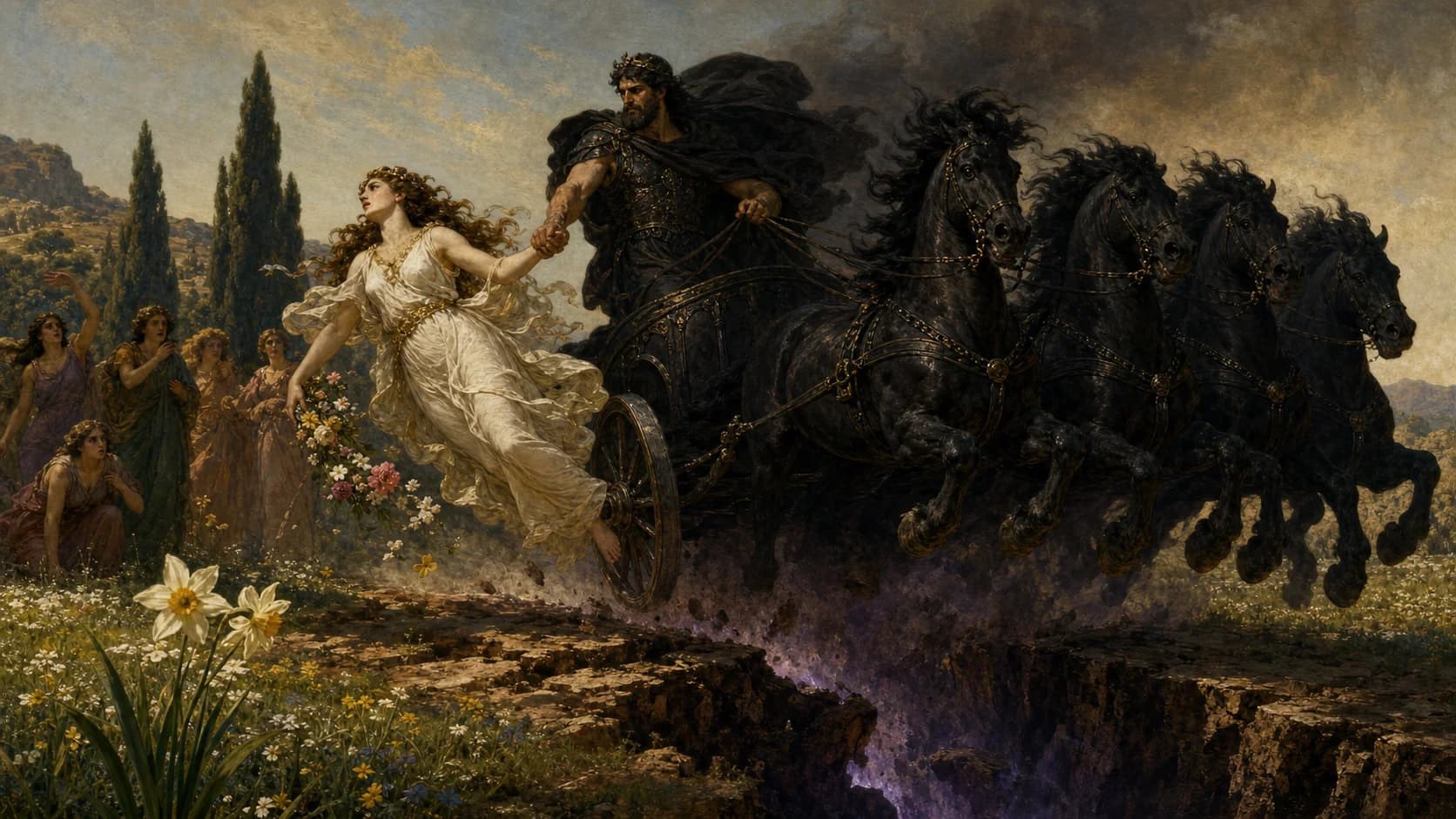
In the Homeric Hymn to Demeter (probably 7th or 6th century BC), Hecate is one of only two beings who hear Persephone cry out when Hades seizes her. She hears it from her cave; the sun god Helios hears it too.
- Demeter searches for nine days with torches, eating nothing.
- On the tenth day, Hecate meets her, holding a light in her hands, and tells her she heard the girl but did not see who took her.
- Together they go to Helios, who reveals that Zeus gave Persephone to Hades.
- After the reunion, Hecate embraces Persephone and from then on serves as her attendant and companion.
This is where Hecate's torch comes from, and her link to the underworld: as Persephone's companion, she has reason to pass between the worlds. Read the full story in Persephone in Greek Mythology.
Why is Hecate linked to crossroads and dogs?
Crossroads were liminal places in Greek belief — between directions and between towns — where ghosts and pollution were thought to gather. Hecate, a goddess of in-between places, belonged there. The Greek title Enodia, "of the road," was used for her.
- Hecate's suppers. At the new moon, food offerings called "Hecate's suppers" (deipna) were left at crossroads. In Aristophanes' comedy Wealth (388 BC), a character jokes that the poor ate them.
- Dogs. Dogs were her animal, and barking dogs announced her approach in later poetry. Plutarch reports that Greeks brought puppies to Hecate in purification rites.
- Triple form. The traveler Pausanias (2nd century AD) says the sculptor Alcamenes, in the late 5th century BC, was the first to make Hecate as three figures joined together, for a statue near the entrance of the Athenian Acropolis. Triple images let her face all three roads of a junction at once.
How did Hecate become the goddess of witchcraft?
Gradually, through literature, over several centuries:
| Period | Source | What changes |
|---|---|---|
| c. 700 BC | Hesiod, Theogony | Generous, universal goddess; no magic |
| 7th–6th c. BC | Homeric Hymn to Demeter | Torch-bearer, cave-dweller, Persephone's companion |
| 431 BC | Euripides, Medea | Medea swears by Hecate, the goddess she honors most, who dwells at her hearth |
| 3rd c. BC | Apollonius, Argonautica | Medea is Hecate's priestess; Hecate rises at night wreathed in serpents, with torches and baying dogs |
| 1st c. BC | Diodorus Siculus | Makes Hecate the mother of Circe and Medea |
| 1st c. BC | Virgil, Aeneid | "Triple Hecate," the three faces of Diana; ruler of the groves of Avernus |
| 1st c. AD | Ovid, Metamorphoses; Seneca, Medea | Medea calls on Hecate in her spells |
By the Roman period, Hecate had merged with Diana (Artemis) and Luna (the moon) into one triple goddess, and the Romans called her Trivia, "of the three ways." Greek magical papyri from Roman Egypt and curse tablets also invoke her, as a goddess with power over ghosts. This is historical religion — it tells us what ancient people believed, not what anyone should practice.
Was Hecate Circe's mother?
Only in one late tradition. In Homer's Odyssey, Circe is the daughter of the sun god Helios and the sea nymph Perse, and sister of Aeetes, Medea's father. That makes Medea Circe's niece. The historian Diodorus Siculus, writing in the 1st century BC, offers a different, rationalizing genealogy in which Hecate is the mother of both Circe and Medea. Most ancient writers follow Homer.
In the sources
- Hesiod, Theogony — her parentage and the long praise of her honors.
- Homeric Hymn to Demeter — Hecate hears Persephone, helps Demeter and becomes Persephone's attendant.
- Euripides, Medea — Medea's personal devotion to Hecate.
- Aristophanes, Wealth — Hecate's suppers at the crossroads.
- Apollonius of Rhodes, Argonautica — Medea as priestess; Hecate's terrifying night epiphany to Jason.
- Diodorus Siculus, Library of History — Hecate as mother of Circe and Medea.
- Virgil, Aeneid — triple Hecate and the Sibyl's descent to the underworld.
- Pausanias, Description of Greece — Alcamenes' triple statue.
- Plutarch, Roman Questions — puppies brought to Hecate in purification.
Contradictions to know:
- Generous or fearsome? Hesiod's Hecate blesses everyday life; Apollonius's rises from the earth among serpents and baying dogs.
- Single or triple? Early sources treat her as one goddess; the triple form appears in sculpture in the 5th century BC and dominates Roman literature.
- Circe's mother? Homer says Perse; Diodorus says Hecate.
- Identity. Some Greek sources blur her with Artemis, and Roman writers make her one face of Diana.
In popular culture
- Macbeth. Shakespeare's play includes Hecate as queen of the witches. Many scholars think her scenes were added by Thomas Middleton.
- Percy Jackson. In Rick Riordan's The House of Hades, Hecate appears to Hazel Levesque at a crossroads and teaches her to use the Mist.
- Hades II (Supergiant Games). Hecate is the Witch of the Crossroads and mentor of the heroine Melinoë — a fair nod to her role as guide between worlds.
The modern "Hecate of Halloween" leans on Apollonius and the Roman poets. Hesiod's version — patron of fishermen and kings — rarely appears on screen.
Frequently asked questions
Who is Hecate in Greek mythology?
Hecate is a Greek goddess of crossroads, doorways, torches and the night, later also of magic and ghosts. Hesiod makes her the daughter of Perses and Asteria.
Is Hecate evil?
No. Hesiod praises her as a generous goddess honored by Zeus, and Athenians set her images at their doors for protection. Her sinister image comes from later literature.
What is Hecate the goddess of?
Crossroads, gateways, torches and the night in early Greek religion, and later also magic, the moon and restless ghosts.
What role does Hecate play in the Persephone myth?
In the Homeric Hymn to Demeter, Hecate hears Persephone's cry, helps Demeter search with a torch, and afterward becomes Persephone's companion.
Why does Hecate have three faces?
Her triple form suited a goddess of crossroads, facing every road at once. Pausanias says the sculptor Alcamenes first made a triple Hecate in the 5th century BC.
What is Hecate's Roman name?
The Romans called her Trivia, meaning of the three ways, and often merged her with Diana and Luna.
Keep exploring
Hecate belongs to the older generation of gods that Zeus absorbed rather than defeated. Trace the Titans in Cronus in Greek Mythology and Who Was Zeus?, map her family in the Greek gods family tree, and meet more creatures of the night in Mythological Monsters: 15 Creatures for Halloween and Halloween's mythological roots. Then find out which Greek god you are.