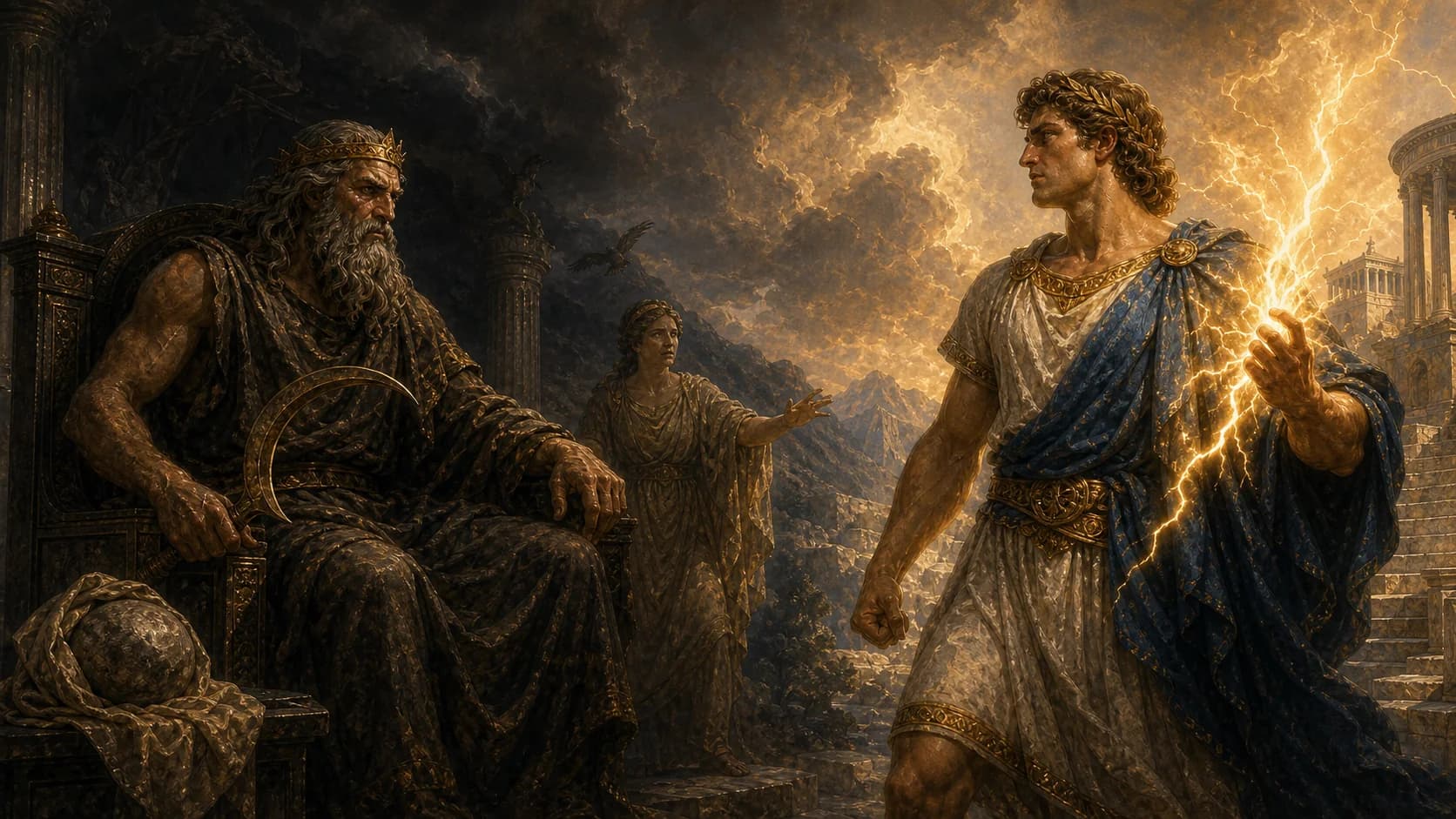
Cronus (also spelled Kronos) was the youngest of the Titans and king of the gods before Zeus in Greek mythology. He took power by castrating his father, Ouranos, with a sickle, then swallowed each of his own children to stop a prophecy that one of them would overthrow him. His wife Rhea saved the youngest, Zeus, who grew up, freed his siblings and defeated Cronus in a ten-year war.
Cronus
Greek pantheon
Domain: King of the Titans, the harvest, the Golden Age
Cronus quick facts
| Fact | Detail |
|---|---|
| Also spelled | Kronos, Cronos |
| Parents | Ouranos (Sky) and Gaia (Earth) |
| Siblings | The Titans, including Oceanus, Hyperion, Iapetus, Rhea, Themis and Mnemosyne; he was the youngest |
| Wife | Rhea, his sister |
| Children with Rhea | Hestia, Demeter, Hera, Hades, Poseidon, Zeus |
| Other child | The centaur Chiron, by the nymph Philyra (Apollodorus) |
| Symbol | The sickle |
| Roman equivalent | Saturn |
| Main sources | Hesiod's Theogony and Works and Days, Homer's Iliad, Apollodorus's Library |
How did Cronus become king of the gods?
The story is told in Hesiod's Theogony. Ouranos, the Sky, hated the children Gaia bore him and kept them hidden inside her body, the Earth. Gaia, in pain and fury, made a great sickle of grey adamant and asked her sons to punish their father.
Only Cronus, the youngest, dared. When Ouranos came to lie with Gaia at night, Cronus ambushed him and cut off his genitals with the sickle. The blood that fell on the earth produced the Furies, the Giants and the ash-tree nymphs. The genitals fell into the sea, and from the foam around them rose Aphrodite.
Cronus now ruled. Hesiod gives him a telling epithet: ankylometes, usually rendered "crooked-minded" or "of crooked counsel."
Why did Cronus eat his children?
Because he was afraid of being treated the way he had treated his father. Gaia and Ouranos told Cronus that he was destined to be overcome by his own son. So as each child came from Rhea's womb, he swallowed it:
| Birth order | Child | Fate |
|---|---|---|
| 1 | Hestia | Swallowed |
| 2 | Demeter | Swallowed |
| 3 | Hera | Swallowed |
| 4 | Hades | Swallowed |
| 5 | Poseidon | Swallowed |
| 6 | Zeus | Saved — Cronus swallowed a stone instead |
The children were not killed. Greek gods cannot die, so they lived on inside their father until he was forced to bring them back up.
Rhea, desperate, asked her own parents for help. They sent her to Crete to give birth to Zeus in secret. She then handed Cronus a large stone wrapped in swaddling clothes, and he swallowed it without looking. The full story of Zeus's rise is in Who Was Zeus?
How did Zeus defeat Cronus?
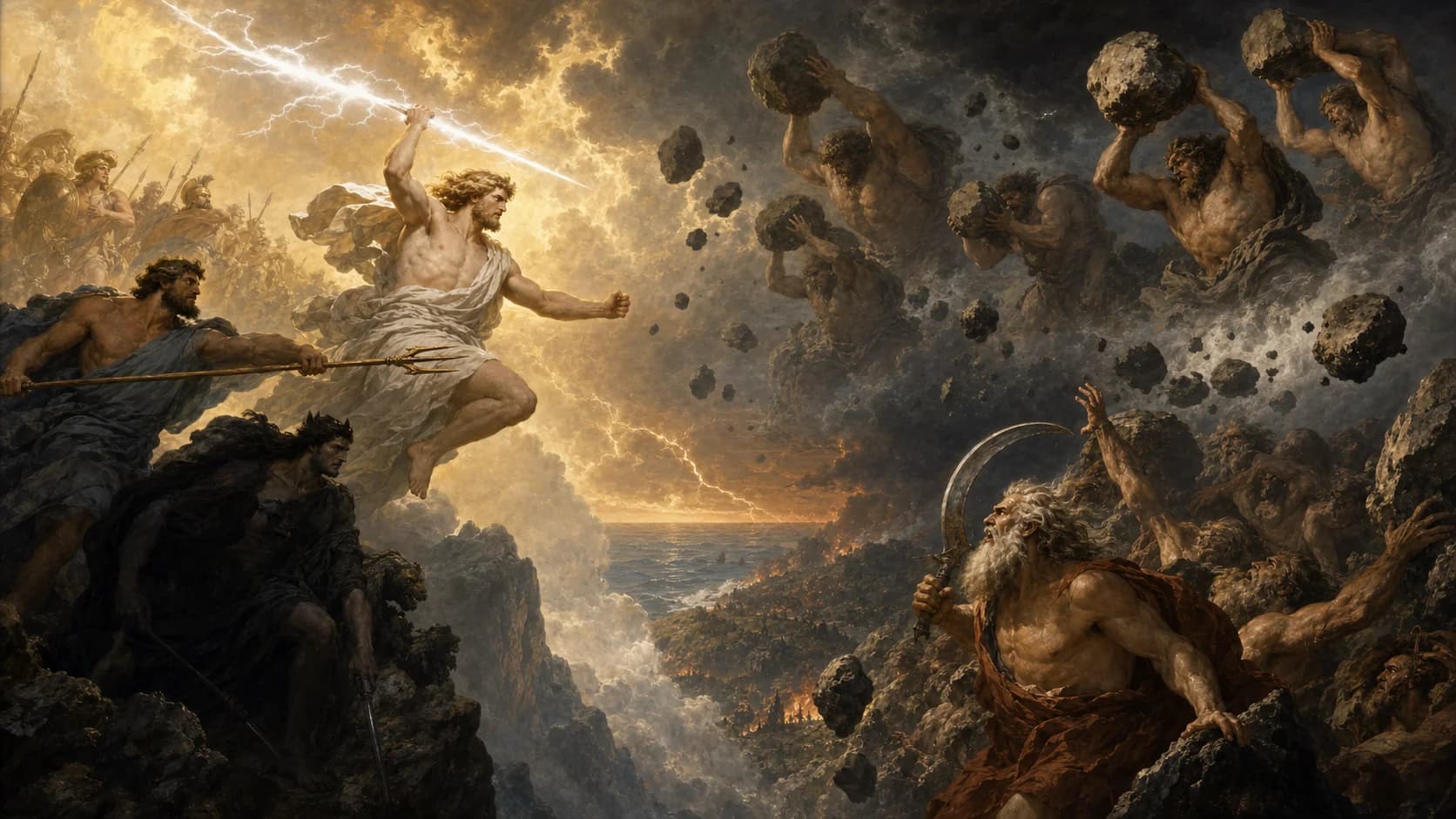
- The children return. Hesiod says Cronus, tricked by Gaia's cunning, vomited up first the stone and then his children. Apollodorus says instead that Metis, a daughter of Oceanus, gave him a drug that made him throw them up.
- The stone at Delphi. Hesiod says Zeus set up the stone at Pytho (Delphi) as a sign and a wonder for mortals.
- New allies. Zeus freed the Cyclopes, who gave him thunder and lightning, and the Hundred-Handers.
- The Titanomachy. The Olympians and the Titans fought for ten years. The Hundred-Handers' volleys of rocks and Zeus's lightning finally broke the Titans.
- The prison. The defeated Titans were bound in Tartarus, as far below the earth as the sky is above it, with the Hundred-Handers as guards. Hesiod places the Titans there together with Cronus.
Homer agrees on the essentials: in the Iliad, Cronus is below the earth and sea, and Zeus says that Iapetus and Cronus sit in the depths of Tartarus.
What was the Golden Age of Cronus?
In Works and Days, Hesiod describes a series of human races. The first, the golden race, lived in the days when Cronus was king in heaven. These people:
- lived like gods, without sorrow or hard work;
- did not suffer old age;
- ate from an earth that gave its fruit freely, without farming;
- died as if falling asleep, and afterwards became kindly spirits watching over mortals.
This gives Cronus two faces. In the Theogony he is a violent, fearful tyrant. In Works and Days his reign is the best time humans ever had. Hesiod never reconciles the two.
A later tradition softened his ending. A few lines found in some manuscripts of Works and Days, which many editors consider later additions, say that Zeus released Cronus to rule the Islands of the Blessed. The poet Pindar, in his second Olympian ode, likewise places a "tower of Cronus" on the Isles of the Blessed, where the righteous dead live.
Is Cronus the same as Saturn?
The Romans identified Cronus with their god Saturn, and adapted the story. In Virgil's Aeneid, Saturn flees from Jupiter to Italy, gathers its scattered people, gives them laws and rules a golden age there. Virgil links the name Latium to the verb latere, "to hide," because Saturn hid there safely.
Saturn's festival, the Saturnalia, was held in December and was famous for role reversal: masters and slaves shared the feast. Athens had its own summer festival for Cronus, the Kronia, which the Roman writer Macrobius also describes as a time when masters and slaves ate together. Saturn's temple in the Roman Forum housed the state treasury.
He also left his name on the planet Saturn and on Saturday.
Is Cronus the same as Chronos, god of time?
No, although the two were mixed up in antiquity. Kronos the Titan and chronos, the Greek word for time, are different words. Cicero, in On the Nature of the Gods, reports the interpretation that Cronus was named for time because time devours what it creates, as Cronus devoured his children. That blend lies behind the later image of Father Time with a scythe.
In the sources
- Hesiod, Theogony — the castration of Ouranos, the swallowing, the stone, the Titanomachy and Tartarus.
- Hesiod, Works and Days — the golden race in the time of Cronus.
- Homer, Iliad — Cronus and Iapetus imprisoned in Tartarus.
- Pindar, Olympian 2 — the tower of Cronus on the Isles of the Blessed.
- Apollodorus, Library — Metis's drug, Zeus's infancy in a cave on Mount Dicte, and Chiron as son of Cronus.
- Virgil, Aeneid (Book 8) — Saturn's golden age in Latium.
Contradictions to know:
- How were the children freed? Gaia's trick in Hesiod; Metis's drug in Apollodorus.
- Where was Zeus born? Hesiod names Lyctus on Crete; Apollodorus names a cave on Mount Dicte.
- Was Zeus the youngest? In Hesiod, yes. In the Iliad, Zeus calls himself the elder brother of Poseidon.
- Tyrant or golden king? The Theogony's cruel usurper against Works and Days's golden age.
- Prisoner forever? Hesiod and Homer keep him in Tartarus; Pindar and the disputed Works and Days lines release him to the Isles of the Blessed.
In popular culture
- Percy Jackson and the Olympians. Kronos is the villain of Rick Riordan's whole series, slowly re-forming from the pieces Zeus cut him into. Riordan invents that detail; in Hesiod, Cronus is imprisoned, not chopped up.
- God of War III. Kratos fights Cronos as a mountain-sized Titan. The ancient Titans were gods, not giant monsters.
- Hades II. Supergiant's villain is "Chronos, the Titan of Time" — a deliberate fusion of the Titan Cronus with Chronos, the personification of time.
- Goya's Saturn Devouring His Son. One of Goya's "Black Paintings," now in the Prado, and the most famous image of the myth. Rubens painted the same subject.
Frequently asked questions
Who was Cronus in Greek mythology?
Cronus was the youngest Titan, son of Ouranos and Gaia, and king of the gods before Zeus. He is the father of Zeus, Hera, Poseidon, Hades, Demeter and Hestia.
Why did Cronus eat his children?
His parents told him that one of his sons would overthrow him, as he had overthrown his own father. He swallowed each child at birth to stop the prophecy.
How did Zeus escape being eaten?
His mother Rhea gave birth to him in secret on Crete and gave Cronus a stone wrapped in swaddling clothes, which he swallowed instead.
What happened to Cronus after the Titanomachy?
Hesiod and Homer say he was imprisoned in Tartarus with the other Titans. Later traditions, including Pindar, place him as ruler of the Isles of the Blessed.
Is Cronus the same as Saturn?
Yes. The Romans identified Cronus with Saturn, whose reign in Italy was remembered as a golden age and celebrated at the Saturnalia.
Is Cronus the god of time?
No. Cronus is a Titan, while Chronos is the Greek word for time. Ancient writers confused the two, which is where the image of Father Time comes from.
Keep exploring
Cronus is where the Olympian family's story begins. See his descendants in the Greek gods family tree, follow his daughter Demeter's family into the underworld with Persephone, or meet Poseidon's victim in Medusa: Monster or Victim?. Then test what you know with the Greek mythology quiz or find a Titan-worthy name with the mythology name generator.