Quick summary
- Greek god of the sea, earthquakes and horses, son of Cronus and Rhea and brother of Zeus and Hades. Roman equivalent: Neptune.
- Won the sea when he, Zeus and Hades drew lots for the world, and ruled it with his trident.
- Delayed Odysseus for years after Odysseus blinded his son, the Cyclops Polyphemus, and lost Athens to Athena's olive tree.
- Hesiod makes Zeus the youngest child, so Poseidon is the older brother; in the Iliad Zeus is the elder.
Poseidon was the Greek god of the sea, earthquakes and horses, a son of the Titans Cronus and Rhea and a brother of Zeus and Hades. When the three brothers divided the world, he received the sea and ruled it with his trident from a palace beneath the waves. He was proud, quick to take offense and slow to forgive — the god whose grudge helped keep Odysseus from home for ten years.
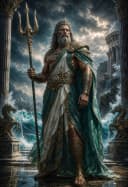
Poseidon
Greek pantheon
Domain: Sea, storms, earthquakes, horses, springs
Poseidon quick facts
| Fact | Detail |
|---|---|
| Greek name | Poseidōn |
| Roman equivalent | Neptune |
| Parents | Cronus and Rhea (Titans) |
| Siblings | Zeus, Hades, Hera, Demeter, Hestia |
| Wife | Amphitrite, a sea-nymph (Hesiod's Theogony) |
| Notable children | Triton (with Amphitrite), the Cyclops Polyphemus (with the nymph Thoosa), Pegasus and Chrysaor (with Medusa), the horse Arion (with Demeter, in Pausanias) |
| Symbols | Trident |
| Sacred animals | Horse, bull, dolphin |
| Homeric titles | Earth-shaker, Earth-holder, the dark-haired god |
| Main cult sites | Isthmia near Corinth (the Isthmian Games), Cape Sounion, Onchestos in Boeotia, Cape Taenarum |
| Home | A golden palace in the sea at Aegae (Iliad, Book 13) |
How did Poseidon become god of the sea?
By drawing lots. In Book 15 of the Iliad, Poseidon tells the story himself: he, Zeus and Hades shook lots for their shares of the world (Apollodorus dates the draw to just after the Titans' defeat). Zeus won the sky, Hades the gloomy underworld, and Poseidon the grey sea, while the earth and Olympus stayed common ground. He cites it to argue that he owes Zeus no obedience — then, warned by Iris, backs down.
His childhood differs by source. In Hesiod's Theogony, Cronus swallows Poseidon at birth along with Hestia, Demeter, Hera and Hades, and Zeus later forces him to vomit them back up. But Pausanias, travelling through Arcadia in the 2nd century AD, heard a local story that Rhea hid the newborn Poseidon among a flock of lambs and gave Cronus a foal to swallow instead — a neat fit for the god of horses.
What are Poseidon's powers?
Poseidon's powers reach well beyond open water. In the epics and later myths he can:
- Raise and calm storms. In the Odyssey, Book 5, he gathers the clouds, stirs the sea with his trident and wrecks the raft Odysseus built to leave Calypso's island.
- Shake the earth. Homer's favourite titles for him mean Earth-shaker. In Iliad Book 20, when the gods go to war, Poseidon shakes the ground so hard that Hades leaps from his throne in fear that the earth will split open and expose the realm of the dead.
- Create springs and horses. He strikes rock to bring out water. Horse races and oaths were his business: in the chariot race of Iliad Book 23, Menelaus makes his rival swear by Poseidon with a hand on his horses.
- Send monsters from the sea. In Apollodorus' Library, he sends a sea monster against Ethiopia after Queen Cassiopeia boasts of her beauty, which leads to Andromeda chained on the rocks for Perseus to rescue.
- Turn things to stone. When the Phaeacians carry Odysseus home, Poseidon turns their ship to rock as it sails back into harbour.
For how these compare with the rest of Olympus, see Greek gods and their powers.
Why did Poseidon hate Odysseus?
Because Odysseus blinded his son. In Odyssey Book 9, the Cyclops Polyphemus, Poseidon's son by the nymph Thoosa, traps Odysseus and his men in his cave and eats several of them. Odysseus gets him drunk, drives a burning stake into his single eye and escapes under the bellies of the sheep — then, unable to resist, shouts his real name back from the ship.
That boast gives Polyphemus what he needs for a curse. He prays to his father that Odysseus never reach home, or if he must, that he arrive late, broken, on a stranger's ship, having lost all his companions, and find trouble in his house. Every part of the prayer comes true.
The Odyssey is careful about the limits of Poseidon's anger. He cannot kill Odysseus, because fate says Odysseus will get home; he can only delay him. The poem opens with Poseidon away among the Ethiopians, which gives Athena her chance to persuade the other gods to let Odysseus go. In Book 11 the prophet Tiresias tells Odysseus how to end the feud: carry an oar inland until he meets people who do not know the sea, and sacrifice to Poseidon there.
Why did Poseidon lose Athens to Athena?
Poseidon competed with other gods for several Greek cities and lost most of the contests. The best known is Athens. Herodotus mentions that the Athenians kept, on their Acropolis, an olive tree and a pool of sea water that they said the two gods had produced while competing for the land. Apollodorus tells the full story: Poseidon struck the rock with his trident and brought up a salt-water sea, then Athena planted the first olive tree. The gods, judging with the early king Cecrops as witness, gave the city to Athena. Poseidon flooded the Thriasian plain in anger.
A later Roman version, which Augustine preserved from the scholar Varro, turns it into a vote of the citizens: the women outnumbered the men by one and chose Athena, and the men took away women's votes to soothe the sea god. The familiar modern version, in which Poseidon offers the horse as his gift to Athens, is not what Herodotus or Apollodorus describe.
The pattern repeats elsewhere. In Pausanias, Poseidon loses Argos to Hera after local river gods judge in her favour, and he dries up their rivers in revenge. At Corinth he has to split the land with the sun god Helios. In Plato's Critias, though, he gets a prize of his own: the island of Atlantis, where his ten sons by the mortal Cleito become its first kings.
Who were Poseidon's wife and children?
His wife is the sea-nymph Amphitrite, and Hesiod names their son Triton, who lives with them in a golden house at the bottom of the sea. Like Zeus, though, he fathers children with many partners, several of them monsters:
| Mother | Child | Source |
|---|---|---|
| Amphitrite | Triton | Hesiod, Theogony |
| The nymph Thoosa | Polyphemus the Cyclops | Homer, Odyssey |
| Medusa | Pegasus and Chrysaor | Hesiod, Theogony |
| Demeter | The horse Arion | Pausanias |
| Aethra | Theseus (who also had a mortal father, Aegeus) | Bacchylides; Plutarch's Life of Theseus |
The Medusa story shows how much the sources diverge. Hesiod says Poseidon lay with her in a soft meadow among spring flowers, with no crime and no curse. Ovid's Metamorphoses makes it a violation inside Minerva's temple, which is why the goddess turns Medusa into a monster. Read both versions in Medusa in Greek mythology.
Was Poseidon on the Greek or Trojan side?
The Greek side, with an old grudge behind it. In Iliad Book 21, Poseidon reminds Apollo that the two of them once served the Trojan king Laomedon for a year: Poseidon built the walls of Troy, and Laomedon then refused to pay and threatened them. Poseidon never forgot it.
In Books 13 and 14 he sneaks onto the battlefield while Zeus is looking away and rallies the Greeks. Hera helps by seducing Zeus and lulling him to sleep, so Poseidon can lead the Greeks openly. When Zeus wakes up, he sends Iris to order his brother off the field.
Even so, Poseidon is not a simple partisan. In Book 20 he rescues the Trojan Aeneas from Achilles, because fate has decided that Aeneas and his descendants will survive.
In the sources
Poseidon appears in Hesiod's Theogony (his birth, Amphitrite and Triton, Medusa); throughout Homer's Iliad and Odyssey; in the short Homeric Hymn to Poseidon; in Pindar's odes, which celebrate victors at his Isthmian Games; in Euripides' Hippolytus (where a bull from the sea kills Theseus' son) and Trojan Women; in Herodotus; in Plato's Critias; in the Library of Apollodorus; in Pausanias' Description of Greece; and as Neptune in Ovid's Metamorphoses.
The sources disagree on some key points:
- Older or younger than Zeus? In Hesiod, Zeus is Rhea's youngest child, which makes Poseidon the older brother. In the Iliad, Zeus is the elder, and Poseidon yields when Iris reminds him that the Furies side with the first-born.
- Swallowed or hidden? Hesiod has Cronus swallow him. Pausanias' Arcadian tradition says Rhea saved him with a foal.
- Medusa. A flowering meadow in Hesiod, a desecrated temple in Ovid.
- Athens. The gods decide in Apollodorus, the citizens vote in Varro's version, and Herodotus only reports the relics.
In popular culture
- Percy Jackson and the Olympians. Rick Riordan's hero Percy is Poseidon's demigod son. Kevin McKidd played Poseidon in the 2010 film. Riordan's distant but loving father is far gentler than Homer's vengeful god, and the rule that keeps the gods from raising their demigod children is Riordan's invention. The tense rivalry between Poseidon and Zeus, at least, is straight from the Iliad.
- God of War III (2010). Kratos kills Poseidon in the opening battle and the seas flood the world. No ancient myth kills Poseidon; the Olympians are deathless.
- Hades (2020). In Supergiant's game, Poseidon is a cheerful uncle who helps the hero Zagreus escape the underworld. That good humour is a long way from the grudge-holding god of the Odyssey.
Frequently asked questions
Who is Poseidon in Greek mythology?
Poseidon is the Greek god of the sea, earthquakes and horses. He is a son of Cronus and Rhea and the brother of Zeus and Hades, and he rules the sea with his trident.
What is Poseidon the god of?
The sea, storms, earthquakes, springs and horses. Homer calls him the Earth-shaker, and horse races and oaths sworn on horses were sacred to him.
Who is Poseidon's wife?
His wife is Amphitrite, a sea-nymph. Hesiod names their son Triton, who lives with them in a golden house beneath the sea.
Why was Poseidon angry at Odysseus?
Odysseus blinded Poseidon's son, the Cyclops Polyphemus, in Odyssey Book 9. Polyphemus prayed to his father for revenge, and Poseidon delayed Odysseus' return for years.
What is Poseidon's Roman name?
Neptune. The Romans identified their god Neptune with Poseidon, and Ovid's Metamorphoses tells Poseidon's myths under that name.
Is Poseidon older than Zeus?
In Hesiod's Theogony, yes, because Zeus is the youngest child of Cronus and Rhea. In Homer's Iliad, Zeus is the elder brother.
Is Poseidon an Olympian?
Yes. He is counted among the twelve Olympians even though his home is a palace in the sea rather than on Mount Olympus.
Keep exploring
Poseidon makes the most sense next to his brothers. Meet the king of the gods in Who Was Zeus?, the ruler of the dead in Hades in Greek mythology, and the rival who beat him for Athens in Athena in Greek mythology. Compare all twelve in Greek gods and their powers, trace his family on the Greek gods family tree, or test yourself with the Greek mythology quiz.