Quick summary
- Greek god of prophecy, music, healing, plague and archery, son of Zeus and Leto and twin of Artemis. The Romans kept the name Apollo.
- Born on Delos, he spoke the will of Zeus through the Pythia at Delphi and led the Muses with his lyre.
- The Homeric Hymn says he won Delphi by killing a serpent; Aeschylus says Phoebe gave it to him as a birthday present.
- Not originally the sun god: Hesiod and Homer give the sun to Helios, and the two merged later.
Apollo is the Greek god of prophecy, music, poetry, healing, plague and archery, the son of Zeus and Leto and the twin brother of Artemis. He spoke through the Oracle at Delphi, led the Muses with his lyre, and could cure disease or send it with his silver arrows. He was the ideal of youthful male beauty, yet his myths are among the cruelest in Greek tradition.
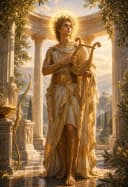
Apollo
Greek pantheon
Domain: Prophecy, music, poetry, healing, plague, archery, light
Apollo quick facts
| Fact | Detail |
|---|---|
| Greek name | Apollon; also Phoebus (Phoibos), the bright one |
| Roman equivalent | Apollo; the Romans took over the Greek god under the same name |
| Parents | Zeus and the Titaness Leto |
| Twin | Artemis |
| Consort | None; many lovers, including Daphne, Coronis, Cyrene and Hyacinthus |
| Notable children | Asclepius (by Coronis), Aristaeus (by Cyrene), Ion (by Creusa) |
| Symbols | Lyre, silver bow and arrows, laurel wreath, tripod |
| Sacred animals and plants | Swan, raven, wolf, dolphin, mouse; laurel, palm |
| Main cult sites | Delphi, Delos, Didyma near Miletus, Claros, Bassae |
| Games | The Pythian Games at Delphi |
| Common epithets | Pythios, Delios, Loxias (the oblique), Smintheus (mouse god), Paian (healer), Mousagetes (leader of the Muses) |
Who are Apollo's parents, and where was he born?
Apollo is the son of Zeus and Leto, and he was born on the island of Delos. In the Homeric Hymn to Apollo, pregnant Leto wanders the Greek world, but every land fears to receive so powerful a god. Only barren little Delos agrees, once Leto swears that her son would build his first temple there.
Leto then labored for nine days, because Hera kept the birth goddess Eileithyia on Olympus. The other goddesses finally bribed Eileithyia with a great necklace, and Leto gave birth holding onto a palm tree. The newborn god immediately claimed three things: the lyre, the curved bow, and the right to declare the will of Zeus to mortals.
The twins' birth is disputed too: the Homeric Hymn puts Artemis's birth on Ortygia, while Apollodorus has her born first and then acting as midwife to her brother.
What are Apollo's powers?
His powers come in opposing pairs: he heals and kills, reveals and riddles.
| Power | How it works in the myths |
|---|---|
| Prophecy | He speaks for Zeus through the Pythia at Delphi, and gives the gift of seeing to mortals such as Cassandra |
| Music and poetry | He plays the lyre for the gods and leads the Muses |
| Healing | Called Paian, the healer; father of Asclepius, the god of medicine |
| Plague | His arrows bring sickness, as at the opening of the Iliad |
| Archery | The far-shooter, deadly at any distance |
| Purification | He cleanses killers of blood-guilt, as he does for Orestes in Aeschylus's Eumenides |
His lyre was a gift, not his own invention. In the Homeric Hymn to Hermes, the infant Hermes builds the first lyre from a tortoise shell, steals fifty of Apollo's cattle, and calms his furious brother by handing the instrument over.
Apollo did not tolerate rivals. Apollodorus says the satyr Marsyas found the pipes Athena had thrown away and challenged Apollo to a contest, on the terms that the winner could do as he pleased with the loser. Apollo played his lyre upside down and dared Marsyas to do the same with his pipes. When the satyr could not, Apollo hung him from a pine and flayed him alive.
Is Apollo the god of the sun?
Not originally. In Hesiod and Homer, the sun is a separate god, Helios, son of the Titan Hyperion. When Odysseus's men eat the sacred cattle of the sun in the Odyssey, it is Helios who demands revenge, not Apollo. His title Phoebus means bright, but the sun itself belonged to another god.
The two merged later, and Roman poets routinely called the sun Phoebus. Ovid's Metamorphoses shows the overlap: in Book 1 Apollo is an archer chasing a nymph, while in Book 2 Phaethon addresses his sun-driving father as Phoebus. The same thing happened to his twin, Artemis, who slowly absorbed the moon goddess Selene.
How did Apollo get the Oracle of Delphi?
By force, according to his own hymn. The Homeric Hymn to Apollo says the young god came to Pytho under Mount Parnassus and shot a monstrous she-serpent that terrorized the region. Her body rotted in the sun, and the Greek word for rotting, pythein, gave the place its name and the god his title Pythios. Apollo then took the form of a dolphin, leapt onto a Cretan ship and steered it to Delphi so its sailors could become his first priests.
Aeschylus tells a completely different story. In the opening speech of his Eumenides, the Pythia lists the oracle's owners in order: first Earth, then Themis, then the Titaness Phoebe, who gave it to Phoebus as a birthday present. No serpent, no killing, just a peaceful family inheritance.
Euripides' Iphigenia in Tauris returns to violence: the infant Apollo kills the serpent and drives out Themis. Ovid names the beast Python and has Apollo found the Pythian Games to celebrate.
Why did Apollo chase Daphne?
Because Cupid made him. In Ovid's Metamorphoses, a Roman poem, Apollo, fresh from killing Python, mocked Cupid's little bow. Cupid answered with two arrows: a golden one that made Apollo burn for the nymph Daphne, and a leaden one that made her flee from love itself.
Exhausted, Daphne begged her father, the river god Peneus, to destroy the beauty that drew the god. She became a laurel tree, and Apollo, still embracing the trunk, made the laurel his sacred plant.
Who were Apollo's children?
The most important was Asclepius, the god of medicine. Pindar's third Pythian Ode tells how his mother Coronis, already pregnant by Apollo, slept with a mortal named Ischys. Artemis killed her for it, and Apollo snatched his unborn son from the funeral pyre and gave him to the centaur Chiron to raise. Asclepius became so skilled that he raised the dead, and Zeus struck him down with a thunderbolt.
Apollo took revenge by killing the Cyclopes who forged Zeus's thunderbolts. In the prologue of Euripides' Alcestis, he explains his punishment: service as a herdsman to a mortal, King Admetus of Pherae. Apollodorus sets the term at one year. Grateful for his treatment, he tricked the Fates into sparing Admetus, if someone would die in his place.
Other sons include Aristaeus, later the patron of beekeeping, whose birth to Cyrene is foretold in Pindar's ninth Pythian Ode, and Ion, ancestor of the Ionians (Euripides' Ion). See them all on the Greek family tree.
What did Apollo do in the Trojan War?
He fought for Troy, and the Iliad opens with his anger. When Agamemnon refused to return the captive daughter of his priest Chryses, Apollo came down from Olympus like the night itself, shooting plague arrows into the Greek camp for nine days.
In Iliad Book 21, Poseidon reminds him that the two of them once served the Trojan king Laomedon for a year, Poseidon building the walls while Apollo herded cattle, and were cheated of their wages. Apollo protects Troy anyway. In Book 16 he strikes Patroclus from behind, stripping his armor so others can kill him, and the dying Hector predicts that Paris and Apollo will kill Achilles at the city's gates.
Cassandra, the Trojan princess, is Apollo's most famous victim. In Aeschylus's Agamemnon she admits she promised herself to Apollo in exchange for prophecy, broke her word, and has been believed by no one since. Apollodorus puts it the same way: Apollo did not take back the gift, he took away its power to persuade.
In the sources
- The Homeric Hymn to Apollo — his birth on Delos and the founding of Delphi. The Homeric Hymn to Hermes covers the stolen cattle and the lyre.
- Homer, Iliad (the plague, Patroclus, Troy) and Odyssey; Hesiod, Theogony (his parents and Helios as a separate god).
- Pindar, Pythian 3 and 9 (Coronis and Asclepius, Cyrene and Aristaeus).
- Aeschylus, Agamemnon and Eumenides; Euripides, Alcestis, Ion and Iphigenia in Tauris.
- Herodotus, Histories, for Delphi's ambiguous oracles, such as the one that told Croesus he would destroy a great empire: his own.
- Apollodorus, Library; Ovid, Metamorphoses; Pausanias, who records the sayings Know Thyself and Nothing in Excess at the Delphic temple.
Where the sources clash:
- Delphi. A killing in the Homeric Hymn and Euripides, a birthday gift in Aeschylus.
- Coronis. In Pindar, Apollo learns of her betrayal through his own all-seeing mind and Artemis kills her. In Ovid, a raven tells him, Apollo shoots her himself, then turns the white raven black.
- The sun. Separate from Helios in Hesiod and Homer, merged with the sun by Roman times.
In popular culture
- Percy Jackson and the Olympians. In The Titan's Curse, Apollo drives the sun as a flashy red sports car. Rick Riordan later gave him his own series, The Trials of Apollo, in which Zeus casts him down to earth as a mortal teenager named Lester Papadopoulos. The premise echoes his year of servitude to Admetus.
- Hades II (Supergiant). Apollo is one of the Olympians who grant boons to the witch Melinoë, with blessings themed on dazzling light.
- Lore Olympus. Rachel Smythe's webcomic makes Apollo the villain who assaults Persephone. No ancient myth tells anything like it. Read about the real goddess in Persephone in Greek mythology.
- NASA's Apollo program. The moon missions took Apollo's name, and their successor is named Artemis after his twin.
Frequently asked questions
What is Apollo the god of?
Apollo is the Greek god of prophecy, music, poetry, healing, plague and archery. He was also linked with light, and in later times with the sun.
Who are Apollo's parents?
Apollo is the son of Zeus and the Titaness Leto. He was born on the island of Delos, and Artemis is his twin sister.
Is Apollo the same as Helios?
Not in the early sources. Hesiod and Homer treat Helios as a separate sun god, and the two were identified only later, especially by Roman poets.
What is Apollo's Roman name?
Apollo. Unusually, the Romans kept his Greek name, and Augustus made him a patron of his regime.
Why is the laurel Apollo's symbol?
In Ovid's Metamorphoses, the nymph Daphne turns into a laurel tree to escape Apollo, and he makes the laurel his sacred plant.
Who killed Apollo's son Asclepius?
Zeus killed Asclepius with a thunderbolt for raising the dead. Apollo retaliated by killing the Cyclopes who made the thunderbolts.
Was Apollo on Troy's side?
Yes. In the Iliad he sends a plague on the Greek camp, helps bring down Patroclus and is foretold to share in the death of Achilles.
Keep exploring
Apollo is easiest to understand next to his twin, so continue with Artemis in Greek mythology, then compare all twelve Olympians in Greek gods and their powers. Meet the brother who stole his cattle in Hermes, revisit his father in Who Was Zeus?, or test what you know with the Greek mythology quiz.