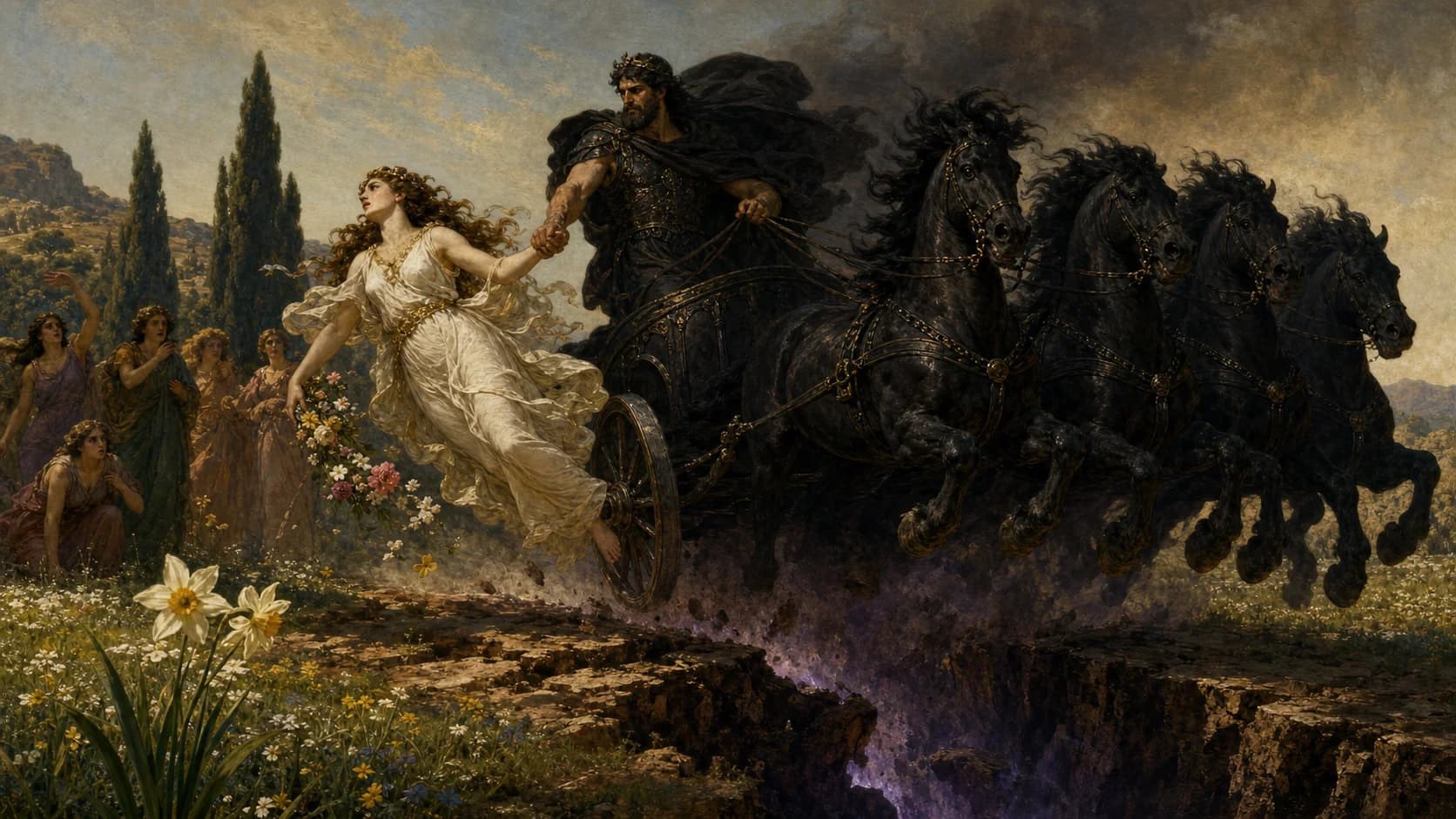
Persephone was the daughter of Zeus and Demeter and the queen of the underworld in Greek mythology. Hades abducted her with Zeus's permission, and because she ate pomegranate seed in his realm she had to spend part of every year below the earth. Her yearly return to her mother was tied to the growth of the crops, and her story was the sacred core of the Eleusinian Mysteries.

Persephone
Greek pantheon
Domain: Queen of the underworld, spring growth, grain, the Eleusinian Mysteries
Persephone quick facts
| Fact | Detail |
|---|---|
| Other names | Kore ("the Maiden"); Proserpina in Rome |
| Parents | Zeus and Demeter |
| Husband | Hades, her father's brother |
| Realm | The underworld, as its queen; the upper world for part of each year |
| Symbols | Pomegranate, torch, sheaf of grain, narcissus (the flower of her abduction) |
| Cult center | Eleusis, near Athens, with Demeter |
| Core source | The Homeric Hymn to Demeter |
Who was Persephone?
Hesiod's Theogony gives the short version: Demeter bore Zeus a daughter, Persephone, whom Hades carried off, and Zeus gave her to him. That one sentence contains the whole problem of the myth — a father arranging a marriage without asking the mother or the bride.
The Greeks often called her simply Kore, "the Maiden," especially when she was worshipped together with Demeter at Eleusis. As queen of the dead she was a figure of real power. Homer calls her "dread Persephone," and in the Odyssey she is the one who sends the spirits of famous women to meet Odysseus at the edge of the underworld.
How was Persephone taken to the underworld?
The fullest account is the Homeric Hymn to Demeter, an anonymous poem from around the seventh or sixth century BC.
- The trap. Persephone was gathering flowers in a meadow with the daughters of Ocean. Gaia, by Zeus's plan, made a wondrous narcissus grow to lure her.
- The abduction. When she reached for it, the earth opened and Hades rode out in a golden chariot and seized her. She cried out to her father, but only Hecate and Helios, the sun, heard her.
- The search. Demeter wandered for nine days with torches in her hands, refusing ambrosia and nectar. On the tenth, Hecate joined her, and Helios told them the truth: Zeus had given the girl to Hades.
- Eleusis. Grieving, Demeter disguised herself as an old woman and became nurse to the infant prince Demophon at Eleusis. She was secretly making him immortal by placing him in the fire at night — until his mother, Metaneira, saw and screamed. Demeter revealed herself and demanded a temple.
- The famine. Shut away in that temple, Demeter made the seed stay hidden in the ground. Nothing grew. Humanity faced starvation, and the gods lost their sacrifices.
- The return. Zeus sent god after god to plead with her; she refused them all. Finally he sent Hermes to bring Persephone back, and Hades agreed — after first slipping her a pomegranate seed to eat.
Zeus's role runs through the whole story; for more on him, read Who Was Zeus?
How many pomegranate seeds did Persephone eat?
There is no single answer — the number changes by source:
| Source | Seeds eaten | Time in the underworld |
|---|---|---|
| Homeric Hymn to Demeter | One pomegranate seed, given by Hades | One third of the year |
| Apollodorus, Library | One seed, given by Hades | One third of the year |
| Ovid, Metamorphoses (Book 5) | Seven, picked by Proserpina herself in Dis's garden | Half the year |
| Ovid, Fasti (Book 4) | Three | Half the year (six months) |
The details shift in revealing ways. In the hymn, Hades gives her the seed secretly, and she later tells her mother he made her eat it. In Ovid's Metamorphoses, she eats the seeds on her own while wandering in a garden, and a witness gives her away: Ascalaphus, whom she turns into a screech owl. In Apollodorus, the same Ascalaphus testifies against her, and it is Demeter who punishes him by pinning him under a heavy rock.
The popular claim that "six seeds equal six months" is not found in these ancient sources.
Why does Persephone's story explain the seasons?
In the hymn, eating food in the underworld binds Persephone to it. The compromise: she spends part of the year with Hades and the rest with her mother and the other gods. When she returns, Demeter lets the fields grow again, and the hymn times Persephone's rise to the season when the earth is full of spring flowers.
Later retellings made the link into a neat formula: Demeter's grief is winter, Persephone's return is spring. The hymn clearly ties her return to spring, but the tidy "her absence causes winter" equation is a simplification layered on by later readers.
Was Persephone happy with Hades?

The Homeric Hymn does not pretend it was a love match. Persephone is taken against her will, cries out for help, and tells Demeter she was forced to eat the seed. Hades, for his part, argues that he is no unworthy husband: he is Zeus's own brother, and as his wife she will rule over everything that lives and moves.
Elsewhere, though, the queen acts with authority and even mercy:
- Orpheus. Moved by his song, Hades and Persephone allow Eurydice to follow Orpheus back to life (Virgil's Georgics, Ovid's Metamorphoses).
- Adonis. Aphrodite hid the baby Adonis in a chest and gave it to Persephone, who refused to hand him back. In Apollodorus, Zeus settles the quarrel by splitting his year between the two goddesses.
- Theseus and Pirithous. The two heroes went down to carry her off as Pirithous's bride. In Apollodorus, they were trapped on the Chair of Forgetfulness; Heracles later freed Theseus, but Pirithous stayed.
For how her husband compares with Egypt's ruler of the dead, see Hades vs Osiris.
Did Persephone have children?
The Homeric Hymn gives her none. Later Orphic tradition does: it makes her, by Zeus, the mother of Zagreus, a god later identified with Dionysus, and an Orphic hymn calls the ghostly goddess Melinoë her daughter. These are specialized religious texts, not mainstream myth, and they vary among themselves.
In the sources
- Hesiod, Theogony — Persephone's parentage and the bare fact that Hades took her with Zeus's consent.
- Homer, Iliad and Odyssey — "dread Persephone" as queen of the dead, invoked in curses and ruling the shades.
- Homeric Hymn to Demeter — the complete abduction, Demeter's search, Eleusis, the famine, the seed and the founding of the Mysteries.
- Apollodorus, Library — a summary of the abduction, Ascalaphus, Adonis, and Theseus and Pirithous.
- Ovid, Metamorphoses (Book 5) and Fasti (Book 4) — the Roman Proserpina, taken near Henna in Sicily.
Contradictions to know:
- Where was she taken? The hymn names the plain of Nysa; Ovid sets the abduction in Sicily, near Henna.
- Who caused it? In the hymn, it is Zeus's plan. In the Metamorphoses, Venus has Cupid shoot Dis (Hades) with an arrow so that he falls in love.
- How much of the year? One third in the hymn and Apollodorus; half in Ovid.
- How many seeds? One, seven or three, as the table above shows.
- Who punished Ascalaphus? Demeter in Apollodorus; Proserpina herself in Ovid.
In popular culture
- Hades (2020) and Hades II. In Supergiant's games, Persephone is the mother of the hero Zagreus and has left the underworld; Hades II stars her daughter Melinoë. Both children come from Orphic tradition, not the Homeric Hymn.
- Hadestown. Anaïs Mitchell's Tony-winning musical makes Persephone a wry, wine-loving queen whose absence brings winter — a modern take on Demeter's grief.
- Lore Olympus. Rachel Smythe's webcomic recasts the story as a modern romance. The ancient hymn is an abduction; the webcomic is a love story.
- Percy Jackson. Rosario Dawson plays Persephone in the 2010 film The Lightning Thief, where she secretly helps Percy against her husband — an invented plot.
Frequently asked questions
Who was Persephone in Greek mythology?
Persephone was the daughter of Zeus and Demeter and the wife of Hades, which made her queen of the underworld. She spent part of each year below the earth and part with her mother.
How many pomegranate seeds did Persephone eat?
One seed in the Homeric Hymn to Demeter and Apollodorus, seven in Ovid's Metamorphoses, and three in Ovid's Fasti.
Why did Persephone have to stay in the underworld?
Because she ate food in the underworld, she could not leave it for good. Zeus arranged for her to spend part of every year with Hades.
How long does Persephone stay in the underworld?
One third of the year in the Homeric Hymn to Demeter and in Apollodorus. In Ovid's versions it is half the year.
Did Persephone love Hades?
The Homeric Hymn presents her marriage as an abduction she resisted. Later myths show her ruling beside Hades as a powerful queen, but no ancient source tells it as a romance.
What is Persephone the goddess of?
She is queen of the underworld and goddess of spring growth and the grain, worshipped with Demeter in the Eleusinian Mysteries.
What is Persephone's Roman name?
The Romans called her Proserpina.
Keep exploring
Persephone links the Olympians to the land of the dead. Trace her family in the Greek gods family tree, meet another woman remade by later poets in Medusa: Monster or Victim?, and go back to where the family's trouble began with Cronus, the Titan who ate his children. The dead she ruled reached her past Charon and Cerberus. Curious where you'd fit on Olympus? Take the which Greek god are you quiz.