Quick summary
- Greek goddess of grain, the harvest and fertile soil; daughter of Cronus and Rhea. Roman equivalent: Ceres.
- When Hades carried off her daughter Persephone, she let every crop on earth fail until Zeus gave in.
- Her grief and her stay at Eleusis became the sacred story of the Eleusinian Mysteries.
- Persephone stays below one third of the year in the Homeric Hymn and Apollodorus, but half the year in Ovid.
Demeter is the Greek goddess of grain, the harvest and the fertile soil, and one of the twelve Olympians. A daughter of the Titans Cronus and Rhea, she is best known as the mother of Persephone: when Hades carried her daughter off, Demeter let every crop on earth fail until Zeus gave in. Her grief and her bargain became the sacred story of the Eleusinian Mysteries, the most famous secret rites of the ancient world.
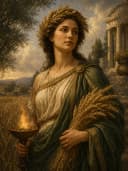
Demeter
Greek pantheon
Domain: Grain, harvest, agriculture, fertile soil, sacred law, the Mysteries
Demeter quick facts
| Fact | Detail |
|---|---|
| Greek name | Dēmētēr; also called Deo in the Homeric Hymn to Demeter |
| Roman equivalent | Ceres |
| Parents | Cronus and Rhea (Hesiod's Theogony) |
| Siblings | Hestia, Hera, Hades, Poseidon, Zeus |
| Children | Persephone by Zeus; Plutus, god of wealth, by the mortal Iasion (Theogony); the horse Arion and a daughter by Poseidon (Pausanias, in Arcadia) |
| Symbols | Ears of wheat or barley, the sheaf, the torch, the poppy |
| Sacred animal | The pig, sacrificed in her rites |
| Epithets | Thesmophoros ("bringer of law"), Chloe ("green shoot"), Melaina ("the Black") at Phigalia |
| Main cult sites | Eleusis near Athens; the Thesmophoria festival across the Greek world; Arcadia; Sicily |
Like her brothers and sisters, Demeter was swallowed at birth by Cronus and only came back into the world when Zeus forced their father to vomit them up.
Why did Demeter starve the world?
To force the gods to return her daughter. The fullest story is the Homeric Hymn to Demeter. Persephone is picking flowers when the earth opens and Hades drives out in his chariot and takes her. Zeus had promised her to him without telling her mother.
Demeter searches for nine days with a torch in each hand, refusing food, drink and bathing. On the tenth day Hecate meets her, and together they ask Helios, the sun, who sees everything. He tells her the truth and advises her to accept a son-in-law of such rank.
She does not. Demeter abandons Olympus, and after her time at Eleusis she shuts herself in her new temple and keeps the seed hidden in the soil. For a full year nothing sprouts. Oxen drag ploughs through empty fields and humanity is close to starving, which also means the gods are losing their sacrifices. Zeus sends Iris, then every god in turn, with gifts. Demeter refuses them all. Only when Hermes brings Persephone back up does she relent, and even then the girl has eaten a pomegranate seed below and must return to Hades for part of each year.
The point is easy to miss: this is a rare myth in which an Olympian beats Zeus by going on strike. Demeter wins without a weapon, because without her the whole system of offerings that feeds the gods collapses.
What happened when Demeter came to Eleusis?
Disguised as an old woman, Demeter sat down by a well at Eleusis, a town west of Athens. The daughters of the local king Celeus found her and brought her home to nurse their baby brother, Demophon.
Two small scenes in the hymn became part of later ritual:
- Iambe's jokes. The grieving goddess will not eat or smile until a servant woman, Iambe, makes her laugh with crude jests.
- The kykeon. She refuses red wine and asks instead for a drink of barley meal, water and pennyroyal, a kind of mint. Initiates at Eleusis later drank the same kind of mixture.
At night Demeter secretly laid the baby in the fire to burn away his mortality. When his mother Metaneira caught her and screamed, the goddess dropped the child, threw off her disguise and ordered the people of Eleusis to build her a temple. At the end of the story she teaches her rites to the local leaders, including Triptolemus and Eumolpus. The hymn says those who have seen the rites are blessed, while the uninitiated have no such share after death.
What are Demeter's powers?
Demeter's power is the food supply itself, and the ancient sources show it working in both directions.
- Growth and harvest. She makes grain rise and ripen. In Hesiod's Works and Days, the farmer prays to her and to Zeus of the earth for a heavy crop.
- Famine. She can stop every seed on earth from sprouting, as the hymn shows.
- Teaching agriculture. In Apollodorus' Library, she gives Triptolemus a chariot drawn by winged serpents and wheat to sow across the inhabited world.
- Punishment through hunger. In Callimachus' Hymn to Demeter and Ovid's Metamorphoses, Erysichthon cuts down her sacred grove and she curses him with a hunger nothing can fill; in Ovid, he finally devours his own body.
- Immortality. Her fire could have made Demophon deathless, and her Mysteries promised initiates a better lot in the afterlife.
- Law and settled life. As Thesmophoros, she was honored at the women-only Thesmophoria as the goddess of settled, ordered life that came with farming.
- Shape-shifting. In Arcadia, Pausanias says she turned into a mare to escape Poseidon, who became a stallion and caught her anyway.
For a side-by-side view of what each Olympian controls, see our guide to the Greek gods and their powers.
Who were Demeter's children?
Persephone is by far the most important. Hesiod's Theogony adds Plutus, "Wealth," whom she conceived with the mortal hero Iasion in a thrice-ploughed field on Crete. In the Odyssey, the nymph Calypso recalls the same affair and adds that Zeus killed Iasion with a thunderbolt once he found out.
The strangest children come from Arcadia. Pausanias reports local stories in which Poseidon pursued Demeter while she grieved. She bore him the wondrous horse Arion and a daughter whose true name was told only to initiates and was known in public simply as Despoina, "the Mistress." At Phigalia, the angry, mourning goddess was worshipped as Black Demeter. To place all of these lines on one chart, open the Greek gods family tree.
What is the difference between Demeter and Dionysus?
The two were often paired. In Euripides' Bacchae, the prophet Tiresias tells the king of Thebes that humanity has two great gifts: Demeter, who gives dry food from the earth, and Dionysus, who gives wine to ease human suffering. Bread and wine, the field and the vineyard.
The two also share the theme of a return from death. Persephone comes up from the underworld every year, and Dionysus, in Apollodorus, goes down to bring up his mother Semele. Both gods offered initiates something beyond ordinary worship.
Is Demeter the same as Ceres?
The Romans identified their grain goddess Ceres with Demeter and gave her Demeter's myths. In Ovid's Metamorphoses and Fasti, the abduction story is told about Ceres and Proserpina. The English word "cereal" comes from Ceres.
In the sources
- Hesiod, Theogony — her birth, her swallowing by Cronus, Persephone as her daughter by Zeus, and Plutus by Iasion.
- Hesiod, Works and Days — Demeter as the goddess the farmer prays to at ploughing time.
- The Homeric Hymn to Demeter — the abduction, the search, Eleusis, the famine and the founding of the Mysteries.
- Homer, Odyssey — Iasion's fate, in Calypso's speech.
- Euripides, Bacchae — Demeter and Dionysus as humanity's two great gifts.
- Callimachus, Hymn to Demeter — the Erysichthon story.
- Apollodorus, Library — Triptolemus and the spread of wheat.
- Ovid, Metamorphoses and Fasti — the Roman retelling with Ceres and Proserpina.
- Pausanias, Description of Greece — Arcadian cults, the mare story and Black Demeter.
Where the sources disagree:
- Where the abduction happened. The hymn places it on the Nysian plain; Ovid sets it in Sicily near the town of Henna, a site Sicilian cult claimed as its own.
- Who tells Demeter the truth. In the hymn it is Helios. In Ovid's Metamorphoses, the nymph Arethusa, who flows underground through the world below, has seen Proserpina there and reports it.
- Which baby she nursed. In the hymn the child placed in the fire is Demophon, and Triptolemus is a grown Eleusinian leader. In Ovid's Fasti, the baby in the fire is Triptolemus himself. Apollodorus keeps Demophon but says the child was burned to death.
- How long Persephone stays below. One third of the year in the hymn and Apollodorus; half the year in Ovid.
In popular culture
- Lore Olympus. Rachel Smythe's webcomic makes Demeter a fiercely protective mother who keeps Persephone sheltered in the mortal world. The overprotective mood is close to the hymn; the modern romance built around it is not.
- Percy Jackson and the Olympians. In Rick Riordan's books, Demeter's children have their own cabin at Camp Half-Blood.
- Hades and Hades II (Supergiant Games). Demeter is one of the Olympians who grant boons, and her powers are built around frost and chill, a game-design reading of the winter she brings while grieving. The ancient hymn describes a failed harvest, not snow.
Frequently asked questions
Who is Demeter in Greek mythology?
Demeter is the Greek goddess of grain, agriculture and the harvest, and one of the twelve Olympians. She is the daughter of Cronus and Rhea and the mother of Persephone.
What is Demeter the goddess of?
She rules over grain, harvests and the fertility of farmland. She was also worshipped as a lawgiver and as the goddess of the Eleusinian Mysteries.
Why did Demeter cause a famine?
In the Homeric Hymn to Demeter she stopped all seeds from growing after Hades took Persephone with Zeus's approval. She ended the famine only when her daughter was returned.
What are Demeter's symbols?
Her main symbols are ears of wheat or barley, the torch she carried while searching for Persephone, and the poppy. The pig was her sacred sacrificial animal.
Who is Demeter's Roman equivalent?
The Romans identified her with Ceres, which is where the English word cereal comes from.
Who are Demeter's children?
Her best-known child is Persephone, fathered by Zeus. Hesiod adds Plutus, god of wealth, and Arcadian tradition gives her the horse Arion and the goddess Despoina by Poseidon.
Keep exploring
Demeter's story is half of a mother-daughter pair, so read the other half in Persephone in Greek mythology, then meet the brother who started it all in Hades in Greek mythology. For the god she was most often paired with, read Dionysus, and see how she compares with the rest of Olympus in Greek gods and their powers. Think you know the Olympians? Take the Greek mythology quiz.