Quick summary
- Greek god of wine, the vine, festivity, theater and ecstatic madness. Roman equivalent: Bacchus.
- Son of Zeus and the mortal Semele, the only Olympian with a human mother; twice-born, the second time from Zeus's thigh.
- In Euripides' Bacchae he drives the maenads to tear apart King Pentheus, who refused to accept him as a god.
- Sources disagree on Ariadne: Hesiod says Zeus made her immortal as his wife; in the Odyssey, Artemis kills her.
Dionysus is the Greek god of wine, the vine, festivity, theater and ecstatic madness. He is the son of Zeus and the mortal princess Semele, and the only Olympian with a human mother. Born twice, snatched from Semele's womb and then delivered from Zeus's thigh, he wanders the world with his wild female followers, the maenads, rewarding those who accept him and driving those who refuse him into madness.
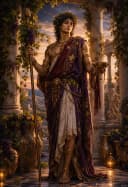
Dionysus
Greek pantheon
Domain: Wine, the vine, revelry, theater, ecstasy, madness, liberation
Dionysus quick facts
| Fact | Detail |
|---|---|
| Greek name | Dionysos; also Bakchos (Bacchus), Bromios ("the roaring one"), Lysios ("the releaser") |
| Roman equivalent | Bacchus, identified with the Italian god Liber |
| Parents | Zeus and Semele, daughter of Cadmus of Thebes (Hesiod, Euripides); Orphic tradition adds an earlier birth from Zeus and Persephone |
| Wife | Ariadne, princess of Crete |
| Followers | Maenads (bacchants), satyrs, and his old tutor Silenus |
| Symbols | The thyrsus (a fennel staff topped with a pine cone), ivy, the grapevine, the wine cup, the theater mask |
| Sacred animals | Panther or leopard, bull, goat, snake |
| Main cult sites | Thebes; Athens, home of the Theater of Dionysus; Delphi, where he was worshipped beside Apollo; the island of Naxos |
The name is old. "Di-wo-nu-so" is already written on clay tablets in the Mycenaean Linear B script from Pylos, centuries before Homer, which undercuts the once-popular idea that he was a late foreign arrival.
How was Dionysus born twice?
Through a disaster arranged by Hera. Zeus loved Semele, a princess of Thebes. In Apollodorus' Library and Ovid's Metamorphoses, the jealous Hera, disguised in Ovid as Semele's old nurse Beroe, persuades her to ask her lover to appear in his full glory, as he comes to Hera. Zeus has already sworn to grant whatever Semele asks, so he has no way out. He arrives with thunder and lightning, and Semele dies.
Zeus snatched the unborn baby from the fire and sewed him into his own thigh until he was ready to be born. That is why Dionysus is "twice-born." Euripides' Bacchae opens with Dionysus himself standing by the still-smoking ruins of his mother's house in Thebes.
Hermes then carried the infant to safety. In Apollodorus, he first goes to Semele's sister Ino, who raises him disguised as a girl; when Hera drives Ino and her husband mad, Zeus turns the baby into a young goat and Hermes delivers him to the nymphs of Nysa. Later, Dionysus went down to the underworld, brought Semele back, and took her up to heaven as a goddess.
What are Dionysus's powers?
Dionysus breaks boundaries, between human and animal, sane and mad, life and death. His powers in the ancient sources:
- Wine and the vine. He discovered wine and gave it to humanity. In the Bacchae, the prophet Tiresias calls it the gift that brings sleep and forgetfulness of grief.
- Madness. He can send mania, a divine frenzy, on anyone. His enemies tear apart animals and even their own children while under it.
- Miracles of nature. In the Bacchae, the maenads strike rocks with their staffs and water springs up; wine, milk and honey flow from the ground.
- Transformation. In the Homeric Hymn to Dionysus (Hymn 7), he turns into a lion, and in other stories he appears as a bull.
- Release. As Lysios, he frees: chains fall off him and his followers, and prison doors open by themselves.
- Passage between worlds. He brings his mother back from the dead, one of very few successful journeys of that kind in Greek myth.
To compare him with the other Olympians, see our guide to Greek gods and their powers.
What happened to Pentheus?
He became the most famous victim of a god who would not be denied. Euripides' Bacchae, first staged after the poet's death in the late fifth century BC, tells the story.
Dionysus returns to Thebes from Asia, but his own family refuses to believe he is divine. His cousin Pentheus, the young king, arrests his followers and mocks the stranger, who is the god in disguise. Dionysus drives the women of the city, including Pentheus's mother Agave, onto Mount Cithaeron in a frenzy. Then he talks Pentheus into dressing as a woman to spy on them. The maenads find him in a tree and tear him apart, and Agave carries his head back to the city, believing it is a lion's. Only when the madness lifts does she understand what she has done.
Why did Dionysus turn pirates into dolphins?
Because they kidnapped him. In the Homeric Hymn to Dionysus, Tyrrhenian pirates spot a handsome young man on the shore, take him for a prince worth ransoming, and drag him aboard. Their ropes will not stay tied on him. Only the helmsman realizes he is a god and begs the crew to let him go.
They refuse. Wine begins to stream across the deck, a vine spreads along the sail, ivy wraps the mast, and the young man becomes a roaring lion, with a bear rising beside him. The terrified sailors leap overboard and are turned into dolphins. The helmsman is spared. Ovid retells the story in the Metamorphoses, where the faithful helmsman is named Acoetes and tells the tale to Pentheus.
Who was Dionysus's wife?
Ariadne, the Cretan princess who helped Theseus escape the Labyrinth. Theseus left her on the island of Naxos (called Dia in older poetry), and Dionysus found and married her. Hesiod's Theogony says Zeus made her immortal and ageless for her husband. In Ovid, Dionysus sets her crown in the sky as a constellation, the Northern Crown.
The Odyssey tells a much darker version, covered below.
Who brought Hephaestus back to Olympus?
Dionysus did. After Hephaestus trapped Hera in a golden throne and refused to return, Dionysus got him drunk and led him home on a donkey or mule with a crowd of satyrs. The scene, the Return of Hephaestus, was a favorite of Athenian vase painters. It is one of the few myths where Dionysus solves a problem for the Olympians instead of fighting for his place among them.
Is Dionysus one of the twelve Olympians?
Yes, in most lists, including the gods shown on the east frieze of the Parthenon. The widely repeated claim that Hestia gave up her seat on Olympus to make room for him is not found in any ancient text; it is a modern retelling.
In the sources
- Homer, Iliad — the king Lycurgus chases the young god's nurses; Dionysus escapes into the sea (Book 6).
- Homer, Odyssey — the death of Ariadne (Book 11).
- Hesiod, Theogony — his birth from Semele and his marriage to Ariadne.
- The Homeric Hymns — Hymn 1 on his birthplace and Hymn 7 on the pirates.
- Euripides, Bacchae — his return to Thebes and the death of Pentheus.
- Aristophanes, Frogs — a comic Dionysus goes down to Hades to bring back a dead playwright.
- Herodotus, Histories — identifies Dionysus with the Egyptian god Osiris.
- Apollodorus, Library — Semele, Ino, Lycurgus and the rescue of Semele from Hades.
- Ovid, Metamorphoses — Semele, the pirates, Pentheus and King Midas's golden touch.
- Nonnus, Dionysiaca — a late, enormous epic about his campaign to India.
Where the sources disagree:
- What happened to Ariadne? Hesiod says Dionysus married her and Zeus made her immortal. In the Odyssey, Artemis kills her on the island of Dia on the testimony of Dionysus, so in this version the god's testimony leads to her death; the poem never explains why.
- How was Lycurgus punished? In the Iliad, Zeus blinds him and he dies soon after. In Apollodorus, Dionysus drives him mad, he hacks his own son to death thinking he is pruning a vine, and his people have him torn apart by horses.
- Where was Dionysus born? The first Homeric Hymn to Dionysus lists rival claims, including Naxos, Icarus and Thebes, rejects them all, and puts his birth on a distant mountain called Nysa.
- One mother or two? Hesiod and Euripides know only Semele. Orphic tradition, preserved in late writers, adds an earlier Dionysus born to Persephone, torn apart by the Titans and reborn.
In popular culture
- Percy Jackson and the Olympians. In Rick Riordan's books, Dionysus is "Mr. D," the grumpy director of Camp Half-Blood, banned from wine by Zeus and stuck drinking Diet Coke. Jason Mantzoukas plays him in the Disney+ series. The sulky, bored god is invented; the idea that Dionysus punishes people who disrespect him is not.
- Kaos (Netflix, 2024). Dionysus, played by Nabhaan Rizwan, is Zeus's party-loving son. The ancient Dionysus is far more dangerous than a party prince, and his bond with Zeus is physical: Zeus literally carries him to term.
- Hades (Supergiant Games, 2020). Dionysus grants boons that inflict a "Hangover" effect. The game makes him a laid-back party host, leaving out the terrifying side seen in the Bacchae.
Frequently asked questions
Who is Dionysus in Greek mythology?
Dionysus is the Greek god of wine, the vine, festivity, theater and religious ecstasy. He is the son of Zeus and the mortal Semele, and one of the twelve Olympians.
Why is Dionysus called twice-born?
His mother Semele died while pregnant, burned by Zeus's true form. Zeus sewed the unborn child into his thigh and Dionysus was born a second time from his father.
What is Dionysus the god of?
He rules over wine, grapes, parties, theater, madness and release from everyday limits. The great drama festivals of Athens were held in his honor.
Who is Dionysus's wife?
His wife is Ariadne, the Cretan princess abandoned by Theseus on Naxos. Hesiod says Zeus made her immortal for Dionysus.
What is Dionysus's Roman name?
The Romans called him Bacchus, a name the Greeks also used, and identified him with their own god Liber.
What are the symbols of Dionysus?
His main symbols are the thyrsus, ivy, the grapevine, the wine cup and the theater mask. His animals include the panther, the bull and the goat.
Who are the maenads?
The maenads, also called bacchants, are the women who follow Dionysus in ecstatic dance on the mountains. In Euripides' Bacchae they tear apart King Pentheus.
Keep exploring
Dionysus links the vineyard to the grain field and the forge. Read about the goddess he was most often paired with in Demeter in Greek mythology, the god he brought home in Hephaestus, and his half-brother in Apollo. See all the Olympians side by side in Greek gods and their powers, or find out which Greek god you are.