Quick summary
- Greek goddess of the hearth, the fire of every home and city; first child of Cronus and Rhea. Roman equivalent: Vesta.
- Courted by Poseidon and Apollo, she swore on the head of Zeus to remain a virgin forever.
- Wine was poured to her first and last at every feast, and she held a share of honor in all the temples of the gods.
- No ancient source says she gave up her Olympian throne to Dionysus; that story is a modern retelling.
Hestia was the Greek goddess of the hearth, the fire at the center of every home and every city. She was the first child of the Titans Cronus and Rhea, sister of Zeus, Poseidon, Hades, Hera and Demeter, and she chose to stay a virgin forever. Her name is simply the Greek word for hearth. She has almost no adventures, yet the Homeric Hymn to Aphrodite says she has a share of honor in all the temples of the gods and is the most revered of goddesses among mortals.
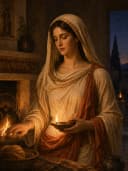
Hestia
Greek pantheon
Domain: Hearth, home, sacred fire, sacrifice, the city's common hearth
Hestia quick facts
| Fact | Detail |
|---|---|
| Greek name | Hestia (the word means hearth) |
| Roman equivalent | Vesta |
| Parents | Cronus and Rhea (Titans) |
| Siblings | Demeter, Hera, Hades, Poseidon, Zeus |
| Birth order | First of Rhea's children in Hesiod's Theogony; both first and youngest in the Homeric Hymn to Aphrodite |
| Suitors | Poseidon and Apollo, both refused (Homeric Hymn to Aphrodite) |
| Status | Sworn virgin, by an oath taken on the head of Zeus |
| Symbols | The hearth and its fire |
| Cult | The hearth of every house and the prytaneion, the common hearth of each Greek city |
| Honors | The richest portion of offerings (Homeric Hymn to Aphrodite); wine poured to her first and last at feasts (Homeric Hymn 29) |
Who was Hestia in Greek mythology?
In Hesiod's Theogony, Rhea bears Cronus six children: Hestia, Demeter, Hera, Hades, Poseidon and Zeus. Hestia comes first. Cronus has been warned that a son will overthrow him, so he swallows each child as it is born, until Rhea saves Zeus by giving her husband a stone wrapped in swaddling clothes. When Cronus is forced to bring them back up, Hestia returns with the rest, and the siblings go on to defeat the Titans. The full story of that war is in Who Was Zeus?
After that, she almost disappears from the stories. Hestia does not fight in the Iliad, travel in the Odyssey or take lovers. Her place is inside, at the fire. The Greeks prayed to her at home, poured wine to her at meals, and kept her flame burning in the town hall of each city, the prytaneion, where honored guests were fed at public expense.
What are Hestia's powers?
Hestia has no thunderbolt or trident. Her power is the fire that makes a house a home and a city a community, and the sources describe it in terms of honor and priority rather than force:
- The hearth fire. She is the hearth itself as much as its goddess. Wherever a household cooked, sacrificed and gathered, she was present.
- The first and last share. Homeric Hymn 29 says that without her mortals hold no feast, because at every banquet wine is poured to Hestia first and last.
- A place in every temple. The Homeric Hymn to Aphrodite says Zeus gave her a seat in the middle of the house, the richest portion of each offering, and a share of honor in all the temples of the gods.
- The shared fire of the city. At Olympia, Pausanias reports, the Eleans sacrificed to Hestia first and to Olympian Zeus second, and the hearth in their prytaneion held a fire that burned day and night. In the Athenian prytaneion he saw statues of Peace and of Hestia.
- Immunity to desire. The Homeric Hymn to Aphrodite names her, with Athena and Artemis, as one of the only three goddesses whose minds Aphrodite could not bend.
To compare her role with the other Olympians, see Greek gods and their powers.
Why is Hestia called the oldest and the youngest?
The Homeric Hymn to Aphrodite calls Hestia the first child Cronus fathered and also the youngest, by the will of Zeus. The poem gives no explanation. The usual reading ties it to the swallowing story: Hestia was born first and swallowed first, so she spent the longest inside her father and was the last to come back out, which makes her rebirth the latest of all.
Hesiod comes close without saying it. In the Theogony, Cronus first vomits up the stone, which he had swallowed last, and then his children, but the poem does not say in what order they came out. So the riddle comes from the Hymn, and the swallowing explanation is how readers have solved it, not something an ancient poet states outright.
Who tried to marry Hestia?
Two of the most powerful gods. The Homeric Hymn to Aphrodite says that Poseidon and Apollo both courted her. She refused them both and swore a great oath, with her hand on the head of Zeus, that she would remain a maiden all her days.
Zeus accepted the oath and gave her something in place of marriage: the central seat of every house and honor among all the gods and mortals. That trade explains her whole character. Athena and Artemis are also virgin goddesses, but they act in the world, in war and on the hunt. Hestia's virginity keeps her at home, as the fixed center that everyone else comes back to.
What happened to Priapus and Hestia?
The fullest story told about her comes from Rome, where she was Vesta. In Book 6 of Ovid's Fasti, the calendar poem, Cybele invites the gods to a feast. When the party winds down, Vesta lies down to sleep, and the fertility god Priapus creeps toward her. Just as he reaches her, the donkey that carried old Silenus lets out a bray. Vesta wakes, the other guests come running, and Priapus barely escapes. Ovid says this is why donkeys were hung with garlands of bread at the Vestalia, Vesta's June festival.
Ovid tells almost the same story twice. In Book 1 of the Fasti, at a festival of Bacchus, Priapus creeps up on the sleeping nymph Lotis, and again Silenus' donkey brays and wakes her. There Ovid uses it to explain why the donkey was sacrificed to Priapus. A different ending appears in Book 9 of his Metamorphoses, where Lotis escapes Priapus by turning into the lotus tree.
Why does Hestia have so few myths?
Because myths need movement and conflict, and Hestia's whole nature is to stay still. Plato's Phaedrus puts this in one image: when Zeus drives his winged chariot across heaven, the gods follow him in eleven companies, because Hestia alone remains at home in the house of the gods.
Her worship also worked differently. She had few temples of her own, because her shrine was every hearth, and Ovid notes that Vesta's round temple in Rome held no statue of the goddess, only the living flame. A goddess who is the fire in the room is everywhere in daily religion and almost nowhere in stories. Hymns and prayers, not epics, are where she lives.
Did Dionysus replace Hestia as an Olympian?
No ancient source says so. The popular story that Hestia gave up her throne on Olympus to make room for Dionysus, to keep the peace, is a modern retelling.
What the ancient evidence shows is that the Greeks never fixed a single list of the Twelve Gods:
- Plato's Phaedrus describes Hestia staying home while the other gods ride out, so she is part of the divine household but not one of the eleven companies that follow Zeus.
- The Parthenon's east frieze shows twelve seated gods. They carry no labels, but the figures are usually identified as including Dionysus and not Hestia.
- The Roman poet Ennius listed the twelve Roman gods in two lines of verse, and Vesta is among them while Bacchus is not.
So both goddesses belong to some versions of the twelve. A dispute between them, or a polite resignation, is not in the sources.
In the sources
Hestia's main ancient sources are Hesiod's Theogony (her birth and the swallowing), the Homeric Hymn to Aphrodite (her suitors, her oath and her honors), the two short Homeric Hymns to Hestia (Hymns 24 and 29), Plato's Phaedrus, Pausanias' Description of Greece (her cult at Athens and Olympia), and Ovid's Fasti, where she appears as Vesta. Hymn 24 places her at Delphi, tending Apollo's holy house at Pytho with oil dripping from her hair. Hymn 29 calls on her together with Hermes.
The sources disagree on some key points:
- Eldest, youngest or third? Hesiod lists Hestia first among Rhea's children. The Homeric Hymn to Aphrodite makes her both the first and the youngest. Ovid's Fasti says Saturn and Ops had Juno and Ceres first and Vesta third.
- Statue or no statue? Ovid says Vesta's temple in Rome held no image of her, only fire. Pausanias saw a statue of Hestia in the prytaneion at Athens.
- One of the twelve? Plato's Phaedrus and Ennius include her, while the Parthenon frieze as usually read does not.
In popular culture
- Percy Jackson and the Olympians. In Rick Riordan's The Last Olympian, Hestia appears as a quiet girl tending the fire at Camp Half-Blood, and she tells Percy she gave up her Olympian throne to Dionysus to avoid a quarrel. That is the modern story covered above, not an ancient one. Her devotion to home and hearth is true to the Hymns.
- Hades II. Supergiant's sequel makes Hestia one of the Olympians who grant powers to the heroine, with fire-based blessings. Fire suits her, though no ancient source gives her a battle of her own.
Frequently asked questions
Who is Hestia in Greek mythology?
Hestia is the Greek goddess of the hearth and the home. In Hesiod she is the eldest child of Cronus and Rhea, sister of Zeus, and a virgin goddess who was honored at every household fire and in every city's common hearth.
What is Hestia the goddess of?
The hearth, the domestic fire, the home and the sacred fire of the city. According to the Homeric Hymns, she received the richest portion of offerings, and wine was poured to her first and last at feasts.
Is Hestia one of the 12 Olympians?
In some lists. Plato's Phaedrus and the Roman poet Ennius include her, while the twelve gods on the Parthenon frieze are usually identified as including Dionysus instead. The Greeks never fixed one list.
Did Hestia give her throne to Dionysus?
No ancient source says so. The story that she stepped aside for Dionysus is a modern retelling, repeated in books like Percy Jackson.
Why did Hestia never marry?
The Homeric Hymn to Aphrodite says Poseidon and Apollo both wanted to marry her, but she swore on the head of Zeus to remain a maiden forever. Zeus gave her the central place in every house instead.
What is Hestia's Roman name?
Vesta. Her eternal flame in Rome was tended by the Vestal Virgins, and Ovid's Fasti tells the story of Priapus and the donkey about her under that name.
Keep exploring
Hestia makes most sense among her family. Meet her father in Cronus in Greek mythology, her rejected suitors in Poseidon and Apollo, and her Roman self in Greek vs Roman gods. Trace all six children of Cronus on the Greek gods family tree, or test what you know with the Greek mythology quiz.