Quick summary
- Greek god of fire, the forge, metalworking and craftsmanship. Roman equivalent: Vulcan.
- The Iliad tells two falls from Olympus: thrown by Zeus in Book 1, and by Hera, ashamed he was born lame, in Book 18.
- He shaped Pandora from earth and water, forged the shield of Achilles and built the gods' palaces.
- In Odyssey Book 8 he caught his wife Aphrodite with Ares in a net of chains as fine as spider silk.
Hephaestus is the Greek god of fire, the forge, metalworking and craftsmanship, and the Olympian who labors at an anvil like a mortal craftsman. He built the gods' palaces, armor and treasures, made the first woman, Pandora, and forged the shield of Achilles. He is also the god the others laugh at: lame, thrown off Olympus as a child, and married to Aphrodite, who betrayed him with Ares.
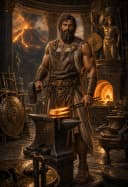
Hephaestus
Greek pantheon
Domain: Fire, the forge, metalworking, crafts, sculpture, invention
Hephaestus quick facts
| Fact | Detail |
|---|---|
| Greek name | Hēphaistos |
| Roman equivalent | Vulcan (Volcanus) |
| Parents | Zeus and Hera in Homer; Hera alone, without a father, in Hesiod's Theogony |
| Wife | Aphrodite in the Odyssey; Charis in the Iliad; Aglaea, youngest of the Graces, in the Theogony |
| Notable children | Erichthonius, an early king of Athens; Periphetes, the club-wielding bandit killed by Theseus; Cacus, in Roman myth |
| Symbols | Hammer, tongs, anvil, the forge fire, the craftsman's felt cap |
| Associated animal | The donkey he rides home to Olympus in vase paintings |
| Workshop | On Olympus in Homer; under volcanic islands near Sicily in Roman poetry |
| Main cult sites | The island of Lemnos; Athens, where his temple, the Hephaisteion, still stands above the Agora |
Why is Hephaestus lame?
The Iliad calls him lame again and again, and it tells two different stories about how he fell from Olympus. Neither one clearly says the fall caused the injury.
In Book 1, Hephaestus warns his mother Hera not to fight Zeus. He reminds her of the time he tried to defend her and Zeus grabbed him by the foot and hurled him off the threshold of heaven. He fell for a whole day and landed on Lemnos at sunset with little life left in him, and the Sintian people of the island cared for him.
In Book 18 he remembers a different fall. This time it was Hera who threw him out, because she was ashamed that her son was born lame. The sea goddesses Thetis and Eurynome caught him, and he lived hidden with them for nine years in a cave by the stream of Ocean, making brooches and jewelry.
So in Book 18 the lameness comes first and the fall follows it. Apollodorus' Library, much later, reverses the order: Zeus throws him for helping Hera, and the landing on Lemnos lames his legs. Many modern retellings follow that later version.
How did Hephaestus get revenge on Hera?
With a gift. In a story painted on Athenian vases and described by Pausanias, Hephaestus sent his mother, Hera, a beautiful golden throne. When Hera sat in it, invisible bonds held her fast, and no other god could set her free. Plato's Republic lists Hera's binding by her son among the stories poets should not tell children.
Only Hephaestus could release her, and he refused to come back. The god who finally fetched him was Dionysus, who got him drunk and led him up to Olympus on a donkey or mule, followed by satyrs. The scene, known as the Return of Hephaestus, appears on the famous François Vase and many other painted pots.
What are Hephaestus's powers?
Hephaestus does not throw lightning or raise storms. His power is making things, and in Homer his workshop produces wonders no mortal could build.
- Master craftsmanship. He built the bronze palaces of the gods on Olympus, the scepter Agamemnon inherits in the Iliad, and the aegis Zeus lends to Apollo.
- Fire as a weapon. In Iliad Book 21, when the river Scamander tries to drown Achilles, Hephaestus attacks it with fire until the water boils and the river god begs for mercy.
- Living machines. In Iliad Book 18 he has self-moving tripods on golden wheels that roll to the gods' assembly and back, and golden handmaidens who can think, speak and help him walk.
- Binding. His chains hold what nothing else can: Hera on her throne, Ares and Aphrodite in their bed, and Prometheus on his rock.
- Creating life from clay. At Zeus's command he shaped Pandora out of earth and water.
For how his skills compare with the other Olympians, see the Greek gods and their powers.
Who did Hephaestus make out of clay?
The first woman. In Hesiod's Works and Days, Zeus decides to punish humanity for receiving the fire that Prometheus stole. He orders Hephaestus to mix earth with water, give it a human voice and strength, and shape it like a lovely young goddess. Athena teaches her weaving, Aphrodite gives her charm and longing, and Hermes gives her a deceitful mind and the name Pandora. In the Theogony Athena sets on her head a golden crown that Hephaestus worked with his own hands.
The irony is sharp. The god of fire builds the "price" humans pay for having fire.
Why did Aphrodite cheat on Hephaestus?
The classic telling is in Odyssey Book 8, a song performed by the bard Demodocus. Aphrodite, Hephaestus's wife, sleeps with Ares in her husband's own house. Helios, who sees everything, tells Hephaestus.
Instead of fighting, Hephaestus goes to his forge and makes chains as fine as spider silk, invisible even to gods, and fixes them around the bed. He pretends to leave for Lemnos. When the lovers lie down, the net drops and they cannot move. Hephaestus calls all the gods to look; the goddesses stay home out of modesty, and the gods break into laughter. Hermes jokes that he would happily trade places with Ares, chains and all. Poseidon finally guarantees that Ares will pay a fine, and the pair are released.
The poem does not explain the affair beyond contrast: Ares is handsome and quick, Hephaestus lame. For the other side of the triangle, read Aphrodite and Ares.
Did Hephaestus split open Zeus's head?
In some versions, yes. Pindar's seventh Olympian Ode says that through the skill of Hephaestus, with a bronze axe, Athena leaped out of her father's head with a war cry. Apollodorus says it was Prometheus or, as others claim, Hephaestus who struck the blow. Hesiod's Theogony tells the birth without naming any helper. Read the rest in Athena in Greek mythology.
Is Hephaestus the same as Vulcan?
The Romans identified their fire god Vulcan with Hephaestus and gave him his myths. Roman poets moved his forge under volcanic ground. In Virgil's Aeneid Book 8, Vulcan's workshop lies in caves beneath an island near Sicily, where the Cyclopes hammer out thunderbolts for Jupiter and armor for Aeneas. The English word "volcano" comes from his name.
In the sources
- Homer, Iliad — both falls from Olympus (Books 1 and 18), the shield of Achilles and the golden handmaidens (Book 18), the fight with the river (Book 21).
- Homer, Odyssey — the net that traps Ares and Aphrodite (Book 8).
- Hesiod, Theogony and Works and Days — his birth from Hera alone, his marriage to Aglaea, and the making of Pandora.
- Pindar, Olympian 7 — the axe at Athena's birth.
- Aeschylus, Prometheus Bound — a reluctant Hephaestus chains Prometheus to the rock on Zeus's orders.
- Plato, Republic — Hera's binding and Hephaestus's fall cited as examples of unfit stories.
- Apollodorus, Library — his fall, the birth of Erichthonius, and Periphetes.
- Pausanias, Description of Greece — the golden throne and the Return.
- Virgil, Aeneid — Vulcan's forge and the arms of Aeneas.
Where the sources disagree:
- Who is his father? Homer makes him the son of Zeus and Hera. Hesiod says Hera bore him alone, in anger at her husband, in a passage that comes right after Athena's birth from Zeus's head.
- Who threw him off Olympus? Zeus in Iliad Book 1; Hera in Iliad Book 18. Even inside one poem, the story changes.
- Who is his wife? Aphrodite in the Odyssey, but Charis in Iliad Book 18, where she welcomes Thetis to his house. Hesiod names Aglaea.
- Who makes the thunderbolts? In Hesiod the Cyclopes give Zeus thunder and lightning on their own; in Virgil they work in Vulcan's forge.
In popular culture
- Percy Jackson and the Olympians. In Rick Riordan's The Lightning Thief, Percy and Annabeth stumble into an abandoned water park ride that Hephaestus rigged to trap Ares and Aphrodite, a modern echo of the net in the Odyssey. In The Battle of the Labyrinth, Percy meets the god in person, and his demigod children, including Leo Valdez in The Heroes of Olympus, are the camp's builders.
- God of War III (2010). Hephaestus is a bitter, broken smith who treats Pandora as his daughter and dies at Kratos's hands. Hesiod has him shape Pandora, not raise her, and no ancient myth kills him.
- Hades II (Supergiant Games). Hephaestus is one of the Olympians who grant boons, and his powers are built around explosive blasts, a fair game reading of the forge god.
Frequently asked questions
Who is Hephaestus in Greek mythology?
Hephaestus is the Greek god of fire, blacksmiths, metalworking and craftsmanship. He built the palaces, weapons and treasures of the Olympian gods.
Why was Hephaestus thrown off Olympus?
The Iliad gives two reasons. In Book 1 Zeus throws him out for siding with Hera; in Book 18 Hera throws him out because she is ashamed that he was born lame.
Who is Hephaestus married to?
In the Odyssey his wife is Aphrodite, who cheats on him with Ares. The Iliad names his wife as Charis, and Hesiod names Aglaea, one of the Graces.
What did Hephaestus make?
His works include the shield of Achilles, the palaces on Olympus, the chains that bound Prometheus, a trapped golden throne for Hera, and Pandora, the first woman.
What is Hephaestus's Roman name?
The Romans called him Vulcan. The word volcano comes from his name.
Who are Hephaestus's parents?
In Homer he is the son of Zeus and Hera. In Hesiod's Theogony Hera gives birth to him alone, without a father.
Keep exploring
Hephaestus is tied to almost every Olympian. Follow the god who brought him home in Dionysus in Greek mythology, meet his unfaithful wife in Aphrodite, or compare his craft with the other Olympians in Greek gods and their powers. For a goddess whose gifts come from the soil rather than the forge, read Demeter, and trace his family in the Greek gods family tree.