Quick summary
- Tartarus is the deepest pit of the Greek cosmos, where Zeus locked away the defeated Titans, and also one of the first beings in Hesiod's Theogony.
- Hesiod says a bronze anvil dropped from the earth falls nine days and nights and reaches Tartarus on the tenth.
- In Hesiod the Hundred-Handers Cottus, Briareus and Gyes guard the Titans behind bronze gates that Poseidon set in place.
- Homer places Sisyphus, Tantalus and Tityos in the realm of Hades; Plato and Virgil later made Tartarus the prison of the wicked dead.
Tartarus is the deepest place in the Greek cosmos: a dark pit far beneath the earth, below even the realm of Hades, where Zeus locked away the defeated Titans. The name also belongs to a god. In Hesiod's Theogony, Tartarus is one of the first beings to exist, after Chaos and Gaia, and he later fathers the monster Typhon with Gaia. Hesiod measures the depth with a falling bronze anvil: nine days and nights down from the earth, landing on the tenth.
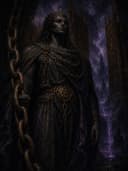
Tartarus
Greek pantheon
Domain: The deepest abyss, prison of the Titans, primordial being
Tartarus quick facts
| Fact | Detail |
|---|---|
| What it is | A place and a primordial god |
| Origin | Comes into being with Chaos, Gaia and Eros at the start of the world (Hesiod) |
| Partner | Gaia, the Earth |
| Child | Typhon (Typhoeus), Gaia's youngest |
| Walls | A bronze fence, with bronze gates that Poseidon set in place |
| Prisoners | Cronus and the Titans; later Typhon |
| Guards | The Hundred-Handers Cottus, Briareus and Gyes |
| Later role | Prison of the wicked dead in Plato and Virgil |
What is Tartarus in Greek mythology?
In the oldest poems, Tartarus is a prison for gods, not for dead humans. Mortal souls go to the house of Hades. Tartarus is where Zeus puts immortals who threaten his order, because a god cannot be killed, only put away.
In Iliad Book 8, Zeus warns the other gods that anyone who disobeys him will be hurled into murky Tartarus, the deepest pit beneath the earth, with gates of iron and a threshold of bronze. In Book 14, Hera swears by the gods beneath Tartarus who are called Titans.
Hesiod gives the fullest picture. A bronze fence runs around it, night is poured around its neck in three layers, and above it grow the roots of the earth and the sea. A man who passed its gates would not reach the floor in a whole year, but would be swept to and fro by terrible storms. In the same dark region Hesiod places the house of Night, in front of which Atlas holds up the sky, and the halls of Hades and Persephone with their watchdog, Cerberus. Even Hesiod does not keep Tartarus and Hades cleanly apart.
How far below Hades is Tartarus?
Very far, but the sources do not agree on the number:
| Source | How deep |
|---|---|
| Hesiod, Theogony | An anvil falls nine days and nights from heaven to earth, and nine more from earth to Tartarus, landing on the tenth |
| Homer, Iliad Book 8 | As far below Hades as heaven is above the earth |
| Apollodorus, Library | A gloomy place in Hades, as far from the earth as the earth is from the sky |
| Virgil, Aeneid Book 6 | Twice as far down as the view up to Olympus |
Hesiod's cosmos is a mirror, with Tartarus as far below the earth as the sky is above it. Homer adds a floor between: his realm of Hades lies under the earth, and Tartarus lies under that.
Is Tartarus a god or a place?
Both, but mostly a place. Hesiod's first beings are Chaos, then Gaia, then misty Tartarus in the depths of the earth, then Eros. As a person, Tartarus does one thing. After Zeus drives the Titans out of heaven, Gaia lies with Tartarus, with the help of golden Aphrodite, and bears her youngest child, Typhon, a monster with a hundred snake heads. Apollodorus keeps the parentage but changes the timing: Gaia bears Typhon in anger after the gods defeat the Giants.
Hades was a god whose name came to mean a place; Tartarus is a place that also acts as a father. His fellow first beings, Chaos and Gaia, open the Greek gods family tree.
Who is imprisoned in Tartarus?
The Titans. After the war between the gods and the Titans, the Hundred-Handers bury the Titans under the earth in chains. In Iliad Book 8, Zeus tells Hera that Iapetus and Cronus sit at the lowest limits of earth and sea, with deep Tartarus all around them. In Aeschylus' Prometheus Bound, Prometheus says his own advice is why Tartarus now hides Cronus and his allies.
Typhon. In Hesiod, Zeus defeats Typhon with thunderbolts and hurls him into wide Tartarus.
The famous sinners, later. Popular summaries put Sisyphus and Tantalus in Tartarus. Homer does not:
| Sinner | Punishment | Where the sources put him |
|---|---|---|
| Tityos | Vultures tear his liver for assaulting Leto | Realm of Hades (Odyssey 11); Tartarus in Virgil |
| Tantalus | Water and fruit pull away whenever he reaches | Realm of Hades (Odyssey 11); Pindar hangs a stone over his head instead |
| Sisyphus | Pushes a boulder uphill that always rolls back | Realm of Hades (Odyssey 11); also in Hades in Apollodorus |
| Ixion | Bound to a wheel | A winged wheel in Pindar; whirled through the air in Apollodorus; Tartarus in Virgil |
| Danaids | Carry water in leaking jars | Not in Homer; best known from Roman poets such as Horace and Ovid |
The shift comes with Plato. In his Gorgias, Socrates says the souls of the unjust go to a prison of punishment called Tartarus, while the just go to the Isles of the Blessed. In the Phaedo, souls judged incurable are thrown into Tartarus and never come out. Virgil then fills it: in Aeneid Book 6 the Sibyl lists the Titans, the giant twins Otus and Ephialtes, Salmoneus, who faked Zeus' thunder, Tityos, Ixion and Pirithous.
Who guards Tartarus?
In Hesiod, the Hundred-Handers: Cottus, Briareus and Gyes, sons of Uranus and Gaia, each with a hundred arms and fifty heads. Their father hid them away; Zeus freed them on Gaia's advice, and in the war they hurled volleys of three hundred rocks at the Titans. Afterwards they live at Tartarus as the trusty guards of Zeus, behind the bronze gates that Poseidon fixed in place.
Virgil changes the staff. In the Aeneid, the Fury Tisiphone watches the gate, a triple wall and the fiery river Phlegethon surround the fortress, and Rhadamanthus judges inside.
Tartarus vs Hades vs Elysium: what is the difference?
| Tartarus | Realm of Hades | Elysium | |
|---|---|---|---|
| Who goes there | Defeated gods; in Plato and Virgil, the worst of the dead | Ordinary dead | A favored few |
| Where | Deep below the earth | Beneath the earth | Homer: the ends of the earth; Virgil: inside the underworld |
| Who rules or guards it | The Hundred-Handers (Hesiod) | Hades and Persephone | Rhadamanthus lives there (Odyssey 4) |
In Odyssey Book 4, Proteus tells Menelaus he will not die but will be sent to the Elysian plain, because he is Helen's husband and so Zeus' son-in-law. It is family privilege, not a reward for virtue. Virgil turns it into a map: in Aeneid Book 6 the road divides, right to Elysium and left to Tartarus. Before that fork, on the far side of the river where Charon ferries the dead, Virgil places those who died before their time.
Is Tartarus the same as hell?
Not originally. The Tartarus of Homer and Hesiod holds defeated gods, not sinners. It became a place of moral punishment in Plato and the Roman poets, and from there the word passed into Christian Greek: the Second Letter of Peter uses a verb built on it for God casting down the angels who sinned, and English Bibles usually translate it as "hell."
In the sources
This article draws on Hesiod's Theogony; Homer's Iliad (Books 8 and 14) and Odyssey (Books 4 and 11); Aeschylus' Prometheus Bound; Pindar's odes; Plato's Gorgias and Phaedo; the Library of Apollodorus; Virgil's Aeneid; and Ovid's Metamorphoses.
The sources disagree on several points:
- How deep is it? As far below the earth as the sky is above it in Hesiod and Apollodorus; that far below Hades in Homer; twice as far in Virgil.
- Where did Uranus hide his sons? Inside the earth, in Hesiod. In Tartarus, in Apollodorus, who has Uranus throw the Hundred-Handers and the Cyclopes there.
- Does Cronus stay there? Yes, in the Theogony, the Iliad and Prometheus Bound. No, in Pindar: Olympian 2 puts the tower of Cronus on the Isle of the Blessed, with Cronus presiding, and Pythian 4 says Zeus freed the Titans.
- Where is Typhon? Hurled into Tartarus, in Hesiod. Buried under Mount Etna, in Apollodorus. Pindar's Pythian 1 has it both ways: Typhon lies in Tartarus, yet Sicily and snowy Etna press down on him.
- Do the guards stay? Hesiod first says the Hundred-Handers live at Tartarus. Later in the same poem, Cottus and Gyes live on the foundations of Ocean and Briareus marries Poseidon's daughter Cymopoleia.
In popular culture
- Hades (2020). In Supergiant's game, Tartarus is the first region the hero Zagreus fights through as he escapes his father's house. The ancient Tartarus is a sealed prison for Titans; the layout is the game's invention.
- Rick Riordan's Heroes of Olympus. At the end of The Mark of Athena (2012), Percy and Annabeth fall into Tartarus, and The House of Hades (2013) follows them across it. Riordan treats Tartarus as both a place and a living god, which echoes Hesiod, but the journey is modern.
Frequently asked questions
What is Tartarus in Greek mythology?
The deepest pit of the Greek cosmos, below the realm of Hades, where Zeus imprisoned the defeated Titans. In Hesiod's Theogony it is also one of the first beings.
How deep is Tartarus?
Hesiod says a bronze anvil dropped from the earth would fall nine days and nights and reach Tartarus on the tenth.
Who is in Tartarus?
In Hesiod and Homer, Cronus and the Titans. In Hesiod, Zeus also hurls Typhon there. Plato and Virgil later sent the worst human sinners there.
Are Sisyphus and Tantalus in Tartarus?
Not in Homer. In Odyssey Book 11 they are among the dead in the realm of Hades. Later writers, especially the Roman poets, set the great sinners in Tartarus.
What is the difference between Tartarus and Hades?
Hades is the realm of the ordinary dead, ruled by Hades and Persephone. Tartarus lies far below it and was first a prison for defeated gods.
Keep exploring
Tartarus only makes sense next to the war that filled it. Meet its prisoners in the Titans in Greek mythology and Cronus, the realm above it in Hades in Greek mythology, and the god who fixed its bronze gates in Poseidon in Greek mythology. Then test what you know with the Greek mythology quiz.