Quick summary
- The Titans were the twelve children of Gaia and Ouranos in Hesiod's Theogony, six sons and six daughters, with Cronus the youngest.
- Cronus overthrew Ouranos with a sickle, and Zeus overthrew Cronus in the Titanomachy, a war that Hesiod says lasted ten full years.
- The defeated Titans were bound in Tartarus, but not all of them: Oceanus, Themis, Mnemosyne and Rhea kept their place under Zeus.
- The Titans are not the Giants. The Giants were a separate race who fought the Olympians in a later war, the Gigantomachy.
The Titans were the older gods of Greek mythology, the generation that ruled before Zeus and the Olympians. In Hesiod's Theogony there are twelve of them, six sons and six daughters of Gaia (Earth) and Ouranos (Sky): Oceanus, Coeus, Crius, Hyperion, Iapetus, Theia, Rhea, Themis, Mnemosyne, Phoebe, Tethys and Cronus, the youngest. Cronus overthrew his father and became king, and his son Zeus later overthrew him in a ten-year war called the Titanomachy.
The Titans
Greek pantheon
Domain: The older generation of gods: sea, sun and light, law, memory, prophecy, kingship before Zeus
Titans quick facts
| Fact | Detail |
|---|---|
| Parents | Gaia (Earth) and Ouranos (Sky) |
| Number | Twelve in Hesiod's Theogony; thirteen in Apollodorus' Library, which adds Dione |
| Sons | Oceanus, Coeus, Crius, Hyperion, Iapetus, Cronus |
| Daughters | Theia, Rhea, Themis, Mnemosyne, Phoebe, Tethys |
| King | Cronus, the youngest, after he overthrew Ouranos |
| Base in the war | Mount Othrys, facing the Olympians on Mount Olympus |
| Defeated by | Zeus and his siblings, with the Cyclopes and the Hundred-Handers |
| Prison | Tartarus, behind bronze gates, guarded by the Hundred-Handers |
| Main sources | Hesiod's Theogony, Homer's Iliad, Apollodorus' Library |
Who were the twelve Titans?
Hesiod names them in one passage of the Theogony: Gaia lay with Ouranos and bore deep-swirling Oceanus, Coeus and Crius, Hyperion and Iapetus, Theia and Rhea, Themis and Mnemosyne, Phoebe of the golden crown and lovely Tethys, and after them Cronus, the youngest and most terrible of her children.
The table below sets out what each Titan was known for, who they paired with and their best-known children. Most consorts and children come from the Theogony. Be aware that several Titans have almost no myths of their own. The ancient sources give Coeus and Crius little more than a family line, and the neat domains that modern websites assign them, such as "intellect" for Coeus, have no clear ancient basis.
| Titan | Known for | Consort | Notable children |
|---|---|---|---|
| Oceanus | The great river that circles the world | Tethys | The river gods and the Oceanid nymphs, including Styx and Metis |
| Tethys | Mother of the rivers and springs | Oceanus | The rivers and the Oceanids |
| Hyperion | Father of the lights of heaven; in Homer, a name of the Sun | Theia | Helios, Selene, Eos |
| Theia | Mother of the Sun, Moon and Dawn | Hyperion | Helios, Selene, Eos |
| Coeus | Little beyond his family line | Phoebe | Leto, Asteria |
| Phoebe | "Golden-crowned"; in Aeschylus, a holder of Delphi | Coeus | Leto, Asteria |
| Crius | Little beyond his family line | Eurybia, a daughter of Pontus and Gaia | Astraeus, Pallas, Perses |
| Iapetus | Father of a rebellious family | Clymene, an Oceanid | Atlas, Menoetius, Prometheus, Epimetheus |
| Themis | Divine law, order and right custom; oracles | Zeus | The Horae (Seasons) and, in one passage, the Moirai (Fates) |
| Mnemosyne | Memory | Zeus | The nine Muses |
| Rhea | Mother of the Olympian gods | Cronus | Hestia, Demeter, Hera, Hades, Poseidon, Zeus |
| Cronus | King of the Titans | Rhea | Zeus and his five siblings; Chiron by Philyra (Apollodorus) |
A few details from the sources fill out the table. Pindar opens his fifth Isthmian ode by calling on Theia, mother of the Sun, and credits her with the reason people value gold above everything. In the opening of Aeschylus' Eumenides, the Pythia says the oracle at Delphi passed from Earth to Themis, and from Themis to Phoebe, who gave it to Phoebus Apollo as a birthday gift. Themis was also the second wife of Zeus in Hesiod's list of his marriages, after Metis, and Mnemosyne lay with him for nine nights to conceive the Muses.
Why are they called Titans?
Hesiod gives the explanation himself, as a pun. Ouranos, he says, called his children "Titans" as a term of reproach, because they had strained (titainontes) in their presumption to do a dreadful deed, and vengeance (tisis) for it would come later. Modern scholars treat this as wordplay rather than real etymology. The true origin of the name is unknown.
How did Cronus overthrow Ouranos?
In the Theogony, Ouranos hated his children and hid each one inside Gaia as soon as it was born. Gaia, groaning under the weight, made a great sickle of grey adamant and asked her sons to punish their father. Only Cronus, the youngest, agreed. When Ouranos came at night to lie with Gaia, Cronus ambushed him and cut off his genitals.
The blood that fell on the earth produced the Furies, the Giants and the ash-tree nymphs. The severed parts fell into the sea, and from the foam around them Aphrodite was born. Cronus took the throne, married his sister Rhea, and swallowed each of their children to stop a prophecy that a son would overthrow him. The full story of his reign is in Cronus in Greek mythology.
What was the Titanomachy?
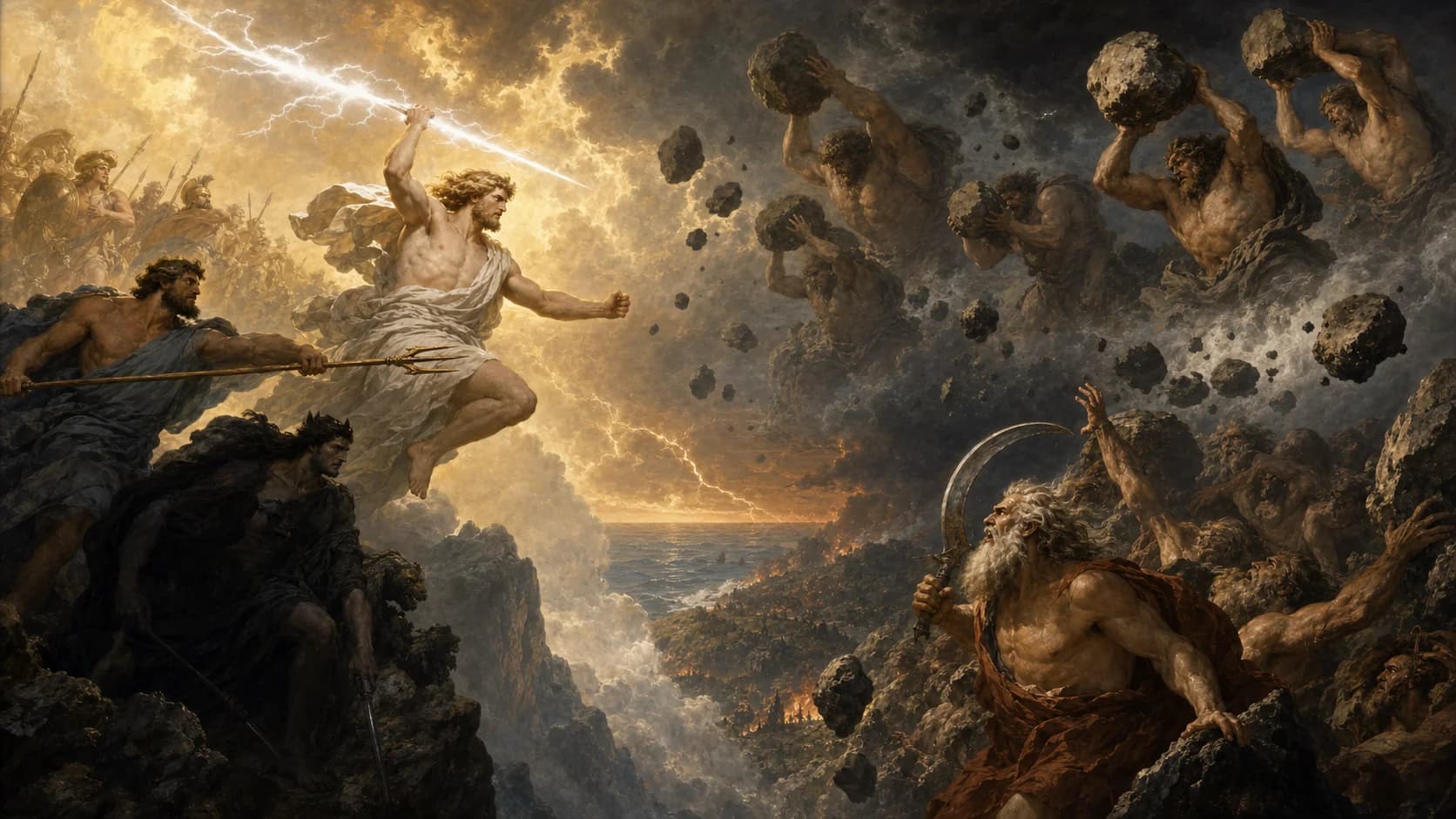
The Titanomachy was the war between the Titans and the Olympians for rule of the cosmos. Rhea saved her youngest son, Zeus, by giving Cronus a stone wrapped in swaddling clothes to swallow. Once grown, Zeus forced his father to bring up the other children, and the two generations went to war.
Hesiod's account in the Theogony runs like this:
- Two mountains. The Titans fought from Mount Othrys, the children of Cronus from Mount Olympus.
- Ten years of stalemate. The war went on for ten full years, with neither side winning.
- New allies. Zeus had already freed the Cyclopes, who gave him thunder and lightning. On Gaia's advice he also freed the Hundred-Handers, Briareus, Cottus and Gyges, whom Ouranos had bound under the earth.
- The decisive battle. Zeus hurled his lightning without pause, and the Hundred-Handers threw three hundred rocks at a time, overshadowing the Titans with their missiles until they were driven down beneath the earth.
- The prison. The Titans were bound in Tartarus, as far below the earth as the sky is above it. A bronze anvil, Hesiod says, would fall nine days and nights from earth before reaching it on the tenth. Poseidon set bronze gates on it, and the Hundred-Handers stood guard.
Zeus also promised before the war that any god who fought on his side would keep their old honors or gain new ones. Styx, a daughter of Oceanus, came first, bringing her children Zelos, Nike, Kratos and Bia, and Zeus made her the great oath of the gods. A separate epic called the Titanomachy also existed in antiquity, but it survives only in a few fragments. For the war told from Zeus's side, see Who Was Zeus?
What happened to each Titan after the war?
The popular picture is that every Titan ended up in Tartarus. The sources do not say that. Hesiod never lists which Titans were imprisoned, and several clearly were not.
- Cronus and Iapetus. In the Iliad, Zeus says that Iapetus and Cronus sit in the depths of Tartarus, with no sun or breeze to cheer them. A few lines found in some manuscripts of Hesiod's Works and Days, probably a later addition, say that Zeus released Cronus to rule the Isles of the Blessed, and Pindar places a tower of Cronus there.
- Oceanus and Tethys. Still free. In Iliad Book 14, Hera says she was raised in their house when Zeus thrust Cronus beneath the earth. In Prometheus Bound, traditionally attributed to Aeschylus, Oceanus visits the chained Prometheus and offers to plead with Zeus for him.
- Themis and Mnemosyne. Not punished but married into the new order: both bore children to Zeus.
- Rhea. Free and honored. In the Homeric Hymn to Demeter, Zeus sends Rhea to bring Demeter back to the gods.
- Hyperion, Theia, Coeus, Phoebe, Crius. The sources say little about their fate. Their children, however, thrived under Zeus: Helios, Selene and Eos kept their places in the sky, and Leto bore Zeus two Olympians.
- The release. Pindar's fourth Pythian ode says that Zeus, in time, freed the Titans.
Hesiod also notes that Zeus did not strip Hecate, a granddaughter of Coeus and Phoebe, of any honor she had held among the earlier Titan gods. Read more in Hecate in Greek mythology.
Who were the second-generation Titans?
The children of the twelve are often called Titans too, and ancient writers sometimes did the same: Ovid's Metamorphoses calls the Sun simply "Titan." The best known are:
- Prometheus, son of Iapetus. He stole fire for mortals. In Hesiod, Zeus chains him and sends an eagle to eat his liver, which grows back each night, until Heracles kills the eagle. In Prometheus Bound, he says he took Zeus's side in the Titanomachy after the Titans ignored his advice.
- Atlas, son of Iapetus. Hesiod says he holds up the wide sky at the ends of the earth near the Hesperides, a lot Zeus assigned him. Homer's Odyssey instead says he keeps the tall pillars that hold earth and sky apart.
- Epimetheus, son of Iapetus, the brother who accepted Pandora, the first woman, from Zeus. Works and Days adds that Prometheus had warned him never to accept a gift from Zeus.
- Menoetius, son of Iapetus. Hesiod says Zeus struck him with a thunderbolt and sent him down to Erebus for his arrogance and overbearing strength.
- Helios, Selene and Eos, children of Hyperion and Theia: the Sun, the Moon and the Dawn.
- Leto, daughter of Coeus and Phoebe, mother of Apollo and Artemis by Zeus.
Iapetus' family is the clearest pattern in the Theogony: Zeus punishes three of his four sons, by thunderbolt, chains and an endless burden, and the fourth, Epimetheus, is the one who takes in Zeus's trick, Pandora.
Titans vs Olympians vs Giants: what is the difference?
These three groups are often mixed up, especially the Titans and the Giants. They are different generations, fought different wars, and come from different stories.
| Titans | Olympians | Giants | |
|---|---|---|---|
| Who | The twelve children of Gaia and Ouranos | Zeus, his siblings and his children | A race born of Gaia |
| Origin | Born to Gaia by Ouranos | Children and grandchildren of Cronus and Rhea | From Ouranos' blood falling on the earth (Hesiod) |
| War | The Titanomachy, against the Olympians | Both wars, as the winners | The Gigantomachy, against the Olympians |
| Outcome | Bound in Tartarus | Rule from Olympus | Killed or buried under islands and mountains |
| Main source | Hesiod's Theogony | Homer, Hesiod and the Homeric Hymns | Apollodorus' Library, and art |
The Olympians are not a separate race from the Titans: they are their children. Zeus, Hera, Poseidon, Hades, Demeter and Hestia are the children of two Titans, and Apollo and Artemis are grandchildren of two more. Zeus also married the Titans Themis and Mnemosyne. The Titanomachy was a family war between generations.
The Giants are something else. Hesiod mentions their birth from the blood of Ouranos, armed and holding long spears, but the Theogony never describes a war with them. The fullest account is in Apollodorus. Gaia, angry at what had been done to the Titans, bore the Giants, who were huge and had serpent scales for feet. An oracle said the gods could not kill them without the help of a mortal, so Zeus summoned Heracles through Athena. Athena threw the island of Sicily onto the Giant Enceladus as he fled, and Zeus and Heracles finished off the rest with thunderbolts and arrows. The Gigantomachy was a favorite subject of Greek art, most famously on the great frieze of the Pergamon Altar.
One more figure adds to the confusion. Typhon, the monster Gaia bore after she lay with Tartarus, fought Zeus alone after the Titanomachy. He was neither a Titan nor a Giant.
In the sources
The Titans' story is told mainly in Hesiod's Theogony (their birth, the overthrow of Ouranos, the Titanomachy and Tartarus) and Apollodorus' Library (the same story, with variations, plus the Gigantomachy). Homer's Iliad places Cronus and Iapetus in Tartarus; Prometheus Bound and Aeschylus' Eumenides add details about Prometheus, Oceanus, Themis and Phoebe; Pindar's odes mention Theia and the Titans' release.
The sources disagree on several basic points:
- Twelve or thirteen? Hesiod names twelve Titans. Apollodorus adds Dione to the daughters, making thirteen.
- Who attacked Ouranos? In Hesiod, Cronus alone dares to act. In Apollodorus, all the Titans except Oceanus attack their father, and Cronus does the cutting.
- Where did the gods begin? Hesiod starts the world with Chaos and Gaia. In Iliad Book 14, Homer calls Oceanus the origin of the gods and Tethys their mother.
- Who was Prometheus' mother? Clymene in Hesiod, Asia in Apollodorus, and Themis in Prometheus Bound.
- Who was the Sun's mother? Theia in Hesiod. The Homeric Hymn to Helios names her Euryphaessa, which some read as another name for Theia. In Homer, Hyperion is often the Sun himself, not his father.
- Who were the Fates' parents? Hesiod contradicts himself: early in the Theogony the Moirai are daughters of Night, later they are daughters of Zeus and Themis.
- Imprisoned forever? Hesiod and Homer keep the Titans in Tartarus. Pindar says Zeus freed them.
- Where did the Giants come from? Hesiod says from the blood of Ouranos. Apollodorus says Gaia bore them to Ouranos after the Titans' defeat, out of anger on their behalf.
In popular culture
- Percy Jackson and the Olympians. Kronos is the villain of Rick Riordan's series, and other Titans join his side. In The Titan's Curse, Atlas schemes to escape his burden by making others hold up the sky. The plot is modern, but the burden itself comes straight from Hesiod.
- Clash of the Titans (1981 and 2010). Despite the title, the films are about Perseus. In the 1981 film, Zeus orders Poseidon to let loose the Kraken, which he calls the last of the Titans. The Kraken comes from Scandinavian folklore, not Greek myth, and no ancient source puts it in the Titan family.
- God of War III. The game makes Gaia a Titan and shows Titans such as Cronos as mountain-sized creatures. In Hesiod, Gaia is the Titans' mother, and nothing in the poem makes them giant monsters.
- Saturn's moons. Astronomers named many of Saturn's moons after the Titans, including Titan, Rhea, Iapetus, Tethys, Phoebe and Hyperion, which fits because Saturn is the Roman Cronus.
- Titanium and "titanic." The chemist Martin Heinrich Klaproth named titanium after the Titans in the 1790s, and "titanic" has meant gigantic in English for centuries. Hesiod's Titans were powerful, but nothing in his poem says they were larger than the Olympians.
Frequently asked questions
Who were the 12 Titans in Greek mythology?
In Hesiod's Theogony, the twelve Titans are Oceanus, Coeus, Crius, Hyperion, Iapetus and Cronus, and their sisters Theia, Rhea, Themis, Mnemosyne, Phoebe and Tethys. All are children of Gaia and Ouranos.
Who was the king of the Titans?
Cronus, the youngest. He became king after he overthrew his father Ouranos with a sickle, and he ruled until his son Zeus defeated him in the Titanomachy.
What was the Titanomachy?
The ten-year war between the Titans, fighting from Mount Othrys, and the Olympians, fighting from Mount Olympus. Zeus won with the help of the Cyclopes and the Hundred-Handers.
Were all the Titans sent to Tartarus?
No. Hesiod binds the defeated Titans in Tartarus and Homer names Cronus and Iapetus there, but Oceanus, Tethys, Themis, Mnemosyne and Rhea remain free and honored under Zeus.
Are the Titans and the Giants the same?
No. The Titans are the children of Gaia and Ouranos who fought the Titanomachy. The Giants are a separate race, born of Gaia, who fought the Olympians in a later war, the Gigantomachy.
Is Prometheus a Titan?
He is a son of the Titan Iapetus, so he is usually called a second-generation Titan. In Prometheus Bound, he sided with Zeus in the war against the Titans.
Keep exploring
The Titans are the bridge between the first powers of the world and the Olympians. Follow their king in Cronus in Greek mythology, their prison in Tartarus, and their most famous sons in Prometheus and Atlas. See how the generations connect on the Greek gods family tree, compare the winners in Greek gods and their powers, or test yourself with the Greek mythology quiz.