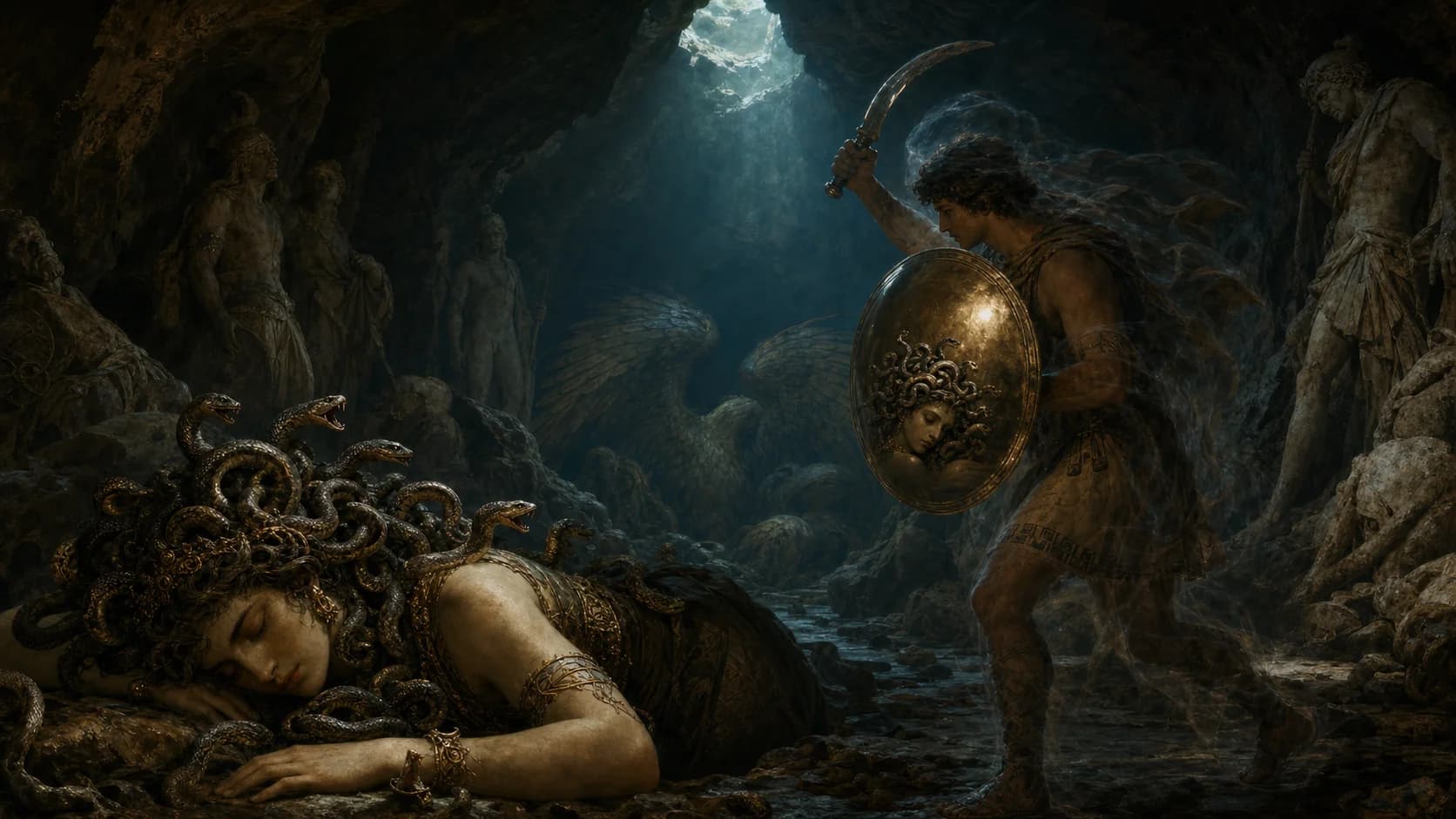
Medusa was one of the three Gorgons of Greek mythology, and the only one of them who could die. The hero Perseus cut off her head, which kept its power to turn onlookers to stone. Whether she was born a monster or made into one depends on the source: Hesiod and Apollodorus give no tragic backstory, while Ovid's Metamorphoses — a Roman poem — tells of a beautiful woman violated by Neptune (Poseidon) in Minerva's (Athena's) temple and then punished by the goddess.
Medusa
Greek pantheon
Domain: Gorgon, petrifying gaze, protective power of the severed head
Medusa quick facts
| Fact | Detail |
|---|---|
| Parents | Phorcys and Ceto, ancient sea deities (Hesiod) |
| Sisters | Stheno and Euryale, the two immortal Gorgons |
| Status | Mortal — the only Gorgon who could be killed |
| Killed by | Perseus, son of Zeus and Danaë |
| Children | Pegasus and Chrysaor, fathered by Poseidon, born from her severed neck |
| Power | Her gaze (and later her severed head) turned people to stone |
| Where the head ended up | Given to Athena, who set it on her aegis or shield |
| Main sources | Hesiod's Theogony, Apollodorus's Library, Ovid's Metamorphoses |
Was Medusa a monster or a victim?
Both answers are in the ancient record, from different centuries.
In the oldest account, Hesiod's Theogony, Medusa is simply one of three Gorgon sisters living far to the west, beyond the stream of Ocean. Hesiod says she was mortal while her sisters were deathless and ageless, and that Poseidon lay with her in a grassy meadow full of spring flowers. There is no temple, no crime and no curse. She is a Gorgon from birth.
The "victim" reading comes almost entirely from Ovid, writing in Rome around the turn of the first century AD. There, Medusa was once a famously beautiful woman, and her hair was her loveliest feature. Neptune assaulted her in Minerva's temple; Minerva hid her eyes behind her aegis and then, so the act would not go unpunished, turned Medusa's hair into snakes.
So: the monster is Greek and old; the wronged woman is Roman and late. Modern readers find Ovid's version the most powerful — and it is the one most people now know.
Why did Athena curse Medusa?
The answer changes with the author:
| Source | Why Medusa became (or was) a monster |
|---|---|
| Hesiod, Theogony | No reason given. She is born a Gorgon. |
| Apollodorus, Library | Reports that "some say" Medusa was beheaded for Athena's sake, because she tried to rival the goddess in beauty. |
| Ovid, Metamorphoses | Neptune violated her in Minerva's temple; Minerva punished Medusa by turning her hair to snakes. |
Notice what even Ovid does not say. He never explains why the goddess punished the victim rather than the god. Ancient readers were used to gods protecting their own dignity first; modern readers see an injustice, and that reaction powers most of Medusa's modern afterlife.
The Apollodorus variant is the least known: in it there is no assault at all, only a mortal's boast about her beauty — the same kind of offense that ruins Arachne and Niobe elsewhere in Greek myth.
What did Medusa look like?
It depends on the century, again.
- Apollodorus describes all three Gorgons as terrifying: heads wreathed with serpent-scales, great tusks like a boar's, bronze hands, and golden wings. Anyone who looked at them turned to stone.
- Archaic Greek art matches that picture: a round, grinning face with a lolling tongue and bared fangs. A famous stone Gorgon stands on the pediment of the temple of Artemis on Corfu, flanked by her children Pegasus and Chrysaor.
- Ovid and later art make her beautiful and tragic, her snakes the only monstrous feature.
This shift, from grotesque to beautiful, is one of the clearest cases of a myth being reshaped by later artists.
How did Perseus kill Medusa?
The fullest Greek version is in Apollodorus. King Polydectes of Seriphos wanted Perseus out of the way so he could pursue Perseus's mother, Danaë, and Perseus rashly promised to bring back a Gorgon's head.
- Hermes and Athena guided him to the Graiai, three sisters who shared one eye and one tooth. Perseus seized the eye and tooth until they told him the way to certain nymphs.
- The nymphs gave him winged sandals, a pouch (the kibisis) for the head, and the cap of Hades, which made him invisible. Hermes gave him a sickle of adamant.
- He found the Gorgons asleep. With Athena guiding his hand, he looked only at Medusa's reflection in a bronze shield and cut off her head.
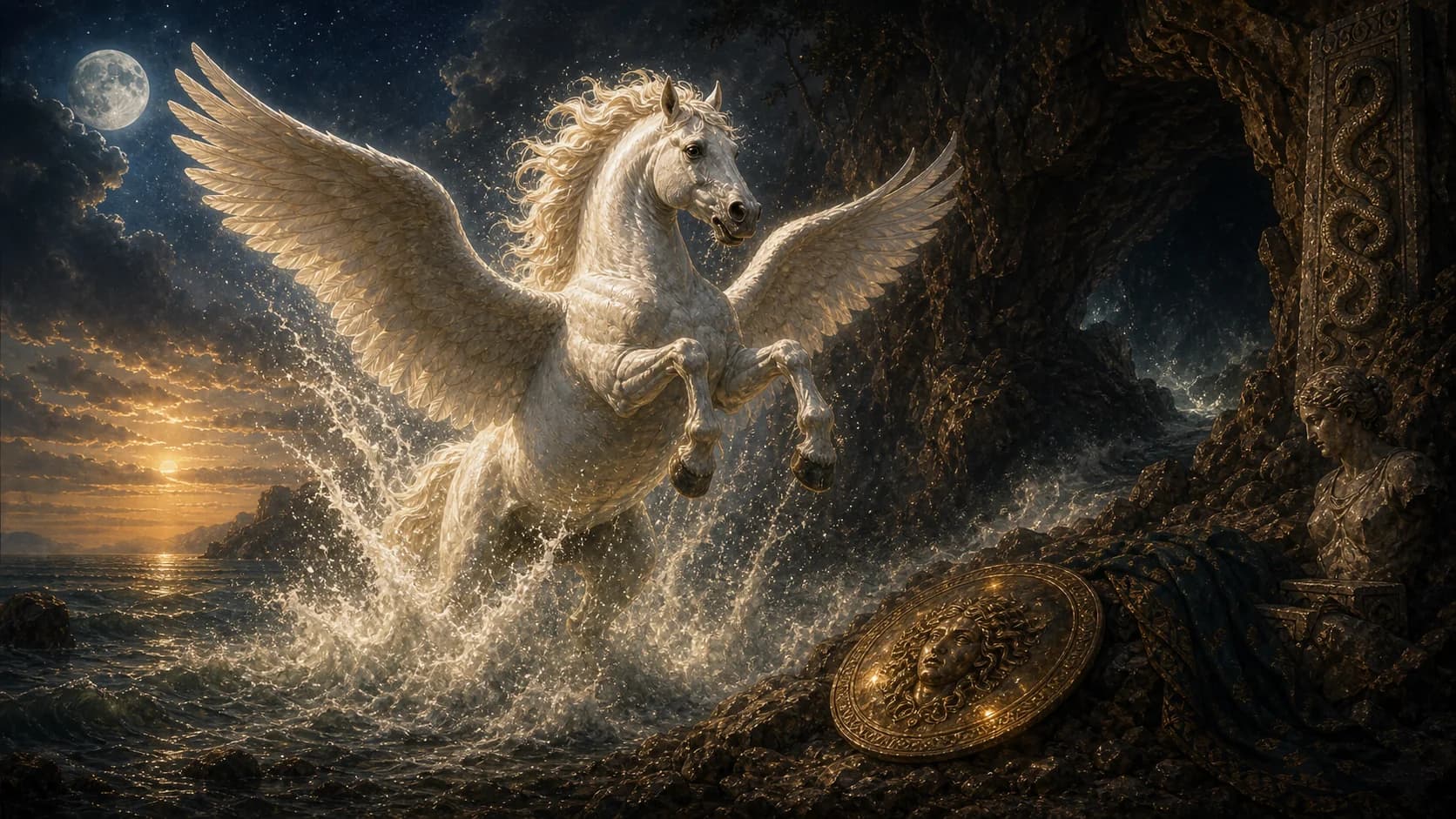
- Pegasus and Chrysaor sprang out of her neck — the children of Poseidon.
- The sisters woke and chased him, but the cap made him invisible and he escaped.
On the way home, Perseus used the head as a weapon. In Apollodorus he turns Polydectes and his court to stone; in Ovid he petrifies Atlas into a mountain and later Phineus and his followers. Finally he gave the head to Athena, who placed it on her aegis. For the gods and heroes involved, see Who Was Zeus? — Zeus is Perseus's father.
Why is Medusa's head on Athena's shield?
In Apollodorus, Perseus hands the head to Athena and she sets it in the middle of her shield; in other sources it sits on her aegis. The Gorgon face, called a gorgoneion, became one of the most common protective images in the Greek world. It appears on shields, armor, temple roofs and drinking cups — the idea being that the thing which kills with a look can also scare off harm.
Medusa's blood carried power too. Apollodorus says Athena gave some of it to the healer Asclepius: blood from the veins on one side of her body was deadly, and blood from the other side could raise the dead.
Was Medusa immortal?
No. Hesiod stresses the difference: Stheno and Euryale were immortal and never grew old, but Medusa was mortal. That is why Perseus's quest was possible at all. The poet Pindar adds a haunting detail in his twelfth Pythian ode: Athena invented the music of the pipes by imitating the wailing of the surviving Gorgons as they mourned their sister.
In the sources
- Hesiod, Theogony — Medusa's parentage, her mortality, Poseidon's union with her in a meadow, and the birth of Pegasus and Chrysaor at her death. No curse.
- Pindar, Pythian 12 — the Gorgons' lament and Athena's invention of pipe music.
- Apollodorus, Library — the complete Perseus quest, the Gorgons' appearance, the beauty-rivalry variant, and the healing and killing blood.
- Ovid, Metamorphoses (Book 4) — Perseus himself tells the story of the temple assault and Minerva's punishment; Books 4–5 cover his use of the head.
Contradictions to know:
- Born or made? Hesiod and Apollodorus's main account treat her as born a Gorgon; Ovid makes her a transformed woman.
- Where did Poseidon meet her? A flowery meadow in Hesiod; Minerva's temple in Ovid.
- What was her offense? None in Hesiod; boasting of her beauty in the variant reported by Apollodorus; being assaulted in Ovid.
- Grotesque or beautiful? Apollodorus gives her tusks and bronze hands; Ovid remembers her as a great beauty.
In popular culture
- Percy Jackson and the Olympians. In The Lightning Thief, Medusa runs "Aunty Em's Gnome Emporium," a roadside shop full of petrified "statues." Uma Thurman played her in the 2010 film. Riordan leans on Ovid's version, with Medusa blaming Athena for her curse.
- Clash of the Titans (1981 and 2010). Both films have Perseus use the head to turn the Kraken to stone. The Kraken comes from Scandinavian folklore, not Greek myth; in the ancient story, Andromeda's sea monster is killed by Perseus himself.
- Hades (Supergiant Games). Medusa appears as Dusa, a cheerful floating Gorgon head working as a maid in the House of Hades — pure invention, and a fond one.
- Versace. The fashion house's logo is a Medusa head, a modern echo of the gorgoneion.
- Feminist rereadings. Hélène Cixous's essay The Laugh of the Medusa (1975) and Luciano Garbati's sculpture Medusa with the Head of Perseus both build on the Ovidian victim, not the Hesiodic monster.
For more screen adaptations, see our guide to Greek mythology movies.
Frequently asked questions
Who was Medusa in Greek mythology?
Medusa was one of the three Gorgons, daughters of the sea deities Phorcys and Ceto. She was the only mortal Gorgon, and the hero Perseus cut off her head.
Why did Athena curse Medusa?
In Ovid's Metamorphoses, Minerva (Athena) turned Medusa's hair to snakes after Neptune (Poseidon) violated her in the goddess's temple. Older Greek sources such as Hesiod contain no curse at all.
Was Medusa born a monster?
In Hesiod's Theogony, yes: she is born a Gorgon. The idea that she was once a beautiful woman comes mainly from Ovid, a Roman poet writing centuries later.
Who killed Medusa?
Perseus, son of Zeus and Danaë, killed her while she slept. He watched her reflection in a bronze shield so he would not look at her directly.
What were Medusa's children?
Pegasus, the winged horse, and Chrysaor, a warrior with a golden sword. Both were fathered by Poseidon and sprang from her neck when Perseus beheaded her.
Was Medusa immortal?
No. Hesiod says her sisters Stheno and Euryale were immortal, but Medusa was mortal, which is why Perseus could kill her.
Keep exploring
Medusa sits at the crossroads of Poseidon, Athena and Perseus. See how they all connect in the Greek gods family tree, then meet two other figures shaped by the gods' violence: Persephone, queen of the underworld, and Cronus, the Titan who ate his children. Think you know your monsters? Try the Greek mythology quiz.