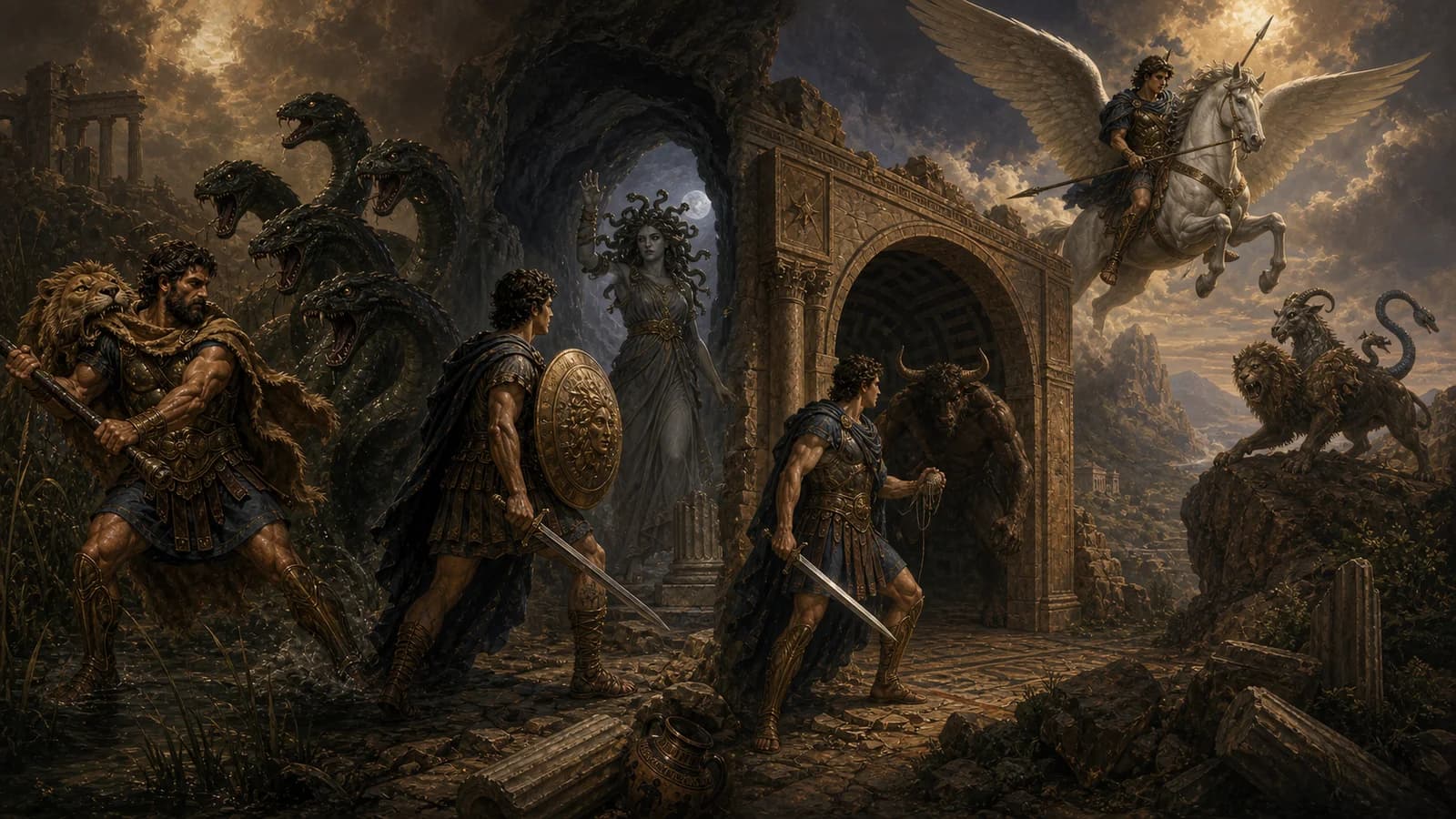
The best mythological monsters for Halloween are the ones with real stories behind them: Medusa, whose gaze turns people to stone; Cerberus, the hound at the gate of the dead; Fenrir, the wolf who will swallow Odin; and Ammit, the Egyptian devourer of unworthy hearts. Below are 15 creatures from seven cultures, each with what it is, where it comes from, and a one-line costume cue. We also mark which ones are ancient myth and which are later folklore — the difference matters more than most lists admit.
15 mythological monsters compared
| # | Monster | Culture | What it does | Where it's from |
|---|---|---|---|---|
| 1 | Medusa | Greek | Turns onlookers to stone | Hesiod, Ovid |
| 2 | The Sirens | Greek | Sing sailors to their deaths | Homer's Odyssey |
| 3 | Scylla | Greek | Six heads snatch sailors from ships | Homer's Odyssey |
| 4 | Polyphemus the Cyclops | Greek | One-eyed giant who eats Odysseus's men | Homer's Odyssey |
| 5 | Cerberus | Greek | Guards the underworld; lets no one leave | Hesiod, Apollodorus |
| 6 | Fenrir | Norse | Giant wolf destined to devour Odin | Poetic Edda, Snorri |
| 7 | Jörmungandr | Norse | World-circling sea serpent, Thor's killer | Poetic Edda, Snorri |
| 8 | Garm | Norse | Chained hound whose howl starts Ragnarök | Völuspá, Snorri |
| 9 | Gryla | Icelandic folklore | Christmas ogress who eats naughty children | Icelandic verse and folklore |
| 10 | Ammit | Egyptian | Eats the hearts of the unworthy dead | Book of the Dead |
| 11 | Tiamat | Mesopotamian | Primordial sea who makes an army of monsters | Enuma Elish |
| 12 | Lamashtu | Mesopotamian | Demoness who attacks mothers and babies | Incantations and amulets |
| 13 | The Banshee | Irish folklore | Wails to announce a death | Irish folk tradition |
| 14 | Baba Yaga | Slavic folklore | Forest witch in a hut on chicken legs | Russian fairy tales |
| 15 | The Tzitzimimeh | Aztec | Star demons who descend during eclipses | Florentine Codex, Aztec codices |
What is the scariest mythological creature?
There is no single answer, because each culture feared something different. A useful way to pick:
- Fear of the look: Medusa. One glance and you are stone.
- Fear of the end of the world: Fenrir and Jörmungandr, both fated to kill gods at Ragnarök.
- Fear of judgment: Ammit, who does not kill you so much as end you — the Egyptian "second death."
- Fear at home, in the dark: Lamashtu and Gryla, monsters that come for children.
If one creature has to win, Ammit has a strong claim: every other monster here can be escaped by luck or courage, but in Egyptian belief Ammit's verdict was final.
Greek mythological monsters
1. Medusa
- What it is: The only mortal one of the three Gorgons; her gaze turned people to stone, and her severed head kept that power.
- Source: Hesiod's Theogony (about 700 BC) makes her a Gorgon from birth; Ovid's Metamorphoses (early 1st century AD) makes her a woman cursed by Minerva (Athena).
- Costume cue: A crown of snakes, a stony grey-green face, and a mirror-polished shield carried by your Perseus.
Full story: Medusa in Greek Mythology: Monster or Victim?
2. The Sirens
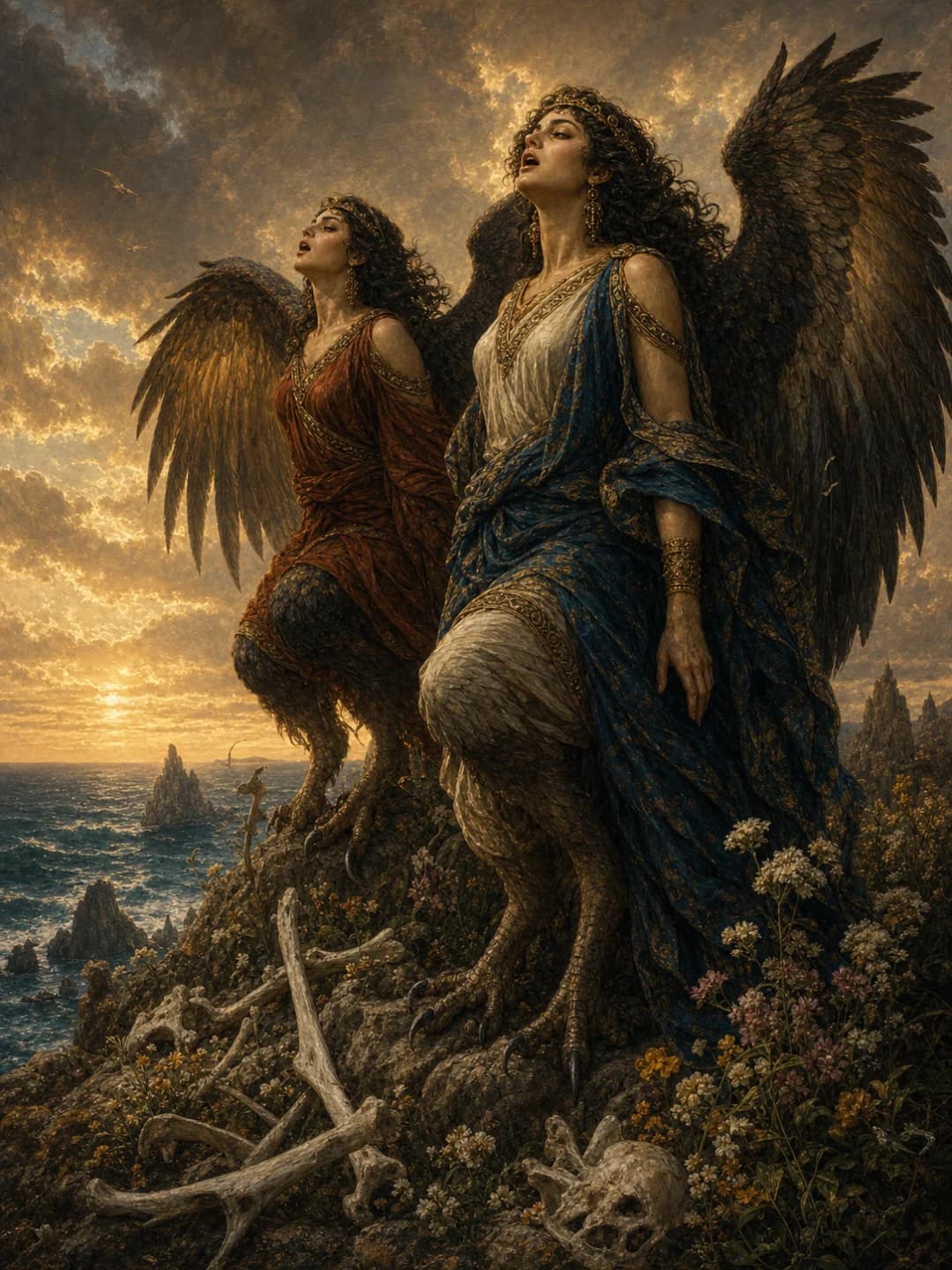
- What it is: Singers whose song draws sailors ashore to die. In the Odyssey they sit in a meadow heaped with the bones of men; Odysseus has his crew plug their ears with wax and ties himself to the mast to hear them safely.
- Source: Homer's Odyssey, Book 12. In Apollonius of Rhodes's Argonautica (3rd century BC), Orpheus drowns them out with his lyre.
- Costume cue: Not a mermaid — Greek art shows Sirens as women with bird wings and bird legs. Feathers, talons, a lyre.
The fish-tailed Siren is a medieval development; the ancient ones were bird-women.
3. Scylla (and Charybdis)
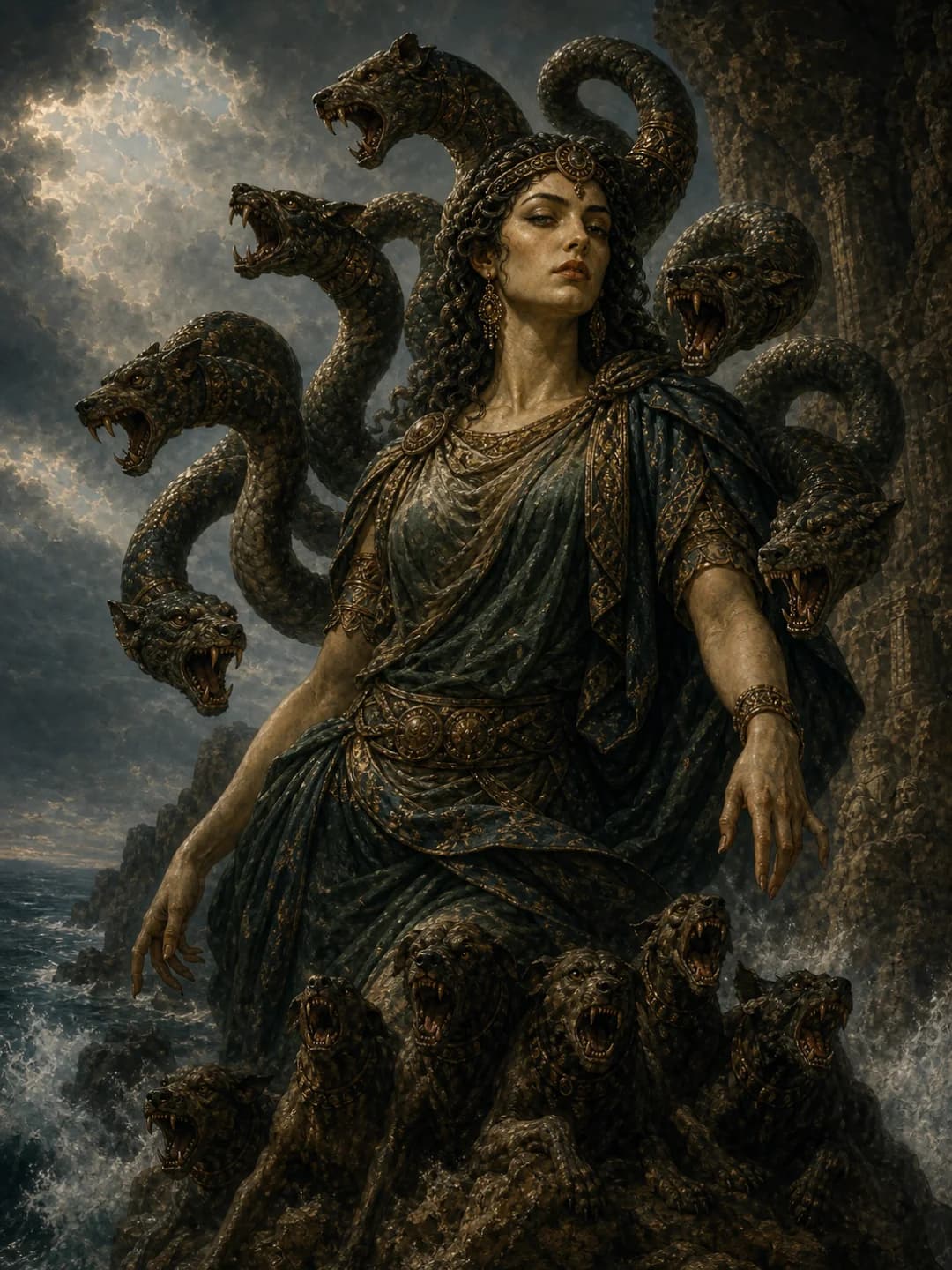
- What it is: A monster in a cliff cave with six long necks and six heads, each with three rows of teeth. She snatches six of Odysseus's men from his ship as it passes. Across the strait lies Charybdis, who swallows the sea three times a day.
- Source: Homer's Odyssey, Book 12. In Ovid's Metamorphoses she was once a nymph, transformed by the jealous sorceress Circe.
- Costume cue: A sea-green gown with snarling dog heads worn around the waist, as later art pictures her.
"Between Scylla and Charybdis" still means choosing between two dangers.
4. Polyphemus the Cyclops
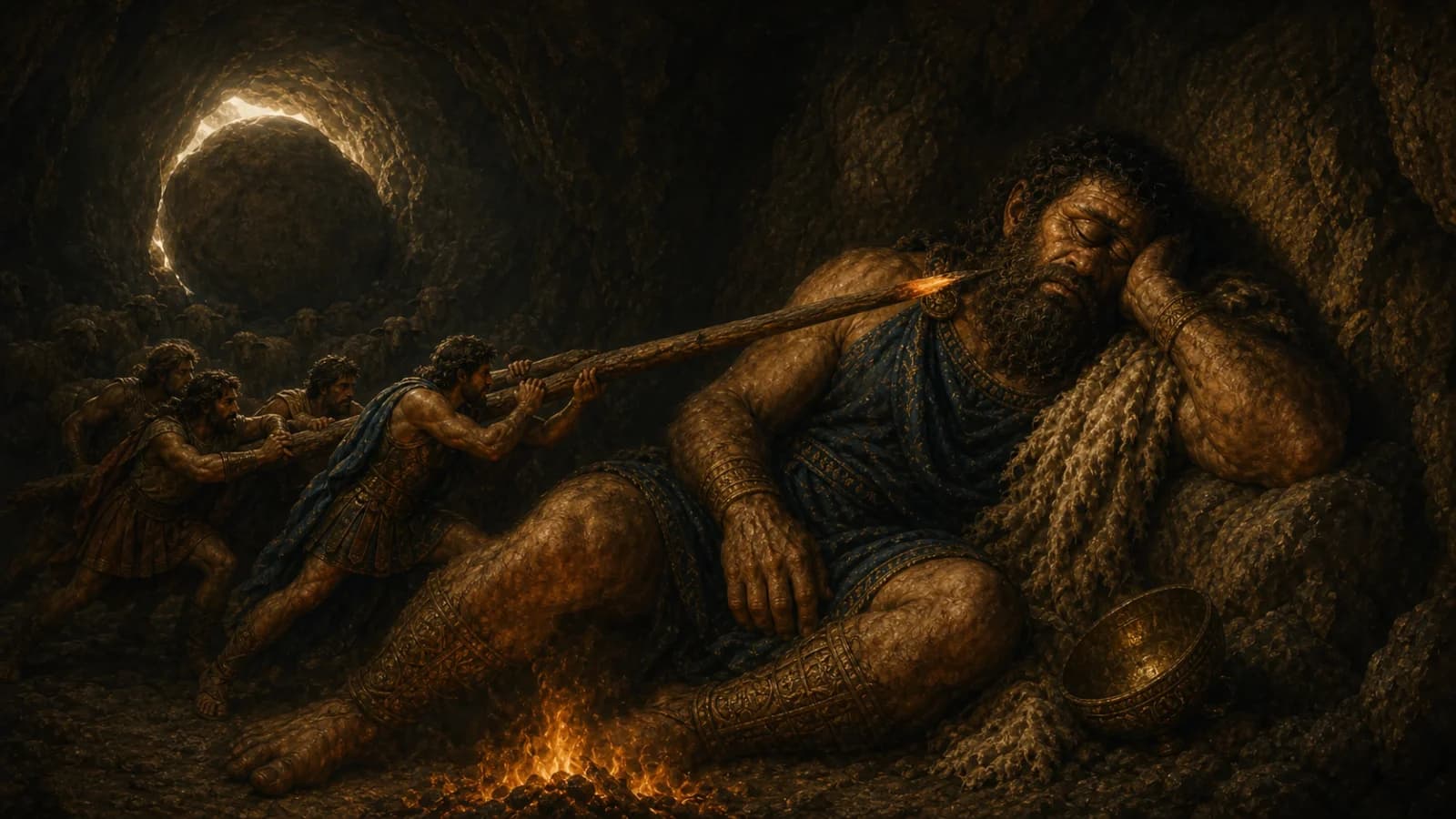
- What it is: A one-eyed giant shepherd, son of Poseidon, who traps Odysseus's crew in his cave and eats them two at a time. Odysseus tells him his name is "Nobody," gets him drunk and blinds him with a sharpened stake.
- Source: Homer's Odyssey, Book 9. Hesiod's Cyclopes are different: three divine smiths who forge Zeus's thunderbolt.
- Costume cue: One huge eye mask, a sheepskin cloak and a giant's club.
5. Cerberus
- What it is: The watchdog of the underworld. He welcomes the dead in and devours anyone who tries to leave. Heracles's last labor was to bring him up to the world of the living.
- Source: Hesiod's Theogony gives him fifty heads; later writers, including Apollodorus, settle on three dog heads, a serpent's tail and snakes along his back.
- Costume cue: A three-headed dog hood (two extra heads on the shoulders), a spiked collar and a chain.
For the realm he guards, see Persephone, queen of the underworld.
Norse mythological monsters
6. Fenrir
- What it is: The giant wolf, son of Loki. The gods bound him with the magic ribbon Gleipnir, and Tyr lost his hand in the wolf's jaws. At Ragnarök Fenrir breaks free and swallows Odin.
- Source: The Poetic Edda (Völuspá, Vafþrúðnismál) and Snorri Sturluson's 13th-century Prose Edda.
- Costume cue: A shaggy grey wolf hood, a broken silk ribbon around the neck, and a torn chain.
Full story: Fenrir in Norse Mythology
7. Jörmungandr
- What it is: The Midgard Serpent, so vast it circles the world and bites its own tail. Thor nearly lands it on a fishing trip; at Ragnarök they kill each other.
- Source: Hymiskviða and Völuspá in the Poetic Edda; Snorri's Gylfaginning.
- Costume cue: A long scaled serpent wrapped around your body, tail held in your mouth or hand.
Full story: Jörmungandr, the World Serpent
8. Garm
- What it is: A blood-stained hound chained before the cave Gnipahellir. His howling signals the start of Ragnarök, and in Snorri he and Tyr kill each other.
- Source: The refrain of the Völuspá; Snorri's Gylfaginning.
- Costume cue: A black hound mask, a red-stained chest and a broken chain.
Full story: Garm, the hound of Ragnarök
9. Gryla
- What it is: An Icelandic ogress who comes down from the mountains at Christmas to carry off and eat misbehaving children. She is the mother of the thirteen Yule Lads and keeps the Yule Cat.
- Source: Folklore, not the Eddas. Her name appears in medieval Icelandic sources, 17th-century Grýlukvæði poems describe her, and 19th-century folklore collections fixed her household.
- Costume cue: A ragged troll with a hooked nose, a sack for children over one shoulder and a black cat companion.
Full story: Gryla, Iceland's Christmas monster
Egyptian and Mesopotamian monsters
10. Ammit
- What it is: "Devourer of the Dead" — part crocodile, part lion, part hippopotamus. She waits beside the scale where a dead person's heart is weighed against the feather of Ma'at, and eats any heart that fails. That means the end of the person entirely.
- Source: The Book of the Dead (New Kingdom onward), especially the judgment scene of Spell 125.
- Costume cue: A crocodile snout, a lion's mane, and a small set of scales.
Note: Anubis, the jackal-headed god at the scale, is not a monster. He is a protector of the dead. Full story: The weighing of the heart and Anubis in Egyptian mythology.
11. Tiamat
- What it is: The primordial salt sea. When her descendants the gods turn against her, she creates an army of eleven kinds of monsters, including serpents and scorpion-men. The god Marduk kills her and splits her body in two to make the sky and the earth.
- Source: The Babylonian creation epic Enuma Elish; its date is debated, but it is often placed in the late second millennium BC.
- Costume cue: A sea-dragon in deep blue-green scales with a wave-crest headdress.
Caveat: the epic never clearly describes Tiamat's body, so the popular dragon image is a modern interpretation.
12. Lamashtu
- What it is: A Mesopotamian demoness who attacked pregnant women and newborn babies. Incantations describe her with a lion's head, donkey's teeth and bird's talons.
- Source: Babylonian and Assyrian incantation texts and protective plaques, mostly from the first millennium BC. Families used amulets of the demon Pazuzu to drive her away — one monster hired against another.
- Costume cue: A lion mask, feathered legs with talons, and a toy snake gripped in each hand, as on her protective plaques.
Pazuzu is best known today from The Exorcist (1973), where his statue opens the film.
Folklore monsters: Irish, Slavic and Aztec
13. The Banshee
- What it is: The bean sí, "woman of the fairy mound," whose keening cry warns that someone in a family is about to die. She is a messenger, not a killer.
- Source: Irish folk tradition, recorded mostly from the early modern period onward; folklorists often compare her with older figures in medieval Irish literature, such as the ominous woman washing blood-stained armor at a ford.
- Costume cue: Long white or grey hair, a pale hooded cloak, and a comb in one hand.
This is folklore, not ancient myth. For the Irish festival behind Halloween, see Halloween's mythological roots.
14. Baba Yaga
- What it is: A bony old witch of the forest who lives in a hut on chicken legs, flies in a mortar and pestle, and sweeps away her tracks with a broom. She eats the unwary — but sometimes helps heroes who treat her correctly.
- Source: Russian and other Slavic fairy tales, famously collected by Alexander Afanasyev in the 1850s–60s, including Vasilisa the Beautiful. Written mentions begin only in the 18th century.
- Costume cue: A headscarf, a long iron-grey nose, a kitchen mortar as a "vehicle," and a small chicken-leg hut prop.
15. The Tzitzimimeh
- What it is: Aztec star demons, often shown as skeletal women with claws. They were feared to descend and devour humans during solar eclipses, and at the end of each 52-year calendar cycle if the New Fire ceremony failed.
- Source: Sahagún's Florentine Codex (16th century) and Aztec-period codices such as the Codex Magliabechiano, which depicts a tzitzimitl.
- Costume cue: A skeleton bodysuit, clawed gloves, a starry skirt and a headdress of stars.
Which monsters are ancient myth and which are folklore?
| Monster | Type | Earliest evidence |
|---|---|---|
| Medusa, Sirens, Scylla, Cyclops, Cerberus | Ancient Greek myth | Homer and Hesiod, around 700 BC |
| Tiamat, Lamashtu | Ancient Mesopotamian | Cuneiform texts, 2nd–1st millennium BC |
| Ammit | Ancient Egyptian | Book of the Dead, New Kingdom |
| Fenrir, Jörmungandr, Garm | Norse myth | Eddic poems, written down in the 13th century |
| Tzitzimimeh | Aztec religion | Codices and Spanish accounts, 16th century |
| Gryla, Banshee, Baba Yaga | Later folklore | Medieval to 19th-century records |
Folklore monsters are no less interesting — but they belong to Christian-era village storytelling, not to ancient temples.
In the sources
- Greek: Homer's Odyssey (Sirens, Scylla, Charybdis, Polyphemus), Hesiod's Theogony (Medusa, Cerberus), Apollodorus's Library, Ovid's Metamorphoses.
- Norse: The Poetic Edda and Snorri Sturluson's Prose Edda.
- Egyptian: The Book of the Dead.
- Mesopotamian: Enuma Elish and the Lamashtu incantations.
- Folklore: Icelandic Grýlukvæði, Irish folk tradition, Afanasyev's Russian fairy tales.
- Aztec: The Florentine Codex and Codex Magliabechiano.
Contradictions to know: Cerberus has fifty heads in Hesiod but three in most later sources. Hesiod's Cyclopes are divine smiths; Homer's Polyphemus is a cannibal shepherd. Medusa is born a monster in Hesiod but made one in Ovid.
In popular culture
- Percy Jackson and the Olympians. Medusa runs a garden-statue shop in The Lightning Thief.
- God of War (2018). Jörmungandr is a giant, speaking ally rather than a mindless beast.
- The Exorcist (1973). Pazuzu, the Mesopotamian demon, is the possessing spirit — though in ancient Mesopotamia his image protected against Lamashtu.
- Hellboy. Mike Mignola's Hellboy comics make Baba Yaga a recurring enemy, and she appears on screen in the 2019 Hellboy film.
Frequently asked questions
What is the scariest mythological creature?
It depends on the fear. Medusa kills with a look, Fenrir will swallow Odin, and the Egyptian Ammit eats the hearts of the unworthy dead, ending them forever.
What are some good mythological monsters for Halloween costumes?
Medusa, the Sirens, Cerberus, Fenrir, Baba Yaga and the Banshee all have instantly recognizable looks: snakes for hair, bird wings, three dog heads, a wolf hood, a witch's mortar or a pale cloak.
Were the Sirens mermaids?
No. In ancient Greek art the Sirens were women with bird wings and bird legs. The fish-tailed version appears only in the Middle Ages.
How many heads does Cerberus have?
Hesiod gives him fifty, but most later sources, including Apollodorus, give him three dog heads, with a serpent for a tail.
Is Anubis a monster?
No. Anubis is the Egyptian god of embalming and protector of the dead. The monster at the judgment scale is Ammit, the Devourer.
Is Baba Yaga from mythology or folklore?
Folklore. She comes from Slavic fairy tales, first written down in the 18th and 19th centuries, rather than from an ancient mythology.
Keep exploring
Want the history behind the holiday itself? Read Halloween's mythological roots, then meet the goddess of crossroads and torches in Hecate in Greek Mythology. Test your monster knowledge with the Greek mythology quiz and the Egyptian mythology quiz, or find out which Norse god you are — and whether you would face Fenrir.