The weighing of the heart was the ancient Egyptian final judgment. After death, a person's heart was placed on a scale against the feather of Ma'at, the principle of truth and cosmic order, in front of Osiris and a court of gods. Anubis checked the balance, Thoth recorded the verdict, and the monster Ammit waited to eat any heart that failed. Pass, and the dead person was declared "true of voice" and entered the afterlife; fail, and they ceased to exist.
Weighing of the heart quick facts
| Fact | Detail |
|---|---|
| Main text | Book of the Dead, Spell 125 (with Spell 30B) |
| Period | Best known from the New Kingdom (from c. 1550 BCE), with roots in the Coffin Texts |
| Place | The Hall of the Two Truths, in the Duat (the underworld) |
| Presiding god | Osiris, ruler of the dead |
| At the scale | Anubis |
| Recorder | Thoth, scribe of the gods |
| Counterweight | The feather of Ma'at, or a small figure of the goddess Ma'at |
| Punisher | Ammit, "Devourer of the Dead" |
| Jury | 42 assessor gods |
| Verdict if passed | Maa-kheru, "true of voice" or "justified" |
Why did the Egyptians weigh the heart?
Because the heart, not the brain, held the person. Egyptians saw the heart (ib) as the seat of thought, memory, emotion and conscience. It carried a record of everything a person had done.
That is also why embalmers usually left the heart inside the body while they pulled out and discarded the brain. The dead would need their heart at the judgment.
What happens at the weighing of the heart, step by step?
The scene is assembled from the text of Spell 125 and from the illustrations (vignettes) painted in Book of the Dead papyri. The order below follows the best-known papyri, such as those of Ani and Hunefer, now in the British Museum.
| Step | What happens | Who is involved |
|---|---|---|
| 1. Arrival | The dead person is led into the Hall of the Two Truths | Anubis, as guide |
| 2. Naming the judges | The deceased greets the 42 assessor gods, each by name | The deceased, the 42 assessors |
| 3. Negative confession | The deceased declares, one by one, the wrongs they did not commit | The deceased |
| 4. The weighing | The heart is placed on the scale against Ma'at's feather | Anubis checks the balance |
| 5. The record | The result is written down | Thoth |
| 6. The verdict | The deceased is declared "true of voice", or the heart is thrown to the Devourer | Osiris's court; Ammit |
| 7. Presentation | The justified dead person is brought before Osiris | Horus, in the Hunefer and Ani papyri |
| 8. The afterlife | The deceased goes on to the Field of Reeds | Osiris |
What is the negative confession?
The negative confession is a list of sins the dead person swears they never committed. In Spell 125 it comes in two parts: a declaration addressed to the great god, and a second one in which the deceased speaks to each of the 42 assessors in turn, naming each one and denying a specific wrong.
The denials cover a wide range of wrongs: killing, stealing, lying, cheating on weights and measures, taking offerings from the gods, and damming water that belonged to others. The assessors have alarming names, such as Wide-Strider and Bone-Breaker. Knowing their names was part of the test. In Egyptian thought, knowing a being's name gave you power over it.
Why 42? Many Egyptologists link the number to the traditional 42 provinces (nomes) of Egypt, so that the whole country sits in judgment. The text itself does not explain it.
Who weighs the heart?
Anubis, the jackal-headed god of embalming, usually kneels beside the scale and watches the plumb line to be sure the balance is true. He is the technician, not the judge. For more on him, see Anubis: Why the Jackal Guards the Dead.
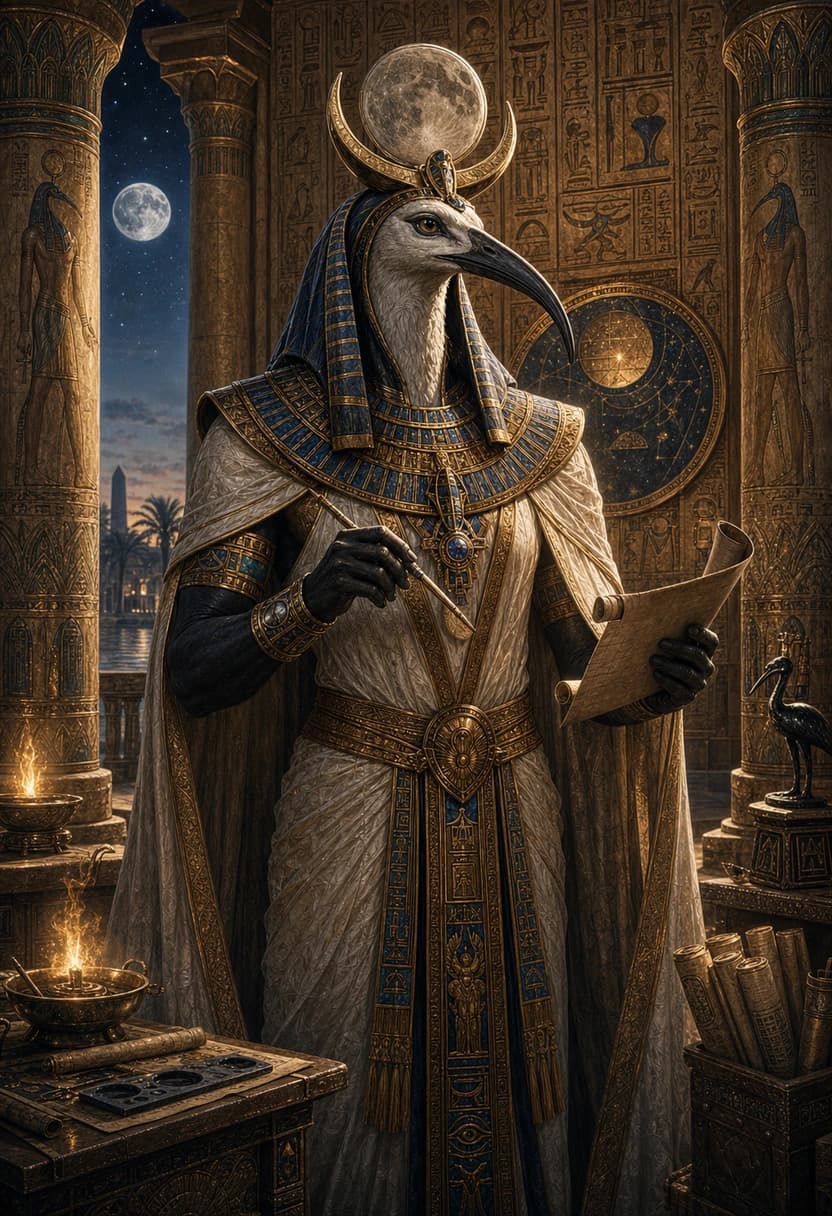
Thoth, the ibis-headed god of writing, stands by with his palette and writes the result. In some papyri a baboon, another form of Thoth, sits on top of the scale.
Osiris sits enthroned and presides. As the god who died and came back, he is the model every dead Egyptian hoped to follow.
What happened if your heart was heavier than the feather?
Ammit ate it. Ammit, "Devourer of the Dead", had the head of a crocodile, the front of a lion and the back of a hippopotamus, the three most dangerous animals Egyptians knew. She was a demon, not a goddess, and nobody worshipped her.
Losing your heart meant the end of your existence, sometimes called a "second death". There was no rebirth and no afterlife.
One striking detail: no Book of the Dead papyrus shows a failure. Every papyrus was made for a specific owner and was meant to guarantee success, so every scene ends with the heart in balance. The judgment was a real fear, but the papyri were designed to make sure it went well.
Could you cheat the weighing of the heart?
In a sense, yes, and Egyptians planned for it. Spell 30B, often carved on a heart scarab laid over the mummy's chest, speaks directly to the heart and begs it not to stand up as a witness against its owner in front of the scale.
This has caused a long debate among scholars. Was the judgment about living a moral life, or about owning the right spells? The honest answer is both: the negative confession lists real moral rules, but the Book of the Dead is also a magical toolkit for getting through.
Where did the dead go after passing?
The justified dead joined Osiris and could live in the Field of Reeds (Sekhet-Aaru), described in Spell 110 as a perfect Egypt with rich fields, canals and endless harvests. There was still farm work to do, which is why tombs were stocked with shabti figurines, small servants that would do the work for the owner.
Egypt's lord of the dead is often compared with the Greek one. See how Osiris stacks up against Hades in Hades vs Osiris.
In the sources
The judgment scene is best known from the Book of the Dead, the collection of roughly 190 spells written on papyrus for burials from the New Kingdom onward. Spell 125 contains the declarations of innocence; Spell 30B is the heart spell. The ideas behind it are older. The Coffin Texts of the Middle Kingdom already speak of judgment after death, and the Middle Kingdom Teaching for King Merikare warns of a divine court that judges the dead without mercy. The older Pyramid Texts, written for kings, focus on the king's rise to the sky rather than a judgment of ordinary people.
Differences between sources:
- Text vs picture. The words of Spell 125 are mostly the confession. The weighing itself is mainly shown in the painted vignettes, which vary from papyrus to papyrus.
- Feather or goddess. Some papyri put the feather of Ma'at on the scale; others put a small seated figure of Ma'at herself.
- Who presents the dead. In the Hunefer and Ani papyri Horus leads the justified dead to Osiris; other copies differ in cast and order.
- Morality or magic. The confession assumes a moral test, while Spell 30B assumes the heart can be persuaded to keep quiet.
In popular culture
- Moon Knight (Disney+, 2022). The show builds its plot on Ammit judging people before they do wrong, which reverses the Egyptian idea: the real judgment happened after death, based on a whole life. In the Duat episodes, the hippo goddess Taweret weighs the heroes' hearts on a scale, a nod to the real ritual. For more on the show's moon god, see Khonshu: The Real Moon God Behind Moon Knight.
Frequently asked questions
What was the weighing of the heart?
It was the ancient Egyptian judgment of the dead. The heart was weighed against the feather of Ma'at, and only a balanced heart let the person enter the afterlife.
What happened if your heart was heavier than the feather?
The monster Ammit ate the heart, and the person ceased to exist. There was no afterlife for them.
Who weighed the heart in Egyptian mythology?
Anubis tended the scale, Thoth recorded the result, and Osiris presided over the court. Ammit waited to devour hearts that failed.
What is Spell 125 of the Book of the Dead?
Spell 125 is the judgment spell. It contains the negative confession, in which the dead person denies committing a list of sins before 42 assessor gods.
Why did Egyptians weigh the heart and not the brain?
Egyptians believed the heart held a person's thoughts, memory and conscience. That is why the heart was usually left in the mummy while the brain was removed.
What was the feather of Ma'at?
It was the symbol of Ma'at, the goddess of truth, justice and cosmic order. A heart in balance with it showed the person had lived in harmony with Ma'at.
Did anyone ever fail the weighing of the heart?
No surviving Book of the Dead papyrus shows a failure. Each papyrus was made for its owner and was meant to guarantee a successful verdict.
Keep exploring
The weighing of the heart ties together half the Egyptian pantheon. Meet its gods in the Egyptian gods family tree, read more about Anubis, test what you learned with the Egyptian mythology quiz, or find out which Egyptian god you are.