Anubis is the ancient Egyptian god of embalming, cemeteries and the passage of the dead, shown as a black canine or a man with a canine's head. Before Osiris took over the afterlife, Anubis was Egypt's chief god of the dead. In the later tradition he is the god who wrapped Osiris as the first mummy and who tends the scales when a dead person's heart is weighed. He is a guardian, not a villain.
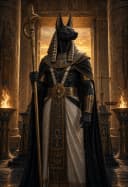
Anubis
Egyptian pantheon
Domain: Embalming, mummification, cemeteries, protection of the dead, guidance of souls
Anubis quick facts
| Fact | Detail |
|---|---|
| Egyptian name | Inpu (also written Anpu); "Anubis" is the Greek form |
| Animal | A black canine, traditionally called a jackal |
| Main roles | Embalmer, guardian of tombs, guide of the dead, keeper of the scales |
| Key titles | "Foremost of the Westerners", "He who is upon his mountain", "Lord of the sacred land", "He who is in the place of embalming" |
| Parents | Differ by period and source (see below) |
| Consort | Anput |
| Cult centre | Cynopolis ("dog city" in Greek), Upper Egypt |
| Greek-era form | Hermanubis, a merger with the Greek god Hermes |
| Main sources | Pyramid Texts, Coffin Texts, Book of the Dead, Plutarch's On Isis and Osiris (Greek-era) |
Why is Anubis a jackal?
The short answer: Egyptian cemeteries sat at the edge of the desert, and wild canines prowled them. People saw dogs and jackals digging near shallow graves. Making a canine the protector of the dead turned the threat into a guardian.
Which animal the Egyptians had in mind is less clear than the word "jackal" suggests. The canine of Egypt long called the golden jackal was reclassified in 2015 as the African golden wolf, a relative of wolves rather than true jackals. Egyptologists still debate which species inspired the god.
His black colour is not a sign of evil. Black was the colour of the fertile Nile mud and of a body darkened by natron and resin during embalming. For Egyptians it signalled rebirth, not death.
What was Anubis the god of?
Anubis had four overlapping jobs:
- Embalmer. He is "he who is in the place of embalming" and the patron of the priests who made mummies.
- Guardian of cemeteries. His title "he who is upon his mountain" pictures him watching the necropolis from the desert cliffs.
- Guide of the dead. He leads the deceased toward judgment.
- Keeper of the scales. In Book of the Dead papyri he checks the balance when the heart is weighed.
Embalming priests acted out his role. Book of the Dead vignettes show a figure of Anubis holding the upright mummy during funeral rites, and a ceramic Anubis mask from the Late Period survives in the Roemer- und Pelizaeus-Museum in Hildesheim, Germany. Scholars still debate whether a priest actually wore it or whether it was a model for lighter masks.
Was Anubis always the god of the dead?
No, and this is where Egypt's 3,000-year timeline matters. In the Old Kingdom, Anubis was the most important funerary god. Early offering prayers for the dead name him.
Osiris rose from the late Old Kingdom onward, and by the Middle Kingdom (c. 2000–1700 BCE) he had taken over as ruler of the dead. Anubis was not pushed out. He got a new job inside the Osiris myth. Even his title "Foremost of the Westerners" ("Westerners" meaning the dead, buried on the west bank) was later given to Osiris.
How is Anubis connected to Osiris?
In the Osiris myth, Set murders his brother Osiris and scatters the body. Isis and Nephthys gather the pieces, and Anubis embalms and wraps them, making Osiris the first mummy. That act became the model for every Egyptian burial afterward. Each dead person hoped to be treated as Osiris had been and to live again as he did.
Anubis also protects Osiris's body from Set. A Ptolemaic-era text, the Papyrus Jumilhac, tells how Set tried to reach Osiris's body disguised as a leopard, and Anubis caught him and branded his hide with a hot iron.
To see how Osiris compares with the Greek lord of the dead, try Hades vs Osiris.
Who are Anubis's parents?
Egyptian sources do not agree. Rather than pick one answer, here is who says what:
| Parents | Source / period |
|---|---|
| Ra | Early tradition, Old Kingdom era |
| Hesat (a cow goddess) or Bastet | Coffin Texts, First Intermediate Period / Middle Kingdom |
| Ra and Nephthys | Another Egyptian tradition (period less clear) |
| Osiris and Isis | Common later understanding once he joined the Osiris family |
| Osiris and Nephthys, raised by Isis | Plutarch, On Isis and Osiris, 1st–2nd century CE (Greek-era) |
| Isis and Serapis | Ptolemaic period |
Plutarch's version is the one most websites repeat. He says Nephthys bore Anubis to Osiris, and Isis found and raised the child, who became her guard. That is a Greek writer describing Egyptian belief roughly 3,000 years after the earliest texts, so treat it as one late tradition, not "the" answer.
What does Anubis do at the weighing of the heart?
In the judgment scene of the Book of the Dead (Spell 125 and its illustrations), the dead person's heart is placed on one pan of a scale and the feather of Ma'at, meaning truth and order, on the other. Anubis usually kneels by the scale and checks that it balances. Thoth, the ibis-headed scribe, writes down the result, and Ammit, the Devourer, waits in case the heart fails.
Anubis does not pronounce the verdict. That belongs to Osiris and his court. Anubis is the one who makes sure the weighing is fair. The whole ritual is explained step by step in The Weighing of the Heart.
Is Anubis evil?
No. Anubis is a protector, and nothing in Egyptian religion casts him as a villain. The "evil Anubis" idea comes from films and games that turn anything linked to death into a monster. In Egypt the god of disorder and violence was Set. Anubis was the one guarding the dead from people like Set.
Is Anubis the same as Wepwawet?
No, though they are often confused. Wepwawet ("Opener of the Ways") was a separate canine god, worshipped mainly at Asyut, which the Greeks called Lycopolis ("wolf city"). He was a warrior and royal god whose standard led processions. Over time the two became closely linked in funerary contexts, and in art they can look almost identical. Look for the name in the inscription.
How was Anubis worshipped?
His main cult centre was Cynopolis in Upper Egypt, a name the Greeks gave it meaning "dog city". At Saqqara, the Dog Catacombs dedicated to him held an estimated eight million animal mummies, about nine in ten of them dogs, according to a 2015 study led by Cardiff University. Pilgrims paid for them as offerings to the god.
The most famous image of Anubis comes from the tomb of Tutankhamun: a gilded shrine topped by a black recumbent jackal, found guarding the treasury room.
In the Ptolemaic and Roman periods, Greeks matched Anubis with Hermes, who also guided souls, and worshipped the combined god Hermanubis. His cult reached Rome.
In the sources
Anubis appears in the Pyramid Texts, the oldest Egyptian religious writings, carved in royal pyramids of the Old Kingdom, and in the Coffin Texts of the First Intermediate Period and Middle Kingdom. He is central to the Book of the Dead, the New Kingdom collection of spells written on papyrus for ordinary tombs, where he tends the scales in the judgment scene. Plutarch's On Isis and Osiris gives a Greek-era version of his birth and role.
Contradictions to keep in mind:
- Parents. At least six parentages exist across the periods (see the table above). None is "correct".
- Ruler of the dead or servant of Osiris? In the Old Kingdom he ruled the dead himself; later he is Osiris's embalmer and helper. Both are "true", but for different eras.
- Who judges? Some modern retellings say Anubis passes judgment. In the Book of the Dead, he runs the scale and Osiris presides.
In popular culture
- The Mummy Returns (2001). The Scorpion King sells his soul to Anubis in exchange for an army of jackal-headed warriors. The pact and the army are the film's invention, and they make Anubis a god of conquest, which he never was.
- Gods of Egypt (2016). Anubis appears as the escort of the dead to the afterlife. That role at least matches the ancient one.
- Stargate SG-1. Anubis is one of the series' chief villains, an alien posing as a god. It borrows the name and none of the character.
Frequently asked questions
Who is Anubis in Egyptian mythology?
Anubis is the Egyptian god of embalming, cemeteries and the dead, shown as a black jackal or a jackal-headed man. He protected tombs and guided the dead to judgment.
Is Anubis good or evil?
Anubis is a protective god, not an evil one. His black colour symbolised rebirth and the fertile Nile mud, not darkness.
Who are Anubis's parents?
It depends on the source. Early traditions make him a son of Ra, the Coffin Texts name Hesat or Bastet, and Plutarch says he was the son of Osiris and Nephthys, raised by Isis.
What does Anubis do in the weighing of the heart?
He checks the scale where the dead person's heart is weighed against the feather of Ma'at. Thoth records the result and Osiris presides over the judgment.
Is Anubis a jackal or a dog?
Egyptians drew him as a black canine that is traditionally called a jackal. Scholars still debate which species inspired him, since the Egyptian 'jackal' is now classified as the African golden wolf.
Why did Anubis mummify Osiris?
In the Osiris myth, Anubis embalmed the murdered Osiris after Isis and Nephthys gathered his body, making him the first mummy. Every later Egyptian burial copied that act.
Keep exploring
Anubis only makes sense next to the gods he served. Read how he fits into The Weighing of the Heart, meet Thebes' moon god in Khonshu: The Real Moon God Behind Moon Knight, trace the family lines in the Egyptian gods family tree, or test yourself with the Egyptian mythology quiz and find out which Egyptian god you are. For every other deity in his world, start with Egyptian Gods and Goddesses: The Major Deities Explained.