Quick summary
- Egyptian religion had hundreds of gods over some 3,000 years; the core figures are the sun god Ra and the nine gods of the Ennead of Heliopolis.
- Set murdered his brother Osiris, Isis restored him, and their son Horus won the throne before a tribunal of the gods.
- Ra, and later Amun-Ra in the New Kingdom, ranked as king of the gods, but each great city told its own story of creation.
- The fullest telling of Osiris's murder is by Plutarch, a Greek writer; Egyptian texts allude to the killing but rarely narrate it.
Ancient Egyptian religion had hundreds of gods and goddesses, worshipped over roughly 3,000 years with no fixed list or holy book. The core figures are the sun god Ra and the nine gods of the Ennead of Heliopolis: the creator Atum, Shu and Tefnut, Geb and Nut, and the siblings Osiris, Isis, Set and Nephthys. Around them stand Horus, Anubis, Thoth, Hathor, Amun and many more, each tied to a home city and often an animal. The murder of Osiris and the rise of Horus explained kingship and the afterlife.
The main Egyptian gods at a glance
| God | Domain | Known for | Family / group |
|---|---|---|---|
| Ra (Re) | The sun, creation, kingship | Sailing the sun boat day and night | Heliopolis; merged with Atum, Horus, Amun |
| Amun (Amun-Ra) | Hidden power, kingship | King of the gods in the New Kingdom | Theban triad with Mut and Khonsu |
| Atum | Creation, the evening sun | Making the first gods alone | Head of the Ennead |
| Osiris | The dead, rebirth, fertility | Murdered, revived, ruler of the dead | Ennead; son of Geb and Nut |
| Isis | Magic, motherhood | Restoring Osiris, hiding baby Horus | Ennead; wife of Osiris |
| Horus | The sky, kingship | Winning the throne from Set | Son of Osiris and Isis |
| Set | Storms, desert, foreign lands | Killing Osiris; spearing Apep | Ennead; brother of Osiris |
| Nephthys | Mourning, protection of the dead | Lamenting Osiris with Isis | Ennead; wife of Set |
| Anubis | Embalming, cemeteries | Wrapping Osiris as the first mummy | Parents differ by source |
| Thoth | Writing, wisdom, the moon | Recording the weighing of the heart | Hermopolis |
| Ma'at | Truth, justice, order | The feather on the scale | Daughter of Ra |
| Hathor | Love, music, joy | Serving as the Eye of Ra | Daughter or Eye of Ra |
| Sekhmet | War, plague, healing | Nearly wiping out humanity | Consort of Ptah |
| Bastet | Cats, home, protection | The festival at Bubastis | Daughter of Ra |
| Ptah | Creation, craftsmen | Creating by thought and word | Memphite triad |
| Khonsu (Khonshu) | The moon, time, healing | The Cannibal Hymn; Moon Knight | Theban triad |
| Sobek | Crocodiles, the Nile | Sacred crocodiles of the Faiyum | Kom Ombo |
| Shu | Air, light | Holding up the sky | Ennead |
| Tefnut | Moisture | The lioness who left for Nubia | Ennead |
| Geb | The earth | Judging between Horus and Set | Ennead |
| Nut | The sky | Swallowing the sun each evening | Ennead |
| Mut | Motherhood, queenship | Consort of Amun | Theban triad |
| Khepri | The morning sun | The scarab who rolls the sun | Form of the sun god |
| Khnum | Creation, the Nile flood | Shaping people on a potter's wheel | Elephantine |
| Neith | Creation, war | Advising the gods at Horus's trial | Sais |
| Taweret | Childbirth | Guarding mothers and newborns | Household goddess |
| Bes | Home, birth, children | Scaring off evil spirits | Household god |
| Aten | The sun disk | Akhenaten's state god | Amarna period |
| Apep (Apophis) | Chaos | Attacking the sun boat nightly | Enemy of the gods |
| Ammit | Devourer of the dead | Eating hearts that fail judgment | Demon, not worshipped |
Ra: the sun god at the head of the gods
Ra (also Re) was the sun god, worshipped above all at Heliopolis, near modern Cairo; from the Old Kingdom on, kings called themselves "Son of Ra". Each night he sailed through the Duat, the underworld, where the serpent Apep tried to stop him, and was reborn at dawn.
In the Book of the Heavenly Cow, an aging Ra sends his Eye, as Hathor, to punish plotting humans; she becomes Sekhmet and starts a massacre. Ra stops her with beer dyed red like blood, then withdraws to the sky on the back of Nut, transformed into a cow.
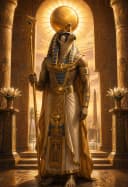
Ra (Re)
Egyptian pantheon
Domain: The sun, creation, kingship, the daily cycle of death and rebirth
Amun: the hidden god who became Amun-Ra
Amun, "the hidden one", rose with the rulers of Thebes. Merged with the sun as Amun-Ra, he was king of the gods in the New Kingdom, with a vast temple at Karnak. Reliefs in Hatshepsut's temple at Deir el-Bahari show Amun, in the form of Thutmose I, fathering her. Akhenaten had Amun's name hacked out of monuments, but the god returned after his death.
Atum: the creator who made the first gods
In the creation story of Heliopolis, Atum, "the complete one", rose from Nun, the primeval waters, and made the first gods alone. The Pyramid Texts picture it two ways: by masturbation in one spell, by sneezing out Shu and spitting out Tefnut in another. He was also the evening sun. In Book of the Dead Spell 175 he warns that he will one day return the world to the waters, leaving only himself and Osiris.
Osiris: the murdered king who rules the dead
Osiris, eldest son of Geb and Nut, was a king of Egypt killed by his brother Set. Isis and Nephthys mourned him, Anubis embalmed him as the first mummy, and Isis conceived Horus from his revived body. He became ruler of the dead and presided over the weighing of the heart. A Middle Kingdom stela of the official Ikhernofret describes his festival processions at Abydos, which scholars read as a reenactment of the god's death and return. Compare him with Hades in Hades vs Osiris.
Isis: the great magician and mother
Isis, sister and wife of Osiris, was the greatest magician among the gods. A New Kingdom magical papyrus tells how she shaped a snake from earth and the aging Ra's spittle; it bit him, and she cured him only after he revealed his secret name. She hid the infant Horus in the marshes of Khemmis, and the Metternich Stela tells how seven scorpions guarded her on her travels.
Horus: the falcon god of kingship
Horus, son of Osiris and Isis, was the falcon god of the sky and of kingship; every living pharaoh was Horus on earth. The 20th Dynasty Contendings of Horus and Set stages his claim to the throne as an 80-year trial before the Ennead. The rivals turn into hippopotamuses and race boats, and Set tears out Horus's eyes, which Hathor heals with gazelle milk. At last Osiris writes from the underworld, and Horus is crowned. His injured and restored eye, the wedjat, became a protective amulet.
Set: storm god, murderer and defender of Ra
Set, the killer of Osiris, was the god of storms, the desert, foreign lands and violence, shown with the head of an animal no one has identified. Yet in the Contendings he boasts that he kills Ra's enemy every day from the prow of the sun boat, and the 19th Dynasty honored him: Seti I's name means "he of Set". Egyptologists date his recasting as an enemy of the gods to the first millennium BCE.
Nephthys: sister, mourner and protector
Nephthys, "Lady of the House", was a daughter of Geb and Nut and the wife of Set, yet she mourned the murdered Osiris beside Isis. The two sisters appear as kites at his bier, and the Ptolemaic Papyrus Bremner-Rhind preserves laments sung in their names. With Isis, Neith and Serqet she guarded the jars holding the organs of the dead. Plutarch adds that she bore Anubis to Osiris.
Anubis: guardian of the dead
Anubis, a black jackal or jackal-headed man, was the god of embalming and cemeteries. In the Old Kingdom he was the chief god of the dead; once Osiris took over that role, Anubis became the god who wrapped Osiris as the first mummy and tends the scale at the judgment. His black color stood for fertile Nile mud and rebirth, not evil.
Thoth: scribe of the gods
Thoth, an ibis, ibis-headed man or baboon, was the god of writing, knowledge and the moon, worshipped above all at Hermopolis. He records the verdict at the weighing of the heart. Plutarch, who calls him Hermes, tells how the Sun cursed Nut so she could give birth in no month or year; Thoth won a seventieth of the Moon's light at draughts and made five extra days for her children. The Greeks matched him with Hermes.
Ma'at: truth and cosmic order
Ma'at was both a goddess and the principle of truth, justice and order; its opposite was isfet, chaos. She wears an ostrich feather and is called a daughter of Ra. Upholding Ma'at was the king's first duty, and temple reliefs show pharaohs offering a small figure of her to the gods. In the judgment scene that illustrates Book of the Dead Spell 125, the heart is weighed against her feather.
Hathor: love, music and the Eye of Ra
Hathor, a cow or a woman with cow horns and a sun disk, was the goddess of love, music and joy, with her great temple at Dendera. She could also be the furious Eye of Ra. In the Contendings she heals Horus's eyes, and when Ra sulks after an insult, she uncovers herself before him until he laughs. The Greeks matched her with Aphrodite.
Sekhmet: lioness of war and plague
Sekhmet, "the Powerful One", was a lion-headed goddess of war, plague and healing. In the Book of the Heavenly Cow she is the form Ra's Eye takes when it nearly destroys humanity. Because she could send disease, she could also remove it, and her priests worked as healers. She was Ptah's consort at Memphis, and Amenhotep III set up hundreds of granodiorite statues of her at Thebes.
Bastet: the cat goddess of Bubastis
Bastet began as a lioness goddess and later became a cat or cat-headed woman, protector of the home, mothers and children. Her city was Bubastis in the Delta. The Greek historian Herodotus describes her festival there: boatloads of pilgrims singing and clapping, and more wine drunk than in the rest of the year.
Ptah: the craftsman who created by speech
Ptah, the god of Memphis, was shown wrapped like a mummy in a close-fitting cap. He was the patron of craftsmen, matched by the Greeks with Hephaestus. The Memphite Theology, carved on the Shabaka Stone in the 25th Dynasty, makes him creator of all: he conceived the world in his heart and spoke it into being.
Khonsu (Khonshu): the moon god of Thebes
Khonsu, "the traveller", was the moon god of Thebes and the son of Amun and Mut. Marvel's Moon Knight spells him "Khonshu". His oldest appearance is violent: in the Cannibal Hymn of the Pyramid Texts he butchers gods for the king. By the New Kingdom he was a youthful, protective god with his own temple at Karnak, later famed as a healer.
Sobek: the crocodile god
Sobek, a crocodile or crocodile-headed man, was a god of the Nile, fertility and royal power, worshipped in the Faiyum and at Kom Ombo, where he shares a double temple with Horus the Elder. Herodotus says people around Thebes and Lake Moeris kept a tame crocodile decked with earrings and bracelets. In Book of the Dead Spell 113, Sobek fishes up Horus's hands after Isis cuts them off, and the fish trap comes into being.
Other Egyptian gods and goddesses
- Shu and Tefnut. Air and moisture, Atum's first children; Shu holds Nut above the earth. In late versions of the Distant Goddess myth, Tefnut flees to Nubia as a lioness and must be coaxed home.
- Geb and Nut. Earth and sky, parents of Osiris, Isis, Set and Nephthys. Nut swallows the sun at evening and births it at dawn. In the Memphite Theology, Geb divides Egypt between Horus and Set, then gives it all to Horus.
- Khnum. The ram god of Elephantine who shapes people on a potter's wheel.
- Neith. A creator and warrior goddess of Sais; in the Contendings she advises giving Horus the throne.
- Taweret and Bes. Protectors of mothers and newborns: a pregnant hippopotamus, and a lion-faced dwarf shown face-on.
- Aten. The sun disk, made the center of state worship by Akhenaten in the 18th Dynasty.
- Apep (Apophis). The chaos serpent who attacks Ra's boat nightly; rituals cursed and burned his image.
- Ammit. The Devourer, part crocodile, lion and hippo, a demon who eats hearts that fail judgment.
Who is the most powerful Egyptian god?
Ra, for most of Egyptian history, and Amun-Ra in the New Kingdom, when Thebes ruled Egypt. A Ramesside hymn on Papyrus Leiden I 350 even says that all gods are three: Amun, Ra and Ptah. The answer still depends on era and city: at Memphis Ptah created everything, at Heliopolis Atum did, and under Akhenaten the Aten stood alone.
How many Egyptian gods are there?
There is no fixed number; Egyptian gods multiplied, merged and split over three millennia. The often-quoted figure of more than 1,500 is a rough modern estimate, not an ancient count, and depends on whether you count local forms, merged gods like Amun-Ra, and underworld demons. Map the major ones in the Egyptian gods family tree.
What are the Ennead and the Ogdoad?
The Ennead is the nine gods of Heliopolis: Atum, Shu and Tefnut, Geb and Nut, and Osiris, Isis, Set and Nephthys.
The Ogdoad is the eight gods of Hermopolis, four pairs embodying the world before creation. The commonest list pairs Nun and Naunet (water), Heh and Hauhet (endlessness), Kek and Kauket (darkness), and Amun and Amaunet (hiddenness). Late temple reliefs show the males frog-headed and the females snake-headed.
Why do Egyptian gods have animal heads?
Egyptologists generally read animal heads as signs of a god's nature, not claims that the god looked like an animal. The falcon soars over everything, fitting a sky and kingship god like Horus; jackals prowled cemeteries, so Anubis guards them. One god could take several animal forms, as Thoth did with ibis and baboon, while Ptah and Osiris were shown fully human.
Who killed Osiris?
His brother Set. The fullest account is Plutarch's: Set, whom he calls Typhon, tricked Osiris into a chest built to his exact size, nailed it shut and threw it into the Nile. Isis recovered the body, but Set tore it into fourteen pieces; she found all but the phallus. Egyptian texts allude to the killing but rarely narrate it: the Pyramid Texts say Set struck Osiris down, and the Memphite Theology says he drowned.
In the sources
- Pyramid Texts. Spells carved in royal pyramids from the end of the 5th Dynasty, the oldest surviving Egyptian religious texts.
- Book of the Dead. Papyrus spells from the New Kingdom on, including Spells 113, 125 and 175.
- Book of the Heavenly Cow. First known from a gilded shrine of Tutankhamun, then from royal tombs; the source for Sekhmet's massacre.
- Memphite Theology. On the Shabaka Stone (25th Dynasty), which claims to copy a worm-eaten older text; its true age is debated.
- The Contendings of Horus and Set. A 20th Dynasty story on Papyrus Chester Beatty I.
- Plutarch's On Isis and Osiris. By a Greek author of the 1st to 2nd century CE, the fullest continuous narrative of the Osiris myth.
Contradictions to flag:
- Rival creation stories. Heliopolis credits Atum, Memphis Ptah, Hermopolis the Ogdoad, and Thebes Amun, side by side.
- Two Horuses. Horus the Elder, whom Plutarch makes a brother of Osiris, and Horus son of Isis were distinct figures that texts often blur.
- Set's reputation. Osiris's murderer in the Pyramid Texts, yet defender of Ra's boat and honored by 19th Dynasty kings.
- One goddess or two? The Book of the Heavenly Cow turns Hathor into Sekhmet; elsewhere they have separate cults.
In popular culture
- Moon Knight (Disney+, 2022). Built around Khonshu, with Ammit as his rival and Taweret in the Duat; the rivalry and avatar are Marvel's.
- The Mummy (1999). Its Book of the Dead raises the dead; the real one guided the dead through judgment. Imhotep borrows the name of a real official later worshipped as a healer god.
- Gods of Egypt (2016). Set seizes the throne and takes Horus's eyes, loosely echoing the Contendings.
- Stargate (1994) and Stargate SG-1. Ra, Apophis and others become alien impostors.
Frequently asked questions
Who are the main Egyptian gods?
Ra, Amun, Osiris, Isis, Horus, Set, Nephthys, Anubis, Thoth, Ma'at, Hathor, Sekhmet, Bastet and Ptah. The nine gods of the Ennead of Heliopolis formed the core family.
Who is the king of the Egyptian gods?
Ra, the sun god, for most of Egyptian history. In the New Kingdom he merged with Amun of Thebes as Amun-Ra, king of the gods.
How many Egyptian gods are there?
No fixed number exists. The often-quoted figure of more than 1,500 is a rough modern estimate that depends on how local forms, merged gods and demons are counted.
Who killed Osiris?
His brother Set. Plutarch says Set trapped him in a chest and later tore his body apart; Egyptian texts allude to the murder but rarely narrate it.
Who is the Egyptian god of death?
Osiris ruled the dead and presided over their judgment. Anubis, chief god of the dead before him, was the god of embalming who tended the scale.
What is the Eye of Horus?
It is the eye of Horus injured in his fight with Set and then restored. As the wedjat, it became a popular protective amulet.
Keep exploring
Go deeper with Anubis: Why the Jackal Guards the Dead, Khonshu: The Real Moon God Behind Moon Knight and the weighing of the heart. Compare Greek gods and their powers, then take the Egyptian mythology quiz and find out which Egyptian god you are.