Thor is the Norse god of thunder, strength and protection, the son of Odin and the giantess Jörð (Earth). With his hammer Mjölnir he defends gods and humans against the giants, and he was probably the most widely worshipped god of the Viking Age. His myths are full of brawls, feasts and humiliating tricks, and they end at Ragnarök, where he kills the World Serpent and dies from its venom.
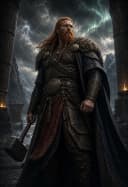
Thor
Norse pantheon
Domain: Thunder, storms, strength, protection of gods and humans
Thor quick facts
| Fact | Detail |
|---|---|
| Old Norse name | Þórr |
| Parents | Odin and Jörð (Earth) |
| Wife | Sif |
| Children | Thrud (Þrúðr), Magni, Móði; stepson Ullr |
| Weapon | The hammer Mjölnir |
| Other gear | Megingjörð (belt of strength) and iron gloves |
| Animals | Goats Tanngrisnir and Tanngnjóstr, who pull his chariot |
| Home | Hall Bilskírnir in Þrúðvangr |
| Enemy | The giants, above all Jörmungandr, the World Serpent |
| Fate | Kills Jörmungandr at Ragnarök, then dies of its venom |
| Weekday | Thursday (Old English Þunresdæg, "Thunor's day") |
Is Thor Odin's son?
Yes. Snorri's Gylfaginning names Odin as his father and Jörð, the Earth personified, as his mother — not Frigg. In the Eddic poem Hárbarðsljóð, Thor proudly introduces himself as Odin's son, not realizing that the rude ferryman insulting him across the water is Odin in disguise.
What Thor is not is Loki's brother. Loki is Odin's blood brother and Thor's travelling companion, sometimes his helper and sometimes his tormentor. The brotherly rivalry is a Marvel invention.
Snorri's prologue to the Prose Edda adds a strange extra version: there, Thor is Tror, a grandson of King Priam of Troy, married to the prophetess Sibyl, whom the prologue equates with Sif. This learned, Christian-era theory is not a myth anyone told in the Viking Age.
How was Mjölnir made?
The story is in Snorri's Skáldskaparmál, and it starts with a prank. Loki cut off all of Sif's golden hair. Thor threatened to break every bone in his body, so Loki went to the dwarves called the sons of Ívaldi, who made new hair of real gold, along with the ship Skíðblaðnir and Odin's spear Gungnir.
Then Loki bet his head that the dwarf Brokkr's brother could not make three treasures as good. While the brothers worked the forge, Loki turned into a fly and stung Brokkr to break his rhythm. The results were:
- Gullinbursti, a golden boar, for Freyr.
- Draupnir, a gold ring, for Odin.
- Mjölnir, for Thor — with a handle a little too short, because the fly stung Brokkr on the eyelid during the last forging.
The gods judged the hammer the best treasure of all. It would never miss, it always came back to Thor's hand, and it could shrink small enough to carry inside his shirt. Loki lost the bet, but he argued that Brokkr could take his head and not his neck, so the dwarf sewed his lips shut instead.
Why did Thor dress as a bride?
To get his hammer back. In the comic poem Þrymskviða, Thor wakes to find Mjölnir gone. The giant Þrymr has hidden it deep underground and will return it only if the goddess Freyja becomes his wife. Freyja's refusal is so furious that her necklace, Brísingamen, bursts.
Heimdall proposes the solution: dress Thor as the bride, veil and all. Loki goes along as the bridesmaid. At the wedding feast, the "bride" eats a whole ox and eight salmon and drinks three casks of mead, and Loki explains that Freyja has not eaten for eight nights out of longing. When Þrymr brings out the hammer to bless the bride, Thor grabs it and kills the giant and his kin.
What happened to Thor in Útgarðr?
He lost every contest — or seemed to. In Gylfaginning, Thor, Loki and two human servants, Þjálfi and Röskva, visit the giant king Útgarða-Loki. Thor fails to drain a drinking horn, can lift only one paw of a grey cat, and is forced to one knee by an old woman.
Next morning the king reveals the truth: the horn's end lay in the sea, and Thor's drinking caused the tides; the cat was Jörmungandr, the serpent circling the world; and the old woman was Elli, old age itself, which defeats everyone. The giants had been terrified.
The servants came from an earlier stop on that trip. Thor cooked his goats for a farming family and raised them the next morning with his hammer — but one goat was lame, because the farmer's son Þjálfi had split a thigh bone for the marrow. The family gave Thor their two children as payment.
Did Thor catch Jörmungandr?
Almost. In Hymiskviða, Thor goes fishing with the giant Hymir, baits his hook with an ox head and hauls up the World Serpent. He strikes its head with his hammer, and the serpent sinks back into the sea. Snorri's Gylfaginning tells it with more drama: Thor braces so hard that his feet go through the boat's bottom, and the terrified Hymir cuts the line just as Thor raises his hammer.
Snorri then adds a telling note. Some people say Thor struck the serpent's head off on the sea floor, he writes, but he believes the serpent is still alive. Their final meeting is at Ragnarök.
Who are Thor's wife and children?
| Family member | Relationship | Source note |
|---|---|---|
| Sif | Wife | Famous for her golden hair |
| Thrud | Daughter with Sif | Her name means "strength"; usually taken to be the daughter the dwarf Alvíss tries to marry |
| Magni | Son by the giantess Járnsaxa | Inherits Mjölnir after Ragnarök |
| Móði | Son | Inherits Mjölnir with Magni |
| Ullr | Stepson, Sif's son | A god of archery and skis |
Magni's power shows early. In Skáldskaparmál, after Thor kills the giant Hrungnir and is pinned under the giant's leg, the three-night-old Magni lifts it off when no god can. Explore the whole household on the Norse family tree.
How does Thor die at Ragnarök?
He wins his last fight and dies anyway. In Völuspá and Gylfaginning, Thor meets Jörmungandr on the final battlefield and kills it, but he walks only nine steps before falling dead from the poison it spat on him. The poem Vafþrúðnismál says his sons Móði and Magni will hold Mjölnir in the renewed world. The full sequence is in Ragnarök: Every Event, In Order.
Who would win: Thor or Zeus?
No ancient source stages that fight, so any answer is a fan verdict. The myths do suggest a contrast. Zeus is king of the gods and throws the thunderbolt from above; Thor is not a king at all but a defender who walks (he wades rivers rather than riding over the Bifröst bridge, according to Grímnismál) and fights at close range. Zeus usually wins; Thor usually wins too, but he can be tricked, shamed and, in the end, killed. Interestingly, the Romans matched Thor with Jupiter, Zeus's Roman counterpart — the reason Thursday is his day. For the rulers of each pantheon, try the Zeus vs Odin comparison.
Why is Thursday named after Thor?
Latin dies Iovis, "Jupiter's day," became Old English Þunresdæg, after Thunor, the English form of Thor, because both were sky gods of thunder. Old Norse had Þórsdagr, and modern Scandinavian languages have torsdag.
In the sources
- Poetic Edda — Þrymskviða (the stolen hammer), Hymiskviða (the fishing trip), Hárbarðsljóð (the flyting with Odin in disguise), Alvíssmál (Thor outwits the dwarf who wants his daughter, usually taken to be Thrud), Lokasenna, Völuspá and Vafþrúðnismál (Ragnarök and after).
- Snorri Sturluson's Prose Edda — the Prologue (Thor as Tror of Troy), Gylfaginning (his family, goats, Útgarða-Loki, the fishing, Ragnarök) and Skáldskaparmál (the making of Mjölnir, the duel with Hrungnir).
- Adam of Bremen — an 11th-century Christian cleric who described the temple at Uppsala with Thor in the central place, flanked by Wodan and Fricco (Freyr).
- Saxo Grammaticus, Gesta Danorum — a Christian-era Danish history in Latin, where Thor appears as a fighter among gods treated as human sorcerers.
Contradictions to flag:
- The fishing trip's ending. Hymiskviða lets the serpent sink; Snorri has Hymir cut the line and reports a variant in which Thor kills it, which he rejects.
- Thor's origin. Snorri's Gylfaginning makes him Odin's son, while Snorri's own Prologue turns him into a Trojan prince. Snorri, a 13th-century Christian, was trying to fit the old gods into learned history.
In popular culture
- Marvel. Thor first appeared in Journey into Mystery #83 (1962), and Chris Hemsworth has played him on screen since Thor (2011). Marvel keeps the hammer, the thunder and Odin as his father, but makes Loki his adopted brother and gives him a human love interest, Jane Foster.
- God of War Ragnarök (2022). Ryan Hurst voices a heavyset, grieving Thor who serves Odin as an enforcer — closer to the brawling, hard-drinking Thor of the sources than Marvel's version, though his tragic arc is original.
- Everyday life. Thursday keeps his name alive, and hammer pendants modelled on Viking-Age amulets are still widely worn.
Frequently asked questions
Who is Thor in Norse mythology?
Thor is the Norse god of thunder, strength and protection, son of Odin and Jörð. He guards gods and humans against the giants with his hammer Mjölnir.
Is Thor Odin's son?
Yes. The Prose Edda and the Eddic poems make Thor the son of Odin and Jörð (Earth). Frigg is his stepmother, not his mother.
Is Loki Thor's brother?
No. In the myths Loki is Odin's blood brother and Thor's companion on several adventures. Marvel made him Thor's adopted brother.
Who made Thor's hammer?
The dwarf brothers Brokkr and Eitri (also called Sindri in some manuscripts) forged Mjölnir after Loki bet his head against their skill, according to Snorri's Skáldskaparmál.
Who is Thor's wife?
Sif, the golden-haired goddess. Their daughter is Thrud, and Sif's son Ullr is Thor's stepson.
How does Thor die?
At Ragnarök Thor kills the World Serpent Jörmungandr, then walks nine steps and falls dead from its venom.
Keep exploring
Thor's story is tied to the monsters he fights and the family he protects. Read about his nemesis in Jörmungandr: The Serpent That Circles the World, his wife in Sif and his father in Odin in Norse Mythology. Then find out whether you are more Thor than Odin with the Which Norse God Are You? quiz, or test what you know with the Norse mythology quiz. For the rest of Asgard, see Norse Gods and Goddesses: Every Major Deity Explained.