Quick summary
- The Norse gods form two families, the Æsir led by Odin and the Vanir of Njörðr, Freyr and Freyja, known mainly from the Poetic Edda and Snorri's Prose Edda.
- Odin rules and Thor is the strongest, but neither escapes fate: at Ragnarök Fenrir swallows Odin and Thor dies of the World Serpent's venom.
- The gods are not immortal. They stay young only by eating Iðunn's apples, and Baldr, Mímir and Kvasir are killed long before the end.
- Snorri's Gylfaginning says there are twelve divine Æsir, then describes fourteen gods, Odin and Loki included, plus more than a dozen goddesses.
The Norse gods and goddesses form two families, the Æsir and the Vanir, and we know them mainly from the anonymous poems of the Poetic Edda and from Snorri Sturluson's 13th-century Prose Edda. Odin leads them, Thor defends them, and the Vanir Njörðr, Freyr and Freyja joined the Æsir after a war between the two families. Unlike the Greek Olympians, these gods are mortal: they stay young only by eating Iðunn's apples, and most of them die at Ragnarök.
The Norse gods at a glance
| God | Domain | Known for | Family / group |
|---|---|---|---|
| Odin | Wisdom, poetry, magic, war, the dead | Gave an eye for wisdom; Valhalla | Æsir; son of Borr and Bestla |
| Frigg | Marriage, motherhood, foresight | Knows every fate but tells none | Æsir; Odin's wife |
| Thor | Thunder, strength, protection | The hammer Mjölnir | Æsir; son of Odin and Jörð |
| Loki | Trickery, shapeshifting | Arranged Baldr's death | Giant's son, counted among the Æsir |
| Baldr | Light, beauty, goodness | Killed by a mistletoe dart | Æsir; son of Odin and Frigg |
| Týr | War, law, oaths | Lost his hand to Fenrir | Æsir; Odin's son or Hymir's |
| Heimdall | Watchman of the gods | Guards Bifröst, blows Gjallarhorn | Æsir; son of nine mothers |
| Freyja | Love, fertility, magic, war | Takes half the battle-slain | Vanir; Njörðr's daughter |
| Freyr | Fertility, harvest, peace | Gave away his sword for love | Vanir; Njörðr's son |
| Njörðr | Sea, wind, wealth | Skaði chose him by his feet | Vanir; father of Freyr and Freyja |
| Sif | Family, beauty | Golden hair cut off by Loki | Æsir; Thor's wife |
| Hel | The dead | Rules the realm of the dead | Daughter of Loki and Angrboða |
| Iðunn | Youth | Keeps the apples of youth | Bragi's wife |
| Bragi | Poetry, eloquence | Poetry is named after him | Æsir; Iðunn's husband |
| Skaði | Skiing, hunting, mountains | Came to Asgard armed for revenge | Giantess, daughter of Þjazi |
| Víðarr | Vengeance, silence | Kills Fenrir at Ragnarök | Æsir; son of Odin and Gríðr |
| Váli | Vengeance | Killed Höðr at one night old | Æsir; son of Odin and Rindr |
| Höðr | Blindness, darkness | Threw the dart that killed Baldr | Æsir; Odin's son |
| Forseti | Justice, reconciliation | Settles every dispute in Glitnir | Son of Baldr and Nanna |
| Ullr | Archery, skiing, single combat | Unmatched archer and skier | Sif's son, Thor's stepson |
| Mímir | Wisdom | His well cost Odin an eye | Æsir; hostage to the Vanir |
| Ægir and Rán | The sea | Brewing ale; Rán's drowning net | Ægir a giant; Rán his wife |
| The Norns | Fate | Urðr, Verðandi and Skuld | Powers at the well of Urðr |
| Thrud | Strength | Likely the bride the dwarf Alvíss claims | Daughter of Thor and Sif |
| The Valkyries | Battle and death | Choose the slain for Valhalla | Odin's servants |
Who are the Æsir and the Vanir?
The Æsir are the main family of Norse gods, living in Asgard: Odin, Frigg, Thor, Baldr, Týr and most others. The Vanir, from Vanaheim, are gods of fertility, wealth and the magic called seiðr; the ones we know by name are Njörðr, Freyr and Freyja. The two families once fought a war, and the sources tell it three ways.
- Völuspá says the war began after the Æsir pierced Gullveig with spears and burned her three times in Odin's hall, and three times she was reborn. Odin hurled his spear into the enemy host, and the Vanir broke the Æsir's wall. The poem mentions no peace.
- Ynglinga saga, Snorri's history of the Swedish kings, says neither side could win, so they exchanged hostages: the Vanir sent Njörðr, Freyr and the wise Kvasir, the Æsir sent Hœnir and Mímir. Feeling cheated by Hœnir, the Vanir beheaded Mímir and sent his head back.
- Gylfaginning, also by Snorri, trades Njörðr for Hœnir alone, and Skáldskaparmál adds that both families spat into a vat to seal the peace, and from that spittle the gods made Kvasir.
Scholars still debate whether the war remembers two cults merging or simply explains why fertility gods lived among the Æsir.
Odin: the All-Father who paid for wisdom
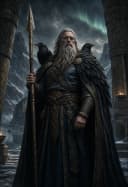
Odin
Norse pantheon
Domain: Wisdom, poetry, magic, runes, war, death, kingship
Odin is the chief of the Æsir and the god of wisdom, poetry, magic, war and the dead. In Snorri's Gylfaginning, he and his brothers Vili and Vé kill the giant Ymir and build the world from his body. He paid for his wisdom with pain: he left an eye in Mímir's well for a single drink (Völuspá, Gylfaginning), and in Hávamál he hangs nine nights on a windswept tree to win the runes. In Valhalla he gathers slain warriors for the last battle, where the wolf Fenrir swallows him.
Frigg: the queen who knows every fate
Frigg is Odin's wife and the foremost of the goddesses. Gylfaginning says she knows the fates of all men though she makes no prophecies, and gives her the hall Fensalir. To protect her son Baldr she took oaths from fire, water, metals, stones, sicknesses and beasts never to harm him, but passed over the mistletoe as too young. Loki found the gap. She is Thor's stepmother, not his mother.
Thor: the thunder god who guards the worlds
Thor is the god of thunder and, in Snorri's words, the strongest of gods and men. He fights the giants with Mjölnir, the hammer a dwarf smith forged after a wager with Loki (Skáldskaparmál). In Þrymskviða he dresses as Freyja to win back his stolen hammer, and in Hymiskviða he hooks the World Serpent while fishing. At Ragnarök he kills Jörmungandr and falls dead nine steps later from its venom.
Loki: the trickster among the gods
Loki is the son of the giant Fárbauti, yet Gylfaginning counts him among the Æsir and calls him handsome but evil in character; in Lokasenna he reminds Odin that they once mixed their blood. As a mare, he gives birth to Odin's eight-legged horse Sleipnir. With the giantess Angrboða he fathered the wolf Fenrir, the World Serpent and Hel. After he arranged Baldr's death the gods bound him under the earth; at Ragnarök he breaks free, and he and Heimdall kill each other.
Baldr: the bright god whose death began the end
Baldr (often spelled Baldur) is the son of Odin and Frigg, so fair that light shines from him, Snorri says. In Gylfaginning, Loki brings the one thing Frigg passed over, the mistletoe, and guides the throw of Baldr's blind brother Höðr. Hel agrees to release him if everything in the world weeps for him, and only the giantess Þökk refuses. Völuspá promises that he will return to the green earth after Ragnarök.
Týr: the one-handed god of oaths
Týr is the god of war and of sworn law. When the gods bound Fenrir with the ribbon Gleipnir, the wolf demanded a hand in his mouth as a pledge, and only Týr offered his; Gylfaginning says the wolf bit it off at the wrist. Hymiskviða makes him a son of the giant Hymir, while Snorri's Skáldskaparmál calls him Odin's son. In Snorri's account of Ragnarök, he and the hound Garm kill each other.
Heimdall: the watchman at the rainbow bridge
Heimdall guards the gods. Gylfaginning calls him the white god, born of nine mothers who were sisters, and places him at Himinbjörg beside the bridge Bifröst to watch for giants. He needs less sleep than a bird, sees a hundred leagues by night as well as by day, and hears grass and wool grow. His horn Gjallarhorn will be heard in every world when Ragnarök begins. Oddly, Þrymskviða says he could see the future like the other Vanir, though Snorri counts him among the Æsir.
Freyja: love, magic and half the slain
Freyja is the great goddess of the Vanir: love, beauty, fertility, magic and war. Njörðr's daughter and Freyr's sister, she came to live among the Æsir after the war. In Grímnismál she chooses half of the battle-slain for her field Fólkvangr, and Odin takes the other half. She owns the necklace Brísingamen and a falcon-feather cloak, and her chariot is drawn by two cats. Snorri's Ynglinga saga says she first taught the Æsir seiðr, the magic of the Vanir.
Freyr: the harvest god who gave away his sword
Freyr is the Vanir god of fertility and prosperity. Gylfaginning says he rules rain and sunshine and so the growth of the earth, and that people should pray to him for good harvests and peace. He owns the golden boar Gullinbursti and the ship Skíðblaðnir. In Skírnismál he sees the giantess Gerðr from Odin's high seat and falls so lovesick that he gives his sword to his servant Skírnir, who wins her for him. The gift costs him his life: at Ragnarök he faces the fire giant Surtr without a sword.
Njörðr: the sea god of Nóatún
Njörðr is the Vanir god of the sea, wind and wealth, and the father of Freyr and Freyja. Gylfaginning says he lives at Nóatún and is the god to call on for seafaring and fishing. His marriage to the giantess Skaði is a famous mismatch: they agreed to take turns between her mountains and his shore, but he hated the howling wolves and she the screaming gulls, so they lived apart. Scholars link his name to Nerthus, an earth goddess described by the Roman historian Tacitus around AD 98.
Sif: the golden-haired wife of Thor
Sif is Thor's wife, remembered above all for her hair. In Skáldskaparmál, Loki shears it off, and Thor forces him to get her new hair of living gold from the dwarves, an errand that, with the wager that followed, also produced Odin's spear Gungnir and Thor's hammer. Snorri names Sif as the mother of the archer god Ullr and, with Thor, of Thrud, and the skalds used "Sif's hair" as a poetic name for gold.
Hel: the half-dead ruler of the dead
Hel rules the realm of the dead, which shares her name. She is Loki's daughter by Angrboða, and Snorri's Gylfaginning describes her as half blue-black and half flesh-colored. Odin cast her into Niflheim and gave her authority over everyone who dies of sickness or old age.
Iðunn and Bragi: youth and poetry
Iðunn keeps the gods young: in Gylfaginning she keeps the apples they bite into when they grow old, to become young again. In Skáldskaparmál, the giant Þjazi forces Loki to lure her out of Asgard. The gods turn grey and old, until Loki, in Freyja's falcon cloak, carries her home as a nut, and the pursuing giant burns at Asgard's wall.
Her husband Bragi is the god of poetry, famed for eloquence; poetry itself, Snorri says, is called bragr after him. In Lokasenna, Loki calls him a coward. Scholars debate whether the god is the early skald Bragi Boddason raised to Asgard.
Skaði: the giantess who chose a husband by his feet
Skaði is a giantess, Þjazi's daughter, whom Snorri counts among the goddesses. After the gods killed her father, she came to Asgard in helmet and mail to avenge him. In Skáldskaparmál the gods offer a settlement: she may choose a husband from among them, seeing nothing but their feet. She picks the most beautiful pair, hoping for Baldr, and gets Njörðr. Loki makes her laugh, and Odin throws Þjazi's eyes into the sky as stars. In Gylfaginning it is Skaði who fastens a venomous snake above the bound Loki.
Víðarr, Váli and Höðr: Odin's other sons
- Víðarr is the silent god, almost as strong as Thor according to Gylfaginning; Skáldskaparmál names his mother, the giantess Gríðr. At Ragnarök he avenges his father by killing Fenrir. Völuspá has him drive a sword into the wolf's heart; Snorri has him plant his thick shoe in the wolf's lower jaw and tear the jaws apart.
- Váli is Odin's son by Rindr, born for revenge. Völuspá and Baldrs draumar say that at one night old he killed Höðr, before he had washed his hands or combed his hair.
- Höðr is the blind god who threw the mistletoe; Völuspá brings him back with Baldr after Ragnarök.
Other Norse gods and goddesses
- Forseti, son of Baldr and Nanna, judges in Glitnir, a hall of gold pillars and silver roof; Grímnismál and Gylfaginning say he settles every dispute.
- Ullr, Sif's son and Thor's stepson, is an unrivaled archer and skier, and Snorri says he is the god to pray to in single combat.
- Mímir guards the well of wisdom under one root of Yggdrasil, the world tree. In Ynglinga saga Odin preserves his severed head with herbs and chanted spells, and in Völuspá Odin speaks with it as Ragnarök begins.
- Ægir and Rán are the sea. Ægir, a giant, brews ale for the gods and hosts the feast of Lokasenna; his wife Rán catches seafarers in her net, and in Skáldskaparmál their nine daughters bear names for waves.
- The Norns, Urðr, Verðandi and Skuld, live at the well beneath Yggdrasil and, in Völuspá, choose the lives of human beings. Read the full guide to the Norns
- Thrud, daughter of Thor and Sif, has a name that means "strength." In Alvíssmál the dwarf Alvíss claims Thor's unnamed daughter, usually taken to be Thrud, and Thor keeps him talking until sunrise turns him to stone. Read the full Thrud guide
- The Valkyries choose who dies in battle and carry the chosen to Valhalla. Read the full guide to the Valkyries
- Magni and Móði, Thor's sons, inherit Mjölnir after Ragnarök, according to Vafþrúðnismál.
Who is the most powerful Norse god?
Odin rules, but Thor is the strongest. Gylfaginning calls Odin the highest and most ancient of the gods, who rules all things, and calls Thor the strongest of all gods and men. In cult, Thor may have ranked higher: Adam of Bremen, an 11th-century cleric, describes the temple at Uppsala with Thor in the central place, flanked by Wodan (Odin) and Fricco (Freyr).
Neither is all-powerful. Odin cannot save Baldr or himself, and at Ragnarök both die. Compare him with his Greek counterpart in Zeus vs Odin, or read Norse vs Greek gods on how the two pantheons treat fate.
How many Norse gods are there?
There is no fixed number. Gylfaginning states that there are twelve divine Æsir and then describes more than that. After Odin come Thor, Baldr, Njörðr, Freyr, Týr, Bragi, Heimdall, Höðr, Víðarr, Váli, Ullr and Forseti, twelve on their own, followed by Loki, whom Snorri also counts among the Æsir. With Odin and Loki that makes fourteen, and two of them, Njörðr and Freyr, are Vanir by birth.
Snorri adds that the goddesses are no less holy and later names more than a dozen, from Frigg and Freyja to minor figures such as Sága, Eir, Gefjun and Fulla. Add the giantesses who married in, like Skaði and Gerðr, the Norns and the Valkyries, and the count keeps growing. See how they connect on the Norse gods family tree.
Are the Norse gods immortal?
No. They age and can be killed. Without Iðunn's apples they grow grey and old. Baldr dies by the mistletoe, the Vanir behead Mímir in Ynglinga saga, and two dwarves murder the wise Kvasir in Skáldskaparmál.
At Ragnarök most of them fall. Víðarr, Váli, Móði and Magni survive, and Baldr and Höðr come back from Hel. Follow the whole sequence in Ragnarök: Every Event, In Order.
In the sources
- Poetic Edda — anonymous poems preserved mainly in the 13th-century Codex Regius: Völuspá (creation, the war, Ragnarök), Grímnismál (the gods' halls), Lokasenna, Þrymskviða, Skírnismál, Baldrs draumar and others.
- Snorri Sturluson's Prose Edda — written by a 13th-century Icelandic Christian who systematized the old myths: Gylfaginning (the lists of gods and goddesses, Baldr, Ragnarök) and Skáldskaparmál (Iðunn, Skaði, Kvasir, Sif's hair, Mjölnir).
- Ynglinga saga, in Snorri's Heimskringla — treats Odin and the Vanir as human rulers later worshipped as gods.
- Adam of Bremen and Tacitus' Germania — outside witnesses to the Uppsala temple and to Nerthus.
Contradictions to flag:
- The Æsir–Vanir war. Völuspá has no peace; Ynglinga saga exchanges Njörðr, Freyr and Kvasir for Hœnir and Mímir; Gylfaginning trades Njörðr for Hœnir alone.
- Who is Kvasir? A Vanir hostage in Ynglinga saga; in Skáldskaparmál, a being the gods made from the peace spittle.
- Who says Frigg knows every fate? In Lokasenna it is Freyja; Snorri, quoting the stanza in Gylfaginning, gives the words to Odin.
- Twelve gods or fourteen? Gylfaginning announces twelve divine Æsir and then describes fourteen.
- Who threw Þjazi's eyes into the sky? Snorri says Odin; in Hárbarðsljóð, Thor boasts that he did it.
- Týr's father. The giant Hymir in Hymiskviða, Odin in Skáldskaparmál.
In popular culture
- Marvel. The Thor films (from 2011) made Loki Thor's adopted brother and Hela (Cate Blanchett in Thor: Ragnarok, 2017) Odin's firstborn daughter. In the myths Loki is Odin's blood brother and Hel is Loki's daughter.
- God of War (2018) and God of War Ragnarök (2022). The games make Freya Baldur's mother and Odin's former wife, merging Freyja with Frigg.
- Wagner's Ring cycle. Wotan, Fricka, Donner, Froh and Freia come from Odin, Frigg, Thor, Freyr and Freyja, and Freia tends golden apples borrowed from Iðunn.
- The week. Tuesday, Wednesday and Thursday are named for Týr, Woden (Odin) and Thor; scholars debate whether Friday honors Frigg or Freyja.
Frequently asked questions
Who are the main Norse gods and goddesses?
The main gods are Odin, Thor, Loki, Baldr, Týr, Heimdall, Freyr and Njörðr. The main goddesses are Frigg, Freyja, Sif, Iðunn, Skaði and Hel.
What is the difference between the Æsir and the Vanir?
The Æsir, led by Odin, are the main family of gods in Asgard. The Vanir, such as Njörðr, Freyr and Freyja, are gods of fertility, wealth and magic who joined the Æsir after a war.
Who is the king of the Norse gods?
Odin, the All-Father. Snorri's Gylfaginning calls him the highest and most ancient of the gods, while Thor is the strongest.
How many Norse gods are there?
No fixed number. Snorri's Gylfaginning says there are twelve divine Æsir but describes fourteen gods, Odin and Loki included, and more than a dozen goddesses.
Are the Norse gods immortal?
No. They stay young by eating Iðunn's apples, but they can be killed, and most of them die at Ragnarök.
Who is the Norse goddess of love?
Freyja, the Vanir goddess of love, beauty, fertility, magic and war. Frigg, Odin's wife, is the goddess of marriage and motherhood.
Keep exploring
Start with the god at the top in Odin in Norse Mythology, map every marriage and feud on the Norse family tree, then test yourself with the Norse mythology quiz or find your match in Which Norse God Are You?. To read the myths themselves, see the best Norse mythology books.