Freyja is the Norse goddess of love, beauty, fertility, magic and war. She belongs to the Vanir, the second family of Norse gods, and is the daughter of Njörðr and the sister of Freyr. She receives half of those who die in battle in her field, Fólkvangr — Odin gets the other half — and according to Snorri she taught the Æsir the magic called seiðr.
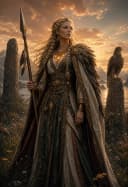
Freyja
Norse pantheon
Domain: Love, beauty, fertility, magic (seiðr), war and the dead
Freyja quick facts
| Fact | Detail |
|---|---|
| Name | Freyja, "the Lady" (her brother Freyr is "the Lord") |
| Family of gods | Vanir, living among the Æsir after the Æsir–Vanir war |
| Father | Njörðr |
| Brother | Freyr |
| Husband | Óðr, who wanders far away |
| Daughter | Hnoss ("treasure") |
| Hall and field | Sessrúmnir, in Fólkvangr |
| Possessions | The necklace Brísingamen, a falcon-feather cloak |
| Animals | Two cats that pull her chariot; the boar Hildisvíni |
| Other names | Mardöll, Hörn, Gefn, Sýr, Vanadís |
Who is Freyja?
Freyja is the most important goddess of the Vanir and, in Snorri's words in Gylfaginning, the most renowned of the goddesses. She came to Asgard as part of the peace that ended the war between the Æsir and the Vanir, when the two sides exchanged hostages. Ynglinga saga names Njörðr, Freyr and Kvasir as the Vanir hostages; Freyja, Njörðr's daughter, lives among the Æsir from then on.
She loves love poetry, Snorri adds, and it is good to call on her for help in love. That romantic side is real, but it is only half of her. Freyja is also a war goddess, a sorceress and a collector of the dead.
Does Freyja take half the slain?
Yes. In the Eddic poem Grímnismál, Freyja chooses half of the fallen each day in Fólkvangr ("field of the people" or "field of the army"), and Odin has the other half. Gylfaginning repeats the arrangement and names her hall there Sessrúmnir.
This makes Freyja a rival to Odin's Valkyries rather than a sidekick. Those who die of sickness or old age are not hers or Odin's at all: in Snorri's Gylfaginning they go to Hel, ruler of the Norse underworld. The sources never explain how the dead are divided or what life in Fólkvangr is like — only that she chooses her share. For Odin's half, see Odin in Norse Mythology.
What is Brísingamen?
Brísingamen is Freyja's famous necklace (or collar), and it appears in very different stories:
| Source | What happens to Brísingamen |
|---|---|
| Þrymskviða (Poetic Edda) | Asked to marry the giant Þrymr, Freyja snorts in rage so hard that the necklace bursts. Thor later wears it in disguise as the bride. |
| Skáldskaparmál (Snorri), quoting older skaldic verse | Loki steals it; Heimdall fights him for it, both in the shape of seals. |
| Sörla þáttr (late 14th century) | Freyja spends a night with each of four dwarves to buy it, and Odin has Loki steal it. |
The last story is the most famous version online, but it is also the latest and least reliable: Sörla þáttr is a Christian-era tale that treats the gods as human rulers.
Can Freyja shapeshift?
She owns the means to fly. Freyja has a feather cloak that turns its wearer into a falcon, and in the sources it is usually Loki who borrows it — in Þrymskviða to search for Thor's stolen hammer, and in Skáldskaparmál to rescue the goddess Iðunn from a giant.
Her travel is famous too. Gylfaginning says she drives a chariot drawn by two cats, and a skaldic poem quoted by Snorri has her ride it to Baldr's funeral. In the poem Hyndluljóð she rides the boar Hildisvíni, "battle-swine," which turns out to be her human favorite Óttar in disguise.
Who is Freyja's husband?
Óðr. Gylfaginning says he went away on long journeys and Freyja wept for him, and her tears are red gold. She searched for him among many peoples under different names — one reason she has so many. Their daughter is Hnoss, whose name means "treasure."
Almost nothing else is known about Óðr. His name looks strikingly like Óðinn (Odin), and scholars have long debated whether Óðr is a form of Odin. The sources themselves keep the two apart.
Did Freyja teach Odin magic?
Snorri says so. In Ynglinga saga, part of his Heimskringla, Freyja becomes a priestess of sacrifices and is the first to teach seiðr to the Æsir, a magic already known among the Vanir. Odin later practiced it, and in Lokasenna Loki mocks him for it.
Some scholars, among them Rudolf Simek and John Lindow, have suggested that Gullveig — the gold-loving figure the gods burn three times at the start of the war in Völuspá — may be Freyja under another name. The poem does not say so, and the identification remains a theory.
Are Freyja and Frigg the same goddess?
Not in the Norse sources, which always treat them as two different goddesses. Frigg is Odin's wife and Baldr's mother; Freyja is a Vanir goddess married to Óðr. But the question is a real scholarly debate:
- Points in favor of a common origin: outside Scandinavia, the Germanic peoples knew only one such goddess — Old English Frīg, Old High German Frīja — and never mention a Freyja. Both Norse goddesses own a falcon cloak, both weep for a lost husband or son, and Freyja's husband Óðr has a name very close to Frigg's husband Odin.
- Points against: the two names come from different roots — Frigg is linked to a word for "love" or "beloved," Freyja means "lady" — and the Norse poets never confuse them.
Stephan Grundy, who studied the question, called it a difficult one because pre-Viking evidence about Germanic goddesses is so thin. The fair answer is: maybe once, but not by the time the myths were written down.
Is Friday named after Freyja?
The scholarship genuinely splits on this too. Friday comes from Old English Frīgedæg, "day of Frīg" — the English equivalent of Frigg — which translated the Latin dies Veneris, "day of Venus." The Scandinavian word fredag is often linked to Freyja, but the Old Norse form frjádagr appears to have been borrowed from Low German rather than formed from either goddess's Norse name. Because the two goddesses may share an origin, the question never fully closes. Our Frigg article looks at the case from her side.
Is Freyja a goddess of war?
Yes, though the sources show it through the dead rather than through battle scenes. She takes a share of the slain, yet no surviving myth shows her fighting. Her war role is closer to Odin's — choosing and receiving warriors — than to Thor's.
Giants want her above all goddesses. The builder of Asgard's wall asked for Freyja plus the sun and moon; Þrymr demanded her for Thor's hammer; the giant Hrungnir boasted he would carry off Freyja and Sif. In each story the gods refuse, and Thor or Loki settles the matter.
In the sources
- Poetic Edda — Grímnismál (Fólkvangr and half the slain), Þrymskviða (Brísingamen bursts), Lokasenna (Loki accuses her of sleeping with every god and elf, and with her brother), Hyndluljóð (Óttar and the boar), and Völuspá (the Æsir–Vanir war).
- Snorri Sturluson's Prose Edda — Gylfaginning (her hall, cats, Óðr, tears of gold, her names) and Skáldskaparmál (the falcon cloak, the fight over Brísingamen).
- Heimskringla, Ynglinga saga — Freyja as a priestess who brings seiðr to the Æsir, in Snorri's human-king version of the gods.
- Sörla þáttr — a late 14th-century tale of the dwarves and the necklace.
If you want to read these texts yourself, our guide to the best Norse mythology books explains where to start.
Contradictions and context: Snorri was a 13th-century Christian scholar, and his Ynglinga saga presents Freyja as a human priestess among deified rulers, while his Gylfaginning treats her as a goddess. The Brísingamen stories disagree about how the necklace was lost and who took it. The Gullveig identification is modern scholarship, not a statement in any source.
In popular culture
- God of War (2018) and God of War Ragnarök (2022). Freya, voiced by Danielle Bisutti, is Odin's estranged wife and Baldur's mother — roles that belong to Frigg in the myths. The games deliberately merge the two goddesses.
- Wagner's Das Rheingold. Freia, the goddess promised to the giants who build Valhalla, tends the golden apples of youth — a role borrowed from Iðunn.
Frequently asked questions
Who is Freyja in Norse mythology?
Freyja is a Vanir goddess of love, beauty, fertility, magic and war. She is Njörðr's daughter and Freyr's sister, and she receives half of the battle-slain in Fólkvangr.
Is Freyja a Valkyrie?
The sources do not list her among the Valkyries, but she chooses half of the fallen, like Odin, which links her closely to their work.
What animals are linked to Freyja?
Two cats pull her chariot, she rides the boar Hildisvíni in Hyndluljóð, and she owns a falcon-feather cloak.
Are Freyja and Frigg the same?
The Norse sources treat them as two goddesses. Some scholars think they may descend from one older Germanic goddess, but this remains debated.
Who is Freyja married to?
Óðr, a mysterious god who travels far away. Freyja weeps tears of red gold for him, and their daughter is Hnoss.
What is Brísingamen?
Freyja's famous necklace. It bursts when she rages in Þrymskviða, and Loki and Heimdall fight over it in a story told by Snorri.
Keep exploring
Freyja links the Vanir to the Æsir, love to death, and magic to war. Compare her with Frigg, Odin's wife, follow the choosers of the slain in The Valkyries, and see where she sits on the Norse family tree. Could you be Freyja? Try the Which Norse God Are You? quiz, then the Norse mythology quiz.