Odin is the chief of the Norse gods: the one-eyed All-Father, god of wisdom, poetry, magic, war and the dead. He gave an eye for a drink from Mímir's well, hung himself on a tree for nine nights to win the runes, and gathers slain warriors in Valhalla for the last battle. He also knows how that battle ends — with his own death in the jaws of the wolf Fenrir.
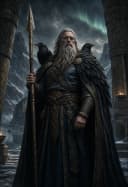
Odin
Norse pantheon
Domain: Wisdom, poetry, magic, runes, war, death, kingship
Odin quick facts
| Fact | Detail |
|---|---|
| Old Norse name | Óðinn |
| Parents | Borr and the giantess Bestla (Snorri's Gylfaginning) |
| Brothers | Vili and Vé |
| Wife | Frigg |
| Notable sons | Thor, Baldr, Höðr, Víðarr, Váli |
| Hall | Valhalla; his high seat Hliðskjálf looks over all worlds |
| Possessions | The spear Gungnir, the ring Draupnir |
| Animals | Ravens Huginn and Muninn, wolves Geri and Freki, the eight-legged horse Sleipnir |
| Fate | Swallowed by Fenrir at Ragnarök; avenged by his son Víðarr |
| Weekday | Wednesday (Old English Wōdnesdæg, "Woden's day") |
Why did Odin sacrifice his eye?
For wisdom. Snorri's Gylfaginning places Mímir's well under the root of Yggdrasil, the world tree, that reaches toward the frost giants. Whoever drinks from it gains wisdom and knowledge, and its keeper Mímir drinks there daily. Odin came asking for one drink and had to leave an eye in the well as a pledge.
The older poem Völuspá knows the same story from the other side: the seeress tells Odin she knows where his eye is hidden — in Mímir's famous well. Neither source says the trade was fair. That is the point. Odin's power is never free; he pays for every piece of knowledge with his own body.
Why did Odin hang himself on Yggdrasil?
To seize the runes. In the Hávamál, Odin himself speaks: he hung on a windswept tree for nine nights, wounded with a spear, "given to Odin, myself to myself," with no bread and no drink. At the end he peered down, took up the runes screaming, and fell back.
Two details are worth knowing:
- The poem does not name the tree. It only says no one knows where its roots run. Reading it as Yggdrasil is a strong inference, because the name Yggdrasill is usually explained as "horse of Yggr" — Yggr, "the terrible one," being one of Odin's names, and "horse" a poetic image for the gallows.
- It is a sacrifice of a god to himself. There is no higher power in the Norse cosmos for Odin to offer himself to, so he becomes both the victim and the one who receives it.
The episode fits a pattern. Odin also stole the mead of poetry from the giant Suttungr (told in Snorri's Skáldskaparmál and hinted at in Hávamál), which is why poets were said to be drinking Odin's mead.
What are Odin's ravens called?
Huginn and Muninn, usually translated "Thought" and "Memory" (or "Mind"). In Gylfaginning they sit on his shoulders and fly out over the world every morning, returning at breakfast to whisper what they have seen. That is why one of Odin's names is Raven-god.
In the poem Grímnismál, Odin admits a fear: he worries that Huginn may not come back, but he fears more for Muninn. Read symbolically, the god of wisdom is most afraid of losing memory.
His other animals:
- Geri and Freki — two wolves. In Valhalla, Odin gives them all the food set before him and lives on wine alone.
- Sleipnir — the best of horses, with eight legs. He is Loki's own offspring, born after Loki, as a mare, lured away the stallion of the giant who built Asgard's wall.
What is Valhalla, and who goes there?
Valhalla, "hall of the slain," is Odin's hall in Asgard. According to Grímnismál and Gylfaginning, its roof is thatched with shields, its rafters are spears, and it has 540 doors — each wide enough for 800 warriors to march out side by side.
Its residents are the einherjar, warriors who died in battle and were chosen by the Valkyries. Every day they fight each other for sport; every evening the fallen rise again and feast on the boar Sæhrímnir, which is cooked each day and whole again each night, and drink mead from the goat Heiðrún.
Valhalla is not a reward for being good. It is a recruitment camp. Odin gathers the best fighters because he knows he will need them at Ragnarök — and he does not get all of them. Grímnismál says Odin takes half of the slain; the goddess Freyja chooses the other half for her hall, Fólkvangr.
Did Odin practice magic?
Yes, and the sources treat it as both powerful and shameful. Odin is the master of runes, spells and galdr (chanted magic), and the Hávamál lists eighteen charms he knows. He also practiced seiðr, a form of sorcery tied to prophecy and changing fate.
In Lokasenna, Loki mocks Odin for having done seiðr on the island of Samsey "like a witch" — an insult, because seiðr was associated with women and its practice brought ergi, unmanliness, on a man. Snorri's Ynglinga saga makes the same point and adds where the art came from: Freyja was the first to teach seiðr to the Æsir, as it was the custom among the Vanir.
Odin's willingness to cross that line, like his eye and his hanging, shows his priority. He will pay any price, including his reputation, for knowledge that might delay the end.
Is Odin Thor's father?
Yes. In both the Poetic Edda and Snorri, Thor is Odin's son by Jörð, the personified Earth — not by Frigg. With Frigg, Odin fathered Baldur and the blind Höðr. The avenger-sons Víðarr and Váli came from other mothers, and Snorri also calls Tyr Odin's son, although the poem Hymiskviða makes Tyr the son of the giant Hymir. See the whole lineage on the Norse family tree.
How does Odin die?
At Ragnarök, Odin rides out at the head of the einherjar in a golden helmet with Gungnir in his hand and goes straight for Fenrir. The wolf swallows him, while elsewhere on the field the hound Garm and Tyr kill each other. His son Víðarr then avenges him — in Völuspá by driving a sword into the wolf's heart, in Snorri by stepping on its lower jaw with a thick shoe and tearing its mouth apart.
The tragedy is that Odin knew all along. Völuspá is framed as a prophecy spoken to Odin himself, and his wisdom-gathering never changes the outcome. As in the Norns' view of fate, even the All-Father cannot escape what is woven.
Are Norse gods immortal?
Not in the Greek sense. The Norse gods age and can die. According to Gylfaginning, they stay young only by eating the apples kept by the goddess Iðunn, and in Skáldskaparmál, when Loki helps a giant carry her off, the gods quickly grow grey and old. Baldr is killed long before the end, and at Ragnarök Odin, Thor, Freyr, Tyr and Heimdall all fall. A few younger gods survive into the renewed world.
Is Odin stronger than Zeus?
No myth pits them against each other, so there is no canonical answer. They are powerful in different ways: Zeus rules by overwhelming force and the thunderbolt, Odin by knowledge he has bled for. Zeus defeats his enemies; Odin knows he will lose to his and fights anyway. Compare them round by round in our Zeus vs Odin tool, or read the wider Norse vs Greek gods comparison.
Why is Wednesday named after Odin?
Because of a Roman habit of translation. The Romans named the day after Mercury (dies Mercurii), and when Germanic peoples adopted the seven-day week, they swapped in the god they matched to Mercury — Woden, the English and continental form of Odin. The Roman historian Tacitus already identified the chief god of the Germans with Mercury in his Germania. The result was Old English Wōdnesdæg, English Wednesday, and Scandinavian onsdag.
In the sources
- Poetic Edda — Völuspá (the seeress's prophecy to Odin, his eye in Mímir's well, his death), Hávamál (his wisdom, the hanging and the runes, the mead of poetry), Grímnismál (Valhalla, the ravens, his many names), Vafþrúðnismál (a deadly wisdom contest with a giant), Lokasenna (the seiðr accusation), Baldrs draumar and Hárbarðsljóð.
- Snorri Sturluson's Prose Edda — Gylfaginning (Odin's family, Mímir's well, Valhalla, Ragnarök) and Skáldskaparmál (the mead of poetry, Gungnir, Draupnir).
- Heimskringla, Ynglinga saga — Snorri presents Odin as a human chieftain from Asia later worshipped as a god.
- Saxo Grammaticus, Gesta Danorum — a Christian-era Danish history in Latin, where Othinus is a powerful sorcerer treated as a false god.
Contradictions and context:
- God or king? In Gylfaginning Odin is the creator-god; in Ynglinga saga, by the same author, he is a mortal king. Snorri was a 13th-century Christian writing about a religion that had faded from his country two centuries earlier, and he hedges accordingly.
- Víðarr's revenge differs between Völuspá (a sword to the heart) and Snorri (the jaw torn apart).
- Tyr's father is Odin in Snorri but Hymir in Hymiskviða.
In popular culture
- Marvel. Anthony Hopkins played Odin in Thor (2011) and its sequels. Marvel makes him a mostly benevolent king and a father to Thor, Loki (adopted) and Hela. In the myths Loki is his blood brother, not his son, and Hel is Loki's daughter.
- God of War Ragnarök (2022). Odin is the main antagonist, voiced by Richard Schiff — a manipulative, paranoid schemer, which leans hard on his mythical deceptiveness and drops his self-sacrifice.
- American Gods. In Neil Gaiman's novel, Odin is the con man Mr. Wednesday; Ian McShane played him in the television series. The name is a direct nod to the weekday.
- Assassin's Creed Valhalla (2020). The game recasts Odin as Havi, a member of the game's ancient Isu race, rather than a god — a science-fiction reframing, not a source-based one.
Frequently asked questions
Who is Odin in Norse mythology?
Odin is the chief of the Norse gods, a god of wisdom, poetry, magic, war and the dead. He rules from Asgard, gathers fallen warriors in Valhalla, and is fated to die at Ragnarök.
Why did Odin give up his eye?
Snorri's Gylfaginning says Odin left one eye as a pledge at Mímir's well in exchange for a drink from it, because its water gave wisdom and knowledge.
Why is Odin called the All-Father?
Snorri explains that Odin is called All-Father because he is the father of all the gods.
What are the names of Odin's ravens?
Huginn and Muninn, usually translated Thought and Memory. They fly over the world each day and report back to him.
Who kills Odin at Ragnarök?
The wolf Fenrir, Loki's son, swallows Odin at Ragnarök. Odin's son Víðarr then kills the wolf in revenge.
Is Odin the same as Woden?
Yes. Woden is the Old English form of the same god, whose Norse name is Óðinn. Wednesday is named after him.
Is Odin Loki's father?
No. In the myths Loki is Odin's blood brother, not his son. The father-son relationship was invented by Marvel.
Keep exploring
Odin's story runs through almost every Norse myth. Follow his wife in Frigg: Odin's Wife and the Only Other Seer, his favorite son in Baldur, and his killer in Fenrir. Meet his most famous son in Thor in Norse Mythology, or find out which god you would be with the Which Norse God Are You? quiz. Ready to test yourself? Take the Norse mythology quiz.