Quick summary
- Greek gods are immortal and their order lasts; Norse gods stay young only with Iðunn's apples, and most of them die at Ragnarök.
- Odin is not the Norse Zeus: Roman-era equations matched Wodan with Mercury, the Roman Hermes, and Thor with Jupiter, the Roman Zeus.
- Greek myth survives in texts from around 700 BC; Norse myth was written down in 13th-century Iceland, over 200 years after it turned Christian.
- Völuspá says Odin, Hœnir and Lóðurr gave life to the first humans; Snorri credits Odin and his brothers Vili and Vé instead.
The biggest difference between Norse and Greek gods is death: the Greek gods are immortal and their rule lasts, while the Norse gods age, know how they will die and fall at Ragnarök. The Greeks pictured radiant Olympians ruling a stable cosmos under Zeus; the Norse pictured Odin and his kin holding off giants they will one day lose to. Their myths were written down nearly two thousand years apart.
Norse vs Greek gods at a glance
| Aspect | Greek | Norse |
|---|---|---|
| Chief god | Zeus, king of gods and men | Odin, the All-Father |
| Home of the gods | Mount Olympus | Asgard |
| Cosmos | Sky, sea and underworld drawn by lot among Zeus, Poseidon and Hades (Iliad) | The world-ash Yggdrasil and nine worlds (Völuspá); in Snorri the serpent Jörmungandr circles Midgard |
| Origin of the world | Chaos, then Gaia; Ouranos, Cronus and Zeus rule in turn | The void Ginnungagap; the world is built from the giant Ymir |
| Fate | The Moirai; Zeus can outwit a prophecy | Urðr and örlög, laid down by the Norns; the gods cannot escape Ragnarök |
| Afterlife | Hades for most, Elysium for a few, Tartarus for the gods' enemies | Valhalla and Fólkvangr for chosen battle dead, Hel for those who die of sickness or old age (Snorri) |
| End of the world | None foretold; the gods are immortal | Ragnarök, where most gods die, then a new world |
| Main sources | Homer and Hesiod, from c. 8th–7th century BC, while the gods were worshipped | The Poetic Edda and Snorri's Prose Edda, 13th-century Christian Iceland |
Why are the Norse sources so much later?
Because the Norse myths were written down only after the religion had ended. Homer and Hesiod composed their poems around the 8th and 7th centuries BC for audiences who still sacrificed to Zeus, and Greek myth kept growing for a thousand years after them.
Iceland adopted Christianity around the year 1000. Snorri Sturluson, a Christian chieftain, wrote his Prose Edda around 1220, and the Eddic poems survive mainly in the Codex Regius, copied around 1270. Some poems are probably older, but every Norse myth reached us through Christian hands, and scholars debate how much that shaped details such as the world's rebirth after Ragnarök.
Is Odin the same as Zeus?
No. Both are kings of their gods — Homer calls Zeus father of gods and men, and Snorri calls Odin Alföðr, "All-Father" — but they rule in different ways.
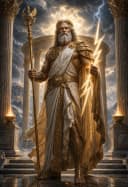
Zeus
Greek pantheon
Domain: Sky, thunder, law, kingship
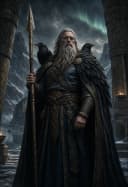
Odin
Norse pantheon
Domain: War, wisdom, poetry, death, magic
Zeus rules by force. In Hesiod's Theogony, the Cyclopes give him thunder and lightning, and with them he defeats the Titans and the monster Typhon. Odin rules by knowledge. His eye lies pledged in Mímir's well (Völuspá) — for one drink of its water, Snorri adds — and he hangs nine nights on a wind-swept tree to win the runes (Hávamál). Adam of Bremen, an 11th-century cleric, glossed his name as "fury."
Zeus wants order and keeps it; Odin wants to know what is coming, and what he learns is his own death. Compare them round by round with the Zeus vs Odin tool, or read Who Was Zeus?
Who is stronger, Zeus or Odin?
No ancient source stages that fight. In raw power Zeus has the edge: his thunderbolt beat the Titans and Typhon. Odin's strength is magic. In Hávamál he lists eighteen spells, among them one that blunts enemies' blades and one that stops an arrow in flight. The endings settle most debates: Zeus has no foretold death, while Odin is swallowed by the wolf Fenrir at Ragnarök.
Is Thor based on Zeus?
No. Thor and Zeus are both thunder gods, and many scholars trace both to a shared Indo-European background rather than one to the other — a reconstruction, not a recorded fact. Zeus's name goes back to the Indo-European sky god Dyēus; some linguists connect the name of Thor's mother, Fjörgyn, with the Lithuanian thunder god Perkūnas.
Their roles differ. Zeus is the king who throws lightning from above; Thor is the king's son, a giant-killer who goes out to fight with his hammer Mjölnir. Roman-era Germanic speakers did match him with Jupiter: Thursday, Thor's day, renders Latin dies Iovis.
How are the creation myths different?
The Greek world is born; the Norse world is built from a corpse. In the Theogony, Chaos comes first, then Gaia (Earth), who bears Ouranos (Sky). Cronus castrates Ouranos and swallows his own children, and Zeus overthrows him and locks the Titans in Tartarus.
Völuspá's creation opens on "a yawning gap," Ginnungagap. Snorri's Gylfaginning says frost from Niflheim met heat from Muspelheim and the giant Ymir formed in the melting ice. Odin and his brothers killed Ymir and made the earth from his flesh, the sea from his blood and the sky from his skull, as Vafþrúðnismál also tells. Odin's mother, Bestla, was a giant's daughter, so the Norse gods are kin to the enemies they fight. For humans, Völuspá has three gods give breath and spirit to Ask and Embla, whose names suggest trees, and Snorri makes them two logs found on the shore. Apollodorus says Prometheus shaped humans from earth and water.
Can the gods escape fate?
Greek gods sometimes can; Norse gods never do. The Old Norse words for fate are urðr — also the name of a Norn — and örlög, "primal law." In Völuspá the Norns "laid down laws, chose lives," and a seeress tells Odin how the world will end. The gods bind Fenrir and try to protect Baldur anyway, and the end still comes.
In the Iliad, Zeus wants to save his son Sarpedon but lets him die rather than overturn fate. Yet Hesiod says Zeus swallowed his first wife, Metis, because she was destined to bear a son who would rule gods and men, and so escaped his own overthrow.
Do the gods die?
Greek gods do not; Norse gods do. In the Iliad, Diomedes wounds Aphrodite and Ares, and Homer explains that gods bleed ichor because they eat no bread and drink no wine. They suffer and can be imprisoned, but they cannot die.
The Norse gods age. Gylfaginning says they stay young by eating the apples of the goddess Iðunn, and in Skáldskaparmál they turn grey when Loki lets a giant carry her off. Baldur is killed before the end. At Ragnarök Odin falls to Fenrir, Thor to the serpent's venom and, in Snorri, Tyr to the hound Garmr. Only a few younger gods, with the returning Baldur and Höðr, live in the new world.
How is the afterlife different?
Both sent most of the dead to a dim realm below, but only the Norse gave a chosen few a place in a coming war.
| Theme | Greek | Norse |
|---|---|---|
| Default afterlife | Hades, a grey underworld of shades | Hel, ruled by Loki's daughter, for those who die of sickness or old age |
| Honored dead | Elysium for a few heroes | Valhalla for Odin's half of the battle-slain, Fólkvangr for Freyja's half |
| Punishment | Tartarus for the Titans | Náströnd, the corpse-shore, for oath-breakers and murderers (Völuspá) |
In the Odyssey, Achilles' ghost would rather be a poor man's hired hand on earth than king of the dead. The Norse chosen dead are gathered by the Valkyries, and Grímnismál says they will march out of Valhalla through its 540 doors on the last day.
Are Norse gods more serious than Greek gods?
On the whole, yes. Greek myth is full of the gods' quarrels and love affairs; Norse stories are braced against disaster. Both have a trickster at the center. Hermes steals Apollo's cattle on the day he is born and stays a welcome Olympian. Loki, Odin's blood brother, ends bound under a dripping serpent, as Prometheus was chained for an eagle to eat his liver. Heracles frees Prometheus; Loki breaks free at Ragnarök to fight the gods.
Are there Norse equivalents of Greek gods?
Only loosely. The oldest equations date from the Roman era. Tacitus's Germania says the Germans worshipped Mercury most of all, along with Hercules and Mars, which scholars usually read as Wodan (Odin), Thor and Tiw (Tyr). The weekdays agree: Wednesday renders Mercury's day, Tuesday Mars's, Thursday Jupiter's. They pair Odin with Mercury — the Roman Hermes — not with Jupiter. See Greek vs Roman gods for how Rome matched its own gods to the Greek ones.
| Greek | Closest Norse figure | Caveat |
|---|---|---|
| Zeus | Odin (as king), Thor (as thunder god) | Thursday pairs Thor, not Odin, with Jupiter |
| Hermes | Odin | Roman Mercury = Wodan |
| Ares | Tyr | Via Mars and Tuesday |
| Hera | Frigg | Role parallel: wife of the chief god |
| Aphrodite | Freyja | Role parallel only |
| Artemis | Skaði | Artemis hunts with a bow; Snorri says Skaði hunts on skis with one |
| Moirai | Norns | Three fate-women each; Snorri adds many lesser norns |
In the sources
- Greek: Hesiod's Theogony (Chaos, Cronus, the Titan war, Metis); Homer's Iliad (the lots, Sarpedon, ichor) and Odyssey (the dead, Elysium); the Homeric Hymn to Hermes; Apollodorus's Library (Prometheus).
- Norse: the Poetic Edda — Völuspá, Vafþrúðnismál, Grímnismál, Hávamál; Snorri's Prose Edda — Gylfaginning and Skáldskaparmál.
- Outsiders: Tacitus's Germania and Adam of Bremen.
Contradictions to flag:
- The first humans. Völuspá has Odin, Hœnir and Lóðurr give life to Ask and Embla; Snorri gives the deed to Odin, Vili and Vé.
- The first things. Hesiod starts with Chaos, but in the Iliad Hera calls Oceanus the origin of the gods.
- The Moirai's parents. The Theogony makes them daughters of Night in one passage and of Zeus and Themis in another.
- Who goes to Hel. Gylfaginning sends those who die of sickness or old age to Hel, but elsewhere sends wicked men to Hel and on to Niflhel — and the good Baldur goes there too.
In popular culture
- Marvel vs Disney. Marvel's Thor keeps Odin as his father but makes Loki his adopted brother, and Thor: Love and Thunder (2022) adds Russell Crowe as a vain Zeus. Disney's Hercules (1997) makes Zeus and Hera the hero's loving parents; in myth Heracles is the son of Zeus and the mortal Alcmene, and Hera hates him.
- God of War. The original trilogy (2005–2010) sends Kratos against the Greek gods and ends with Zeus's death. God of War (2018) and Ragnarök (2022) move him north, where Odin becomes the main villain.
Frequently asked questions
What is the main difference between Norse and Greek gods?
Greek gods are immortal and their rule lasts. Norse gods age, stay young only with Iðunn's apples, and most of them die at Ragnarök.
Is Odin the Norse version of Zeus?
Only as a king. Zeus rules by thunderbolt and Odin by wisdom and magic, and the Romans matched Odin with Mercury, the Roman Hermes, not Jupiter.
Who would win, Zeus or Odin?
No ancient source stages the fight. Zeus has the thunderbolt and no foretold death, while Odin is fated to be swallowed by Fenrir at Ragnarök.
Is Thor the same as Zeus?
No. Both are thunder gods, likely from a shared Indo-European background, but Zeus is the king of the gods and Thor is the king's son, a giant-killer.
Do Norse gods die?
Yes. Baldur is killed before the end, and at Ragnarök Odin, Thor and others fall. A few younger gods survive into the new world.
Why were the Norse myths written down so late?
Iceland became Christian around 1000, and the main sources date from the 13th century. Greek myth was written down while the gods were still worshipped.
Keep exploring
Meet the whole Northern pantheon in Norse Gods and Goddesses and the Olympians in Greek Gods and Their Powers, then trace both families on the Norse family tree and the Greek family tree. Or find your match with the Which Norse God Are You? quiz.