Quick summary
- Greek hero, son of Zeus and Danaë, best known for cutting off the head of the Gorgon Medusa with the help of Athena and Hermes.
- He rescued Andromeda from the sea monster Cetus, turned Polydectes to stone and killed his grandfather Acrisius by accident.
- Apollodorus has nymphs give him the sandals, pouch and cap of Hades and Hermes the sickle; Ovid tells the quest without the nymphs.
- He traded Argos for Tiryns and fortified Mycenae. Perseus, Andromeda, Cassiopeia, Cepheus and Cetus all became constellations.
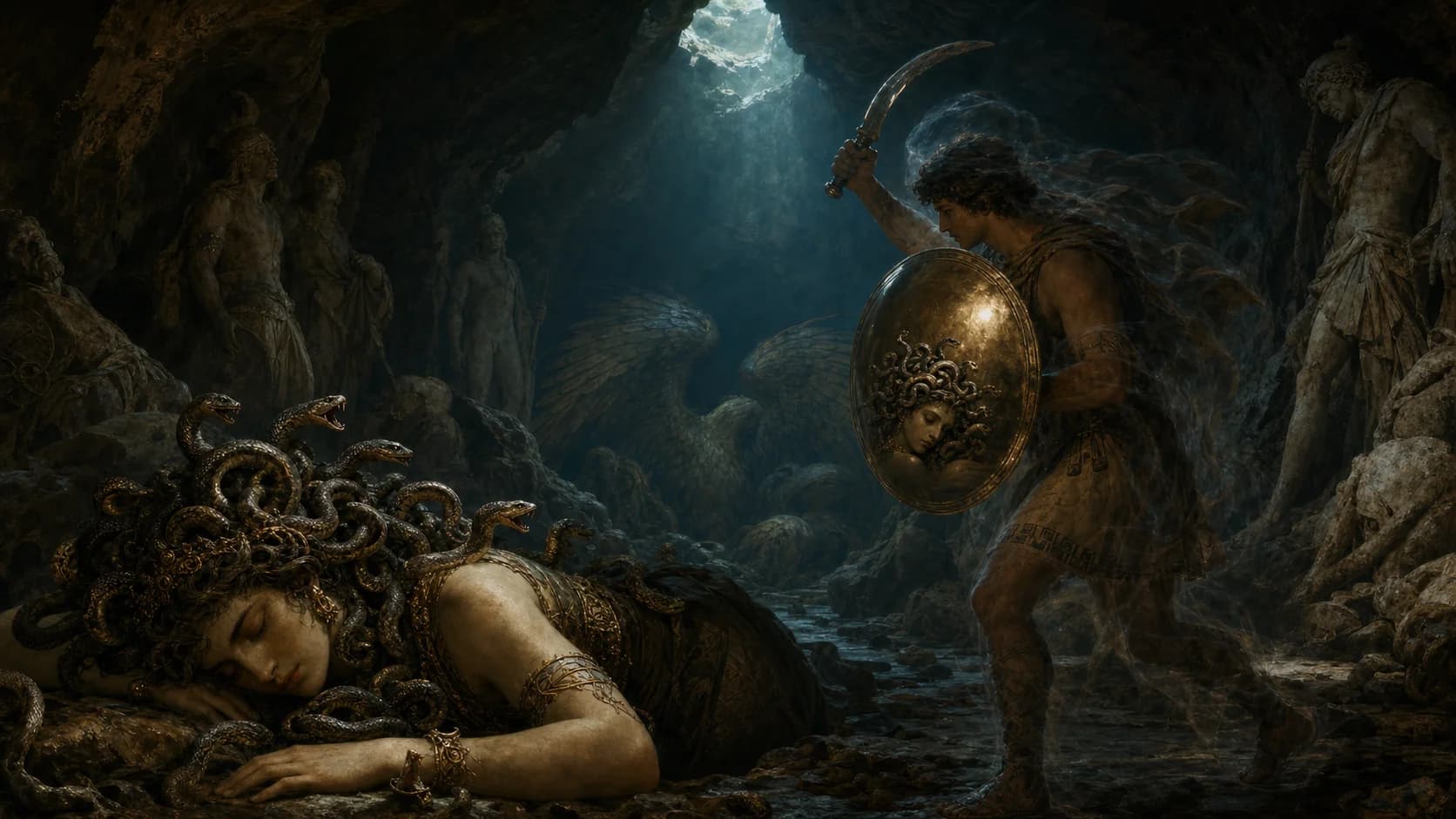
Perseus was the Greek hero who cut off the head of the Gorgon Medusa. He was a son of Zeus and the Argive princess Danaë, born despite his grandfather's efforts to stop a prophecy that he would kill him. With gifts from the nymphs and the gods, he beheaded Medusa, rescued Andromeda from a sea monster, and in the end killed his grandfather by accident with a discus, just as the oracle had said.
Perseus
Greek pantheon
Domain: Hero; slayer of Medusa, rescuer of Andromeda, founder of Mycenae
Perseus quick facts
| Fact | Detail |
|---|---|
| Greek name | Perseus (Περσεύς) |
| Pronunciation | PUR-see-əs (/ˈpɜːrsiəs/) |
| Parents | Zeus and Danaë, daughter of King Acrisius of Argos |
| Raised by | Dictys, a fisherman on the island of Seriphos |
| Wife | Andromeda, princess of Ethiopia |
| Children | Perses, Alcaeus, Sthenelus, Heleus, Mestor, Electryon and a daughter, Gorgophone (Apollodorus) |
| Famous descendant | Heracles, his great-grandson through Alcmene, daughter of Electryon; Heracles's stepfather Amphitryon was a grandson of Perseus too |
| Key deeds | Beheading Medusa, killing the sea monster Cetus, turning Polydectes to stone |
| Equipment | Winged sandals, the kibisis (pouch), the cap of Hades, an adamantine sickle (harpe) |
| Fate | Ruled Tiryns and founded Mycenae; placed among the stars as a constellation |
| Roman name | Perseus (the Romans kept the Greek name) |
| Main sources | Hesiod, Pindar, Apollodorus, Ovid's Metamorphoses, Pausanias |
How was Perseus born?
The story begins with an oracle. According to Apollodorus' Library, King Acrisius of Argos asked the god about male children and was told that his daughter Danaë would bear a son who would kill him. Acrisius shut Danaë in a bronze chamber built underground so no man could reach her.
A god could. Zeus came to her as a shower of gold that poured through the roof into her lap, and she bore Perseus. Apollodorus also reports a rival version in which the father was Acrisius's brother Proetus, which explained the brothers' feud.
When Acrisius discovered the child, he refused to believe Zeus was the father. He put Danaë and the baby in a wooden chest and threw it into the sea. A famous fragment of the poet Simonides imagines Danaë in the dark chest, comforting the sleeping infant while the waves crash around them. The chest washed up on the island of Seriphos, where the fisherman Dictys took them in and raised the boy.
Why did Perseus go after Medusa?
Dictys's brother Polydectes, king of Seriphos, fell in love with Danaë, and the grown Perseus stood in his way. Apollodorus says the king claimed to be collecting gifts to win the bride Hippodameia. When the other guests offered horses, Perseus boasted that he would not refuse even the Gorgon's head, and Polydectes took him at his word.
Who gave Perseus his weapons?
In Apollodorus' account, Hermes and Athena guided him. The quest had three steps:
- The Graeae. These three gray-haired sisters of the Gorgons shared a single eye and a single tooth. Perseus seized them and refused to give them back until the sisters showed him the way to certain nymphs.
- The nymphs. They gave him three things: winged sandals for flight, a pouch called the kibisis to carry the head, and the cap of Hades, which made the wearer invisible.
- Hermes. The god added a sickle of adamant, the curved blade often called the harpe.
| Item | What it did | Giver in Apollodorus |
|---|---|---|
| Winged sandals | Let him fly | The nymphs |
| Kibisis | Held Medusa's head safely | The nymphs |
| Cap of Hades | Made him invisible | The nymphs |
| Adamantine sickle | Cut through the Gorgon's neck | Hermes |
Other sources tell it differently. Hesiod's Shield of Heracles pictures Perseus on the hero's shield with winged sandals, a sword, the kibisis and the cap of Hades, but does not say where they came from. Ovid's Metamorphoses skips the nymphs altogether: his Perseus tricks the Graeae out of their eye and goes straight on to the Gorgons.
How did Perseus kill Medusa?
He found the three Gorgons asleep at the edge of the world. Only Medusa was mortal. Since one look at her face would turn him to stone, Perseus looked at her reflection in a bronze shield while Athena guided his hand, and cut off her head. From her neck sprang the winged horse Pegasus and the warrior Chrysaor, children of Poseidon.
He put the head in the kibisis, and when the other Gorgons woke and chased him, the cap of Hades hid him. Pindar's twelfth Pythian ode adds that Athena invented the music of the pipes to copy the wailing of the surviving sisters.
On the flight home, Ovid adds a stop in the far west. The Titan Atlas remembers a prophecy that a son of Jupiter would rob his golden apples, so he refuses Perseus hospitality. Perseus shows him the head, and Atlas becomes a mountain. Ovid ignores the problem this causes: in other myths, Perseus's great-grandson Heracles later meets Atlas in person.
How did Perseus save Andromeda?
In Ethiopia, Queen Cassiopeia had boasted that she was more beautiful than the Nereids, the sea nymphs. Poseidon answered with a flood and a sea monster, called Cetus. An oracle of Ammon said the land would be saved only if King Cepheus offered his daughter Andromeda to the monster, so she was chained to a rock by the sea.
Perseus saw her from the air, killed the monster and claimed her as his wife. Her uncle Phineus, who had been promised her, plotted against him. Apollodorus says Perseus turned Phineus and his men to stone with the head; Ovid makes it a full battle at the wedding feast. Euripides wrote a famous Andromeda on the story, but it survives only in fragments.
What happened when Perseus returned to Seriphos?
He came back to find his mother and Dictys hiding at an altar from Polydectes's violence. Perseus walked into the palace, where the king had gathered his friends, and held up the head. They were all turned to stone in the positions they were sitting in. He made Dictys king of Seriphos.
Then he gave the sandals, the kibisis and the cap to Hermes, who returned them to the nymphs, and he gave the head to Athena, who set it in the center of her shield.
How did Perseus kill his grandfather?
Perseus set out for Argos to meet Acrisius, and the old king, hearing of it, fled to Larissa in Thessaly. In Apollodorus, Perseus came there too and entered the pentathlon at funeral games held by the local king. His discus struck Acrisius on the foot and killed him. Pausanias gives the same story of an accidental discus throw at Larissa.
Did Perseus found Mycenae?
Ashamed to inherit the kingdom of the man he had killed, Perseus exchanged Argos with Megapenthes, son of Proetus, for Tiryns, and fortified Midea and Mycenae (Apollodorus).
Pausanias reports two explanations for the name of Mycenae. In one, the cap (mykes) of Perseus's scabbard fell off there, and he read it as a sign to found a city. In the other, he was thirsty, picked a mushroom (also mykes), and drank from the water that ran out beneath it.
His son Electryon was the father of Alcmene, mother of Heracles; his son Sthenelus was the father of Eurystheus, who set Heracles his labors. Herodotus records the Greek belief that Perses, the son Perseus left with Cepheus, gave his name to the Persians. Map the whole line on the Greek gods family tree.
Why are Perseus and Andromeda constellations?
The whole cast of the Andromeda story is in the northern sky: Perseus, Andromeda, her parents Cepheus and Cassiopeia, and Cetus the sea monster. Ancient star catalogues such as Eratosthenes' Catasterisms and Hyginus' Astronomica explain them through this myth. In the Perseus constellation, the star Algol marks Medusa's head; its name comes from the Arabic for the demon's head.
In the sources
- Hesiod, Theogony — Medusa's death and the birth of Pegasus and Chrysaor; the Shield of Heracles — Perseus fleeing the Gorgons with his gear.
- Pindar, Pythian 10 and 12 — Perseus among the Hyperboreans, the Gorgons' lament, Polydectes's fate.
- Simonides — the fragment of Danaë's lament in the chest.
- Herodotus, Histories — Perses and the Persians.
- Apollodorus, Library — the complete life, from the oracle to Tiryns.
- Ovid, Metamorphoses (Books 4–5) — Atlas, Andromeda, the fight with Phineus and the punishment of Polydectes.
- Pausanias, Description of Greece — Larissa and the founding of Mycenae.
Where the sources disagree:
- His father. Zeus as a golden shower in nearly every source; Proetus in a variant reported by Apollodorus.
- The equipment. The nymphs give sandals, kibisis and cap and Hermes the sickle in Apollodorus; the Shield of Heracles names the gear without givers; Ovid leaves out the nymphs.
- Atlas. Ovid has Perseus turn Atlas to stone, which clashes with the Heracles myths.
- The name of Mycenae. A scabbard cap or a mushroom, both reported by Pausanias.
In popular culture
- Clash of the Titans (1981). Harry Hamlin plays Perseus in Ray Harryhausen's last stop-motion film. It invents Calibos and the mechanical owl Bubo, has Perseus ride Pegasus, which in the myths is Bellerophon's mount, and swaps Cetus for the Kraken, a monster from Scandinavian folklore.
- Clash of the Titans (2010) and Wrath of the Titans (2012). Sam Worthington's Perseus fights the Kraken again and makes Hades the main villain, a role the ancient god never plays.
- Percy Jackson and the Olympians. Rick Riordan's hero is named after Perseus, chosen by his mother because the ancient Perseus was one of the few heroes with a happy ending.
For more adaptations, see our guide to Greek mythology movies.
Frequently asked questions
Who was Perseus in Greek mythology?
Perseus was a Greek hero, the son of Zeus and Danaë. He is famous for cutting off Medusa's head and rescuing Andromeda from a sea monster.
Who were Perseus's parents?
His father was Zeus, who visited Danaë as a shower of gold. His mother Danaë was the daughter of King Acrisius of Argos.
How did Perseus kill Medusa without being turned to stone?
He looked only at her reflection in a bronze shield while Athena guided his hand, and cut off her head with Hermes's adamantine sickle.
What items did Perseus use?
Winged sandals, a pouch called the kibisis, the cap of Hades for invisibility and an adamantine sickle. In Apollodorus the nymphs gave him the first three and Hermes the sickle.
Who did Perseus marry?
Andromeda, daughter of King Cepheus and Queen Cassiopeia of Ethiopia, whom he saved from the sea monster Cetus.
Did Perseus kill his grandfather?
Yes, by accident. At games in Larissa, his discus struck Acrisius and killed him, fulfilling the oracle Acrisius had tried to escape.
Is Perseus related to Heracles?
Yes. Perseus was the great-grandfather of Heracles through his mother Alcmene, and the grandfather of Eurystheus, who set Heracles his labors.
Keep exploring
Read the other side of the story in Medusa in Greek mythology, then follow the family line to Heracles. Compare him with Theseus and Odysseus, or test what you know with the Greek mythology quiz.