Quick summary
- The greatest Greek warrior at Troy, son of the mortal king Peleus and the sea goddess Thetis, and the hero of Homer's Iliad.
- His wrath at Agamemnon over Briseis, and his revenge on Hector for killing Patroclus, drive the plot of the Iliad.
- Homer gives him no invulnerability; the dip in the river Styx comes from Statius' Achilleid, a Roman poem of the first century AD.
- Paris and Apollo kill him before Troy falls, as the Iliad foretells and later sources such as Apollodorus narrate.
Achilles was the greatest Greek warrior of the Trojan War, the son of the mortal king Peleus and the sea goddess Thetis, and the hero of Homer's Iliad. Offered a long, quiet life or a short, glorious one, he chose glory, and died at Troy from an arrow shot by Paris with the help of Apollo. The famous invulnerable body with one weak heel is not in Homer at all: it comes from a Roman poem written centuries later.
Achilles
Greek pantheon
Domain: Hero; the greatest warrior at Troy, leader of the Myrmidons
Achilles quick facts
| Fact | Detail |
|---|---|
| Greek name | Achilleus (Ἀχιλλεύς) |
| Pronunciation | ə-KIL-eez (/əˈkɪliːz/) |
| Parents | Peleus, king of Phthia, and the Nereid Thetis |
| Teacher | The centaur Chiron |
| Companion | Patroclus |
| Partners | Deidamia of Skyros; the captive Briseis at Troy |
| Child | Neoptolemus, also called Pyrrhus |
| Key deeds | Kills Hector, the Amazon queen Penthesilea and the Ethiopian king Memnon |
| Death | Killed by Paris and Apollo, before Troy fell |
| Roman name | Achilles |
| Main sources | Homer's Iliad and Odyssey, Epic Cycle summaries, Pindar, Apollodorus, Statius' Achilleid |
Who were Achilles' parents?
His father Peleus was a mortal king of Phthia in Thessaly; his mother Thetis was a sea nymph, a daughter of Nereus. The gods arranged the match for a reason. In Pindar's eighth Isthmian ode, both Zeus and Poseidon wanted Thetis, until the goddess Themis warned them she was fated to bear a son mightier than his father. To keep that son from overthrowing a god, they married her to a mortal.
Was Achilles invulnerable?
Not in Homer. In Iliad 21 the Trojan ally Asteropaeus grazes Achilles' forearm with a spear and draws blood. Homer's Achilles can be hurt like anyone else; what makes him deadly is his strength, his speed and his divine armor.
The attempts to make him immortal come later, and they disagree:
- Apollodorus, Library. Thetis holds the baby in the fire at night to burn away his mortal part and anoints him with ambrosia by day. Peleus catches her and cries out, and Thetis leaves for good.
- Statius, Achilleid. In this unfinished Roman poem of the first century AD, Thetis dips the infant in the river Styx, protecting every part of him except where she held him.
The heel, in other words, is a late addition that became the best-known fact about him. Apollodorus' Epitome does say Paris and Apollo shot him in the ankle, so the wound to the foot was already part of the death story.
Who raised Achilles?
Peleus gave the boy to the wise centaur Chiron on Mount Pelion. Apollodorus says Chiron fed him on the innards of lions and wild boars and the marrow of bears. Homer remembers the training too: in Iliad 11, Patroclus knows healing remedies that Achilles learned from Chiron.
Why was Achilles hidden on Skyros?
Thetis knew her son would die if he went to Troy. In Apollodorus and Statius she disguises him as a girl among the daughters of King Lycomedes on Skyros, where he fathers Neoptolemus with the princess Deidamia. Odysseus unmasks him: with a trumpet blast in Apollodorus, and in the Achilleid with gifts that include weapons, which Achilles grabs when a trumpet sounds. Homer has none of this. For the hero who found him, see Odysseus in Greek mythology.
What is the wrath of Achilles?
The Iliad opens with the word wrath. It covers a few weeks in the war's tenth year, and it is the story of Achilles' anger and its cost.
| Book | What happens |
|---|---|
| 1 | Forced to return his captive Chryseis to end Apollo's plague, Agamemnon takes Achilles' prize, Briseis. Achilles quits the fighting, and Thetis asks Zeus to let the Trojans win. |
| 9 | Odysseus, Phoenix and Ajax offer gifts. Achilles refuses. |
| 16 | Patroclus fights in Achilles' armor and is killed by Hector, with Apollo's help. |
| 18–19 | Thetis brings new armor made by Hephaestus. Achilles returns to battle. |
| 22 | He kills Hector and drags the body behind his chariot. |
| 24 | Guided by Hermes, King Priam enters Achilles' tent at night and ransoms his son's body. The two enemies weep together. |
The poem ends not with Achilles' death but with Hector's funeral, after an act of pity between enemies.
Why did Achilles choose a short life?
In Iliad 9 Achilles explains that Thetis told him of two fates. If he stays at Troy, he loses his homecoming but wins glory that never dies. If he goes home, he will live long, without fame. At that moment he says he will sail home. Patroclus' death decides it: in Iliad 18 he accepts that his own death will follow soon after Hector's.
How did Achilles die?
The Iliad foretells his death but never shows it. In Book 22 the dying Hector names his killers: Paris and Apollo, at the Scaean Gate.
The story itself comes from later sources. In the summary of the lost epic Aethiopis, Achilles kills Penthesilea and Memnon, chases the Trojans to the city and is killed by Paris and Apollo; Ajax carries his body back while Odysseus holds off the enemy. Apollodorus' Epitome adds that the arrow struck his ankle.
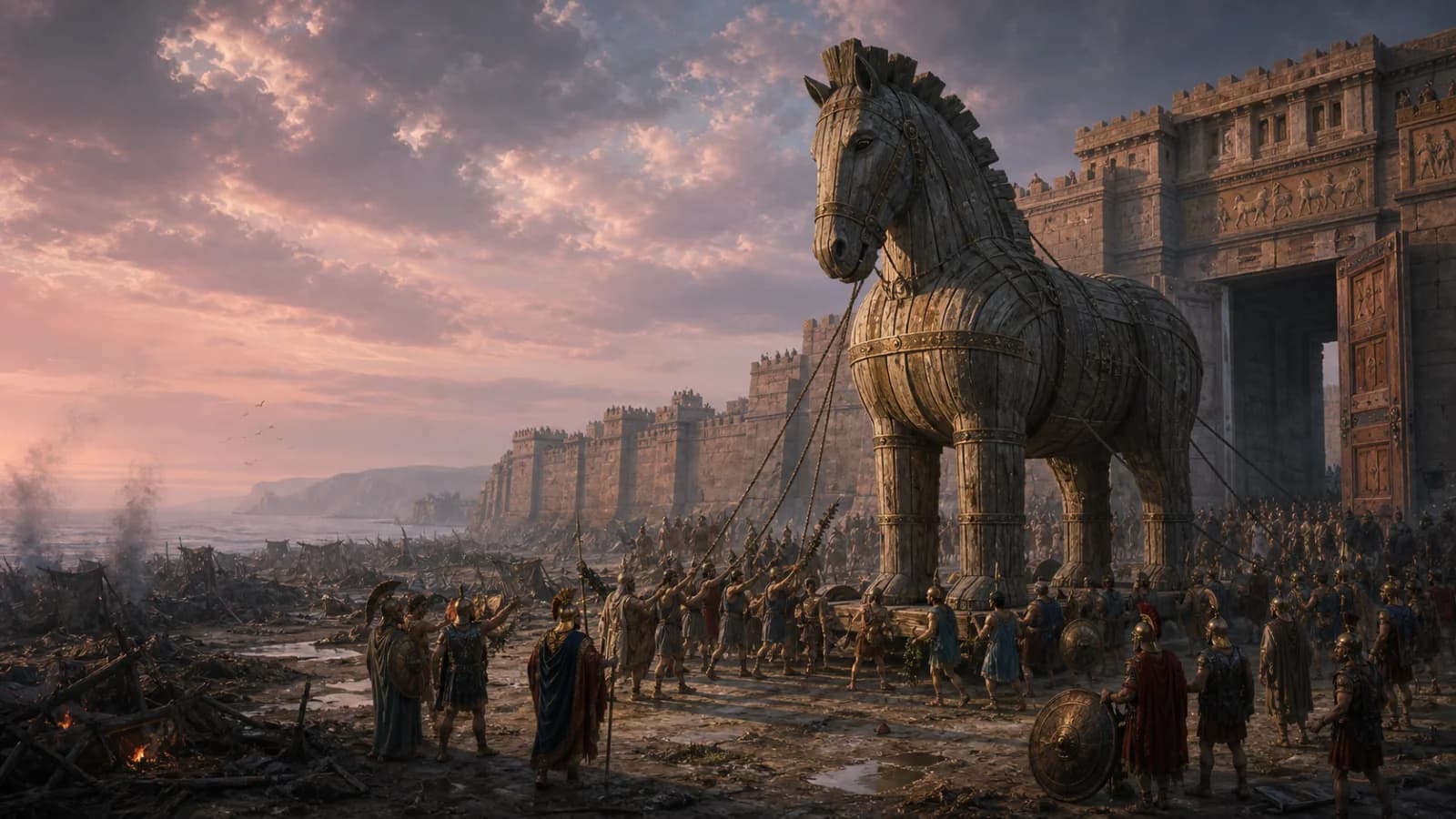
So Achilles died before Troy fell and never saw the Trojan Horse that ended the war. His armor caused one more tragedy: awarded to Odysseus instead of Ajax, it drove Ajax to madness and suicide, the subject of Sophocles' Ajax.
What did Achilles say in the Underworld?
In Odyssey 11, Odysseus meets his shade in the realm of Hades and says he must surely rule among the dead. Achilles rejects the comfort: he would rather be a hired laborer for a poor man on earth than king over all the dead. It is the sharpest second thought about heroic glory in Greek epic.
Were Achilles and Patroclus lovers?
Homer never says so. In the Iliad they are inseparable, and Achilles' grief for Patroclus is the most intense in the poem, but no passage calls them lovers. Classical Athens read the bond differently. Aeschylus' lost play Myrmidons presented them as lovers, as its fragments show. In Plato's Symposium, the speaker Phaedrus agrees but says Aeschylus got the roles backwards, since Achilles was the younger. The romantic reading is ancient, but it is later than Homer.
In the sources
- Homer, Iliad — the wrath, Patroclus, Hector, Priam, the two fates and the prophecies of his death.
- Homer, Odyssey — his shade in Book 11.
- Epic Cycle summaries — the Aethiopis on Penthesilea, Memnon and his death.
- Pindar, Isthmian 8 — the prophecy about Thetis' son.
- Apollodorus, Library and Epitome — the fire, Chiron, Skyros and the arrow in the ankle.
- Statius, Achilleid — Skyros and the dip in the Styx.
- Sophocles, Ajax; Aeschylus, Myrmidons (fragments); Plato, Symposium.
Where the sources disagree:
- Invulnerability. None in Homer, where Asteropaeus wounds him in Iliad 21. Statius adds the Styx; Apollodorus has a failed attempt with fire instead.
- His death. The Iliad only foretells it; the Aethiopis summary and Apollodorus narrate it, and only later accounts place the wound in his ankle or heel.
- Patroclus. A companion in Homer; a lover in Aeschylus and Plato, who disagree on who loved whom.
- Skyros. Absent from Homer; Apollodorus and Statius tell the unmasking differently.
In popular culture
- Troy (2004). Brad Pitt's Achilles lives in a world without gods, Patroclus is his cousin, and Achilles dies inside Troy during the sack after the Horse. In the ancient sources he dies before the Horse is built, and Briseis is a war captive, not a Trojan priestess.
- The Song of Achilles (2011). Madeline Miller's novel, narrated by Patroclus, follows the classical reading of the pair as lovers.
For more films, see Greek mythology movies, and for retellings worth reading, the best Greek mythology books.
Frequently asked questions
Who was Achilles in Greek mythology?
Achilles was the greatest Greek warrior of the Trojan War, son of King Peleus and the sea goddess Thetis, and the hero of Homer's Iliad.
Why was Achilles' heel his weakness?
In Statius' Achilleid, a Roman poem, Thetis dipped him in the river Styx and the part she held stayed vulnerable. Homer gives him no invulnerability at all.
Who killed Achilles?
Paris, with the help of Apollo. The Iliad foretells it, and later sources such as the Aethiopis summary and Apollodorus describe it.
Did Achilles die before the Trojan Horse?
Yes. In the ancient sources Achilles dies before Troy falls, so he plays no part in the Trojan Horse. The film Troy changes this.
Why was Achilles angry in the Iliad?
Agamemnon took his captive Briseis, so Achilles refused to fight. After Hector killed Patroclus, his anger turned on Hector.
Were Achilles and Patroclus lovers?
Homer does not say so. Later Athenian writers such as Aeschylus and Plato present them as lovers, and modern retellings often follow them.
Keep exploring
Meet the archer who guided the fatal arrow in Apollo, the goddess who backed the Greeks in Athena, and his fellow hero Odysseus. Trace his divine relatives on the Greek gods family tree, or test yourself with the Greek mythology quiz.